
By Murat Yıldız
Türkiye has the lowest overall price level among seven major European holiday destinations in a comparison based on Eurostat's 2025 purchasing-power data. The same advantage sits uneasily beside the country's $100 billion tourism target, which requires a sharp increase in spending per visitor.
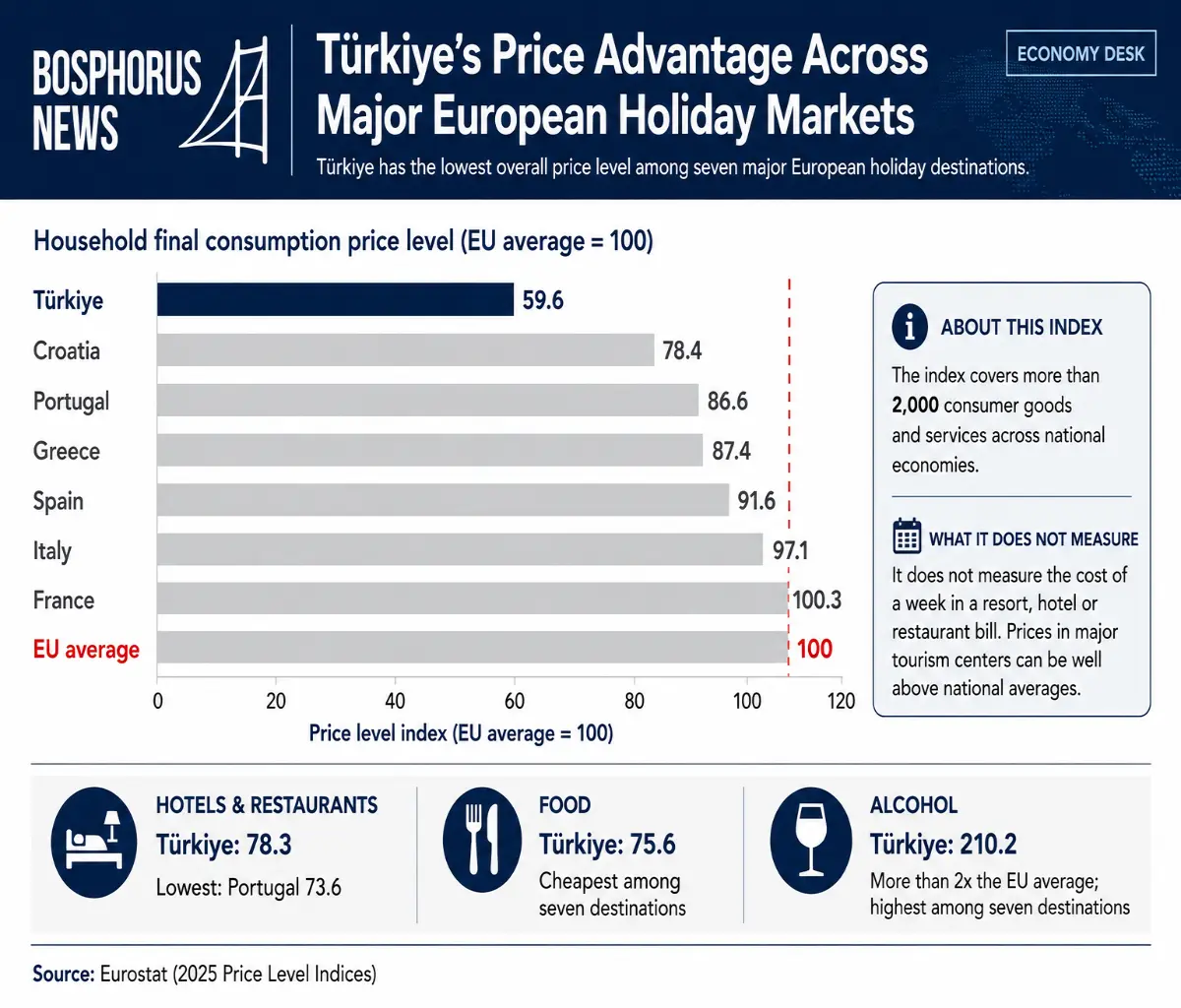
With the European Union average set at 100, Türkiye's household consumption price level stood at 59.6. A comparable basket costing €100 across the bloc would cost the equivalent of €59.60 in Türkiye. Croatia ranked second at 78.4, followed by Portugal, Greece, Spain, Italy and France.
Eurostat did not declare Türkiye Europe's cheapest holiday country. The index covers more than 2,000 consumer goods and services across national economies. It does not measure the cost of a week in Antalya, a hotel in Bodrum or a restaurant bill in central Istanbul.
The data still expose a central tension in Türkiye's tourism strategy.
Bosphorus News previously examined the gap between the government's $100 billion annual tourism revenue target and the spending levels required to reach it. That analysis found that even strong growth in visitor numbers would leave a revenue shortfall of about $35 billion unless spending per traveller rose substantially. Türkiye's $100 Billion Tourism Goal Faces $35 Billion Revenue Gap.
Cheap Overall, Not in Every Category
Türkiye's lead narrows in the categories closest to a tourist's actual bill.
Portugal recorded the lowest restaurant and hotel price level among the seven destinations, at 73.6. Türkiye followed at 78.3. Spain, Greece and Croatia also remained below the EU average, while Italy and France were above it.
The broad household index includes expenses many visitors never encounter. Accommodation, food, transport, excursions and entertainment determine the cost of a trip more directly, and prices in major tourism centres can sit well above national averages.
Türkiye also ranked as the cheapest of the seven countries for food. Alcohol moved in the opposite direction. Its price index reached 210.2, more than twice the EU average and higher than every other destination in the comparison.
Türkiye therefore does not offer a uniformly cheap holiday. It combines low general prices with competitive accommodation and restaurant costs, while heavily taxed categories can erase part of that advantage.
The Revenue Gap Behind the Price Advantage
A low national price level helps Türkiye remain attractive to travellers earning euros, pounds or dollars. The $100 billion target requires much more than high arrival numbers.
Daily spending, length of stay and the share of visitor expenditure retained inside Türkiye determine the revenue outcome. Arrivals can rise faster than income when demand is concentrated in discounted packages, short stays or lower-cost accommodation.
Türkiye has increasingly promoted luxury travel, health tourism, gastronomy, culture, yachting, congresses and longer stays. Those segments can lift revenue only if visitors spend more per day and a larger share of that spending reaches domestic businesses.
Eurostat's comparison shows that price remains one of Türkiye's strongest competitive tools. The government now has to raise visitor spending without weakening the mass-market demand that supplies much of the volume.
Affordable for Visitors, Expensive for Residents
The international comparison says little about what Turkish households can afford.
Price-level indices compare the cost of the same goods and services across countries. They do not account for local wages or disposable income. Türkiye can remain cheap for a visitor paid in euros while restaurants, hotels and domestic holidays move further beyond the reach of residents paid in Turkish lira.
The split is especially visible in coastal tourism centres, where businesses often price around foreign demand and exchange rates. National averages can show a large European discount while local consumers experience the same market as expensive.
"Cheap destination" describes Türkiye's position against foreign purchasing power. It does not describe the experience of Turkish households.
Türkiye still has the price advantage needed to protect visitor numbers. Reaching $100 billion will depend on whether it can turn that volume into much higher spending per traveller.
Sources: Eurostat, Euronews Business, Bosphorus News review and reporting.