

By Bosphorus News Geopolitics Desk
Türkiye says commercial passage through the Straits remains open despite additional Black Sea security measures, while Parliament prepares to take up legislation tied to PKK disarmament. In the Red Sea, a Houthi claim over a fire at Saudi Aramco's Jazan refinery comes only days after the Mecca defense pact was signed, as Syria and Russia agree new terms for Hmeimim and Tartous and the Republic of Cyprus puts a March 2028 date on first Cronos gas exports.
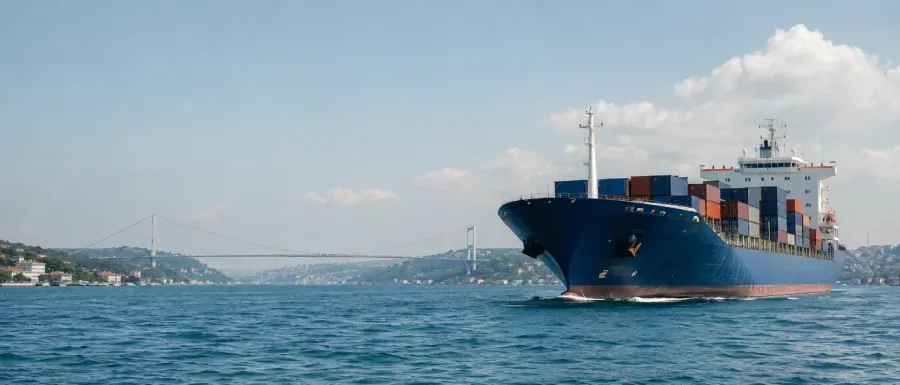
Türkiye denies reports of Black Sea shipping restrictions
Türkiye says commercial traffic through the Bosphorus and Dardanelles is continuing after reports that authorities had begun delaying or withholding transit permissions for some vessels entering the Black Sea, with two Turkish government officials saying ships were passing normally and navigation remained open under the Montreux Convention even as temporary security measures were introduced following attacks on commercial shipping.
The officials did not explain how those measures were being applied, while Bloomberg had reported that tighter controls were affecting vessels bound for Russia's Novorossiysk and, in some cases, ships heading toward Ukrainian ports. The two accounts are not necessarily incompatible, since Türkiye can keep civilian passage formally open while subjecting particular vessels or routes to additional scrutiny as security risks increase.
Those risks have become harder to separate from Turkish commercial interests after a series of attacks on vessels linked to Türkiye. Ankara has repeatedly called on Moscow and Kyiv to keep civilian shipping outside the conflict, while Foreign Minister Hakan Fidan has said Türkiye proposed a moratorium on attacks against vessels in the Black Sea.
One of the recent incidents has already moved into the legal arena, with the owner and crew of the Reyhan Sarı preparing an Article 15 communication to the International Criminal Court following the July attack that killed a Turkish crew member, although responsibility for that strike has not been independently established.
Jazan fire puts Mecca pact under early scrutiny
Yemen's Houthis said they targeted Saudi Aramco's Jazan refinery with a drone on August 9, two days after Saudi Arabia signed the Mecca Joint Defense Agreement with Türkiye and Pakistan, while Saudi Arabia's Energy Ministry confirmed that a fire broke out at the refinery and was later extinguished without injuries but did not identify its cause.
That leaves the Houthi claim separate from the Saudi account of the incident, although the timing immediately raises a question the three governments had not yet faced in practice: what kind of attack would be sufficient to move the new agreement from political signaling into formal consultation.
The Houthis also said they carried out missile and drone strikes on the Yemeni port of Mocha, close to the Bab el-Mandeb strait, with Yemeni officials reporting fatalities, injuries and damage to port infrastructure.
There has been no announcement that Saudi Arabia has invoked the new defense agreement, and neither Türkiye nor Pakistan has announced action under its collective-defense provisions. Foreign Minister Hakan Fidan previously said the country facing an attack would identify what assistance it required and that the three governments would then determine the form and scale of support through consultation, a structure Bosphorus News detailed after the pact was signed.
The Jazan incident therefore does not show the pact in operation, but it does present the first type of event that could force Riyadh, Ankara and Islamabad to decide where the threshold for using the new mechanism actually lies.
Syria and Russia agree new terms for Hmeimim and Tartous
Syria and Russia have reached a memorandum of understanding governing Moscow's future presence at Hmeimim and Tartous after 18 months of negotiations, with Damascus set to assume management of civilian facilities at Hmeimim airport and the commercial section of Tartous port while military facilities at both locations remain in use as joint Syrian-Russian training and qualification centers.
The transition is expected to be completed within three months, and Syria's General Authority for Ports and Customs will take control of commercial facilities at Tartous previously operated by Russia, including areas Moscow had sought to develop as part of a logistics hub.
Russia is therefore retaining a military presence on the Syrian Mediterranean coast, but under a narrower arrangement that returns civil aviation and commercial port functions to Syrian administration while shifting the remaining Russian military footprint onto a joint institutional basis with Damascus.
Hmeimim and Tartous have underpinned Russia's military reach into the Eastern Mediterranean for years, and the new agreement preserves access to both sites while giving Syria considerably greater control over the civilian and commercial infrastructure surrounding them.
Cronos gas gets March 2028 export target
The Republic of Cyprus expects natural gas from the offshore Cronos field to begin reaching European markets as early as March 2028, with Eni and TotalEnergies moving ahead with a development plan that relies heavily on nearby Egyptian infrastructure rather than a new long-distance export system across the Eastern Mediterranean.
Cronos contains more than 3 trillion cubic feet of gas and is expected to produce around 500 million standard cubic feet per day once output reaches planned levels, while the development scheme calls for a subsea pipeline connecting the field to infrastructure serving Egypt's Zohr field about 105 kilometers away.
From Zohr, the gas would move through Egypt's existing network to the Damietta liquefied natural gas terminal for export, including to European buyers, giving the project a shorter and more commercially direct route to market than several earlier Eastern Mediterranean pipeline concepts.
The use of existing Egyptian infrastructure is central to the timetable because it reduces the amount of new construction required before production can begin and turns Cronos from another offshore discovery into a project with a defined export chain and target date.
PKK bill goes to General Assembly
Türkiye's Parliament is due to take up the National Solidarity and Social Integration bill in the General Assembly on August 10 after the Justice Committee approved the legislation early on August 8, moving the proposal beyond the committee stage and into consideration by the full chamber.
The bill has been issued as Parliament's Serial No. 290, but its principal legal mechanisms would not take effect automatically with parliamentary approval because they remain conditional on an official determination that the PKK and formations covered by the law have surrendered their weapons and ended their armed structure.
That determination must then be followed by the required National Security Council decision before provisions covering suspended investigations, prosecutions and sentence enforcement can operate, while intentional homicide and several other categories remain outside those mechanisms.
Bosphorus News detailed the bill and its disarmament conditions during the committee stage, and the move to the General Assembly now advances the legislation without removing the separate security threshold built into its implementation.
Strategic Take
Ankara's Black Sea position leaves deliberate room between a formal restriction and normal traffic, with Türkiye insisting that the Straits remain open while acknowledging additional security measures that give authorities scope to scrutinize individual vessels without announcing a broader change to civilian passage under Montreux.
Jazan presents a different kind of test because the Mecca agreement is only days old, Saudi Arabia has confirmed the refinery fire without attributing it to the Houthis, and none of the three members has announced consultations under the pact, leaving Riyadh's next move more revealing than the claim itself.
On Syria's Mediterranean coast, Moscow keeps military access to Hmeimim and Tartous but under revised terms that return civilian and commercial functions to Damascus, while Cronos is moving toward production through an established Egyptian export chain instead of waiting for another large regional pipeline project.
The PKK bill reaches the General Assembly with another threshold still ahead, since even parliamentary approval would leave its central legal mechanisms dependent on a later determination that disarmament has actually taken place.
Sources: Türkiye's Ministry of Foreign Affairs, Grand National Assembly of Türkiye, Saudi Arabia's Ministry of Energy, Syrian Ministry of Foreign Affairs, Republic of Cyprus Energy Ministry, Reuters, Associated Press, Bloomberg, Bosphorus News review and reporting.
Read Yesterday's brief: Eastern Mediterranean Strategic Brief – August 9, 2026: PKK Bill Advances, Mecca Pact Takes Shape