
By Murat Yıldız
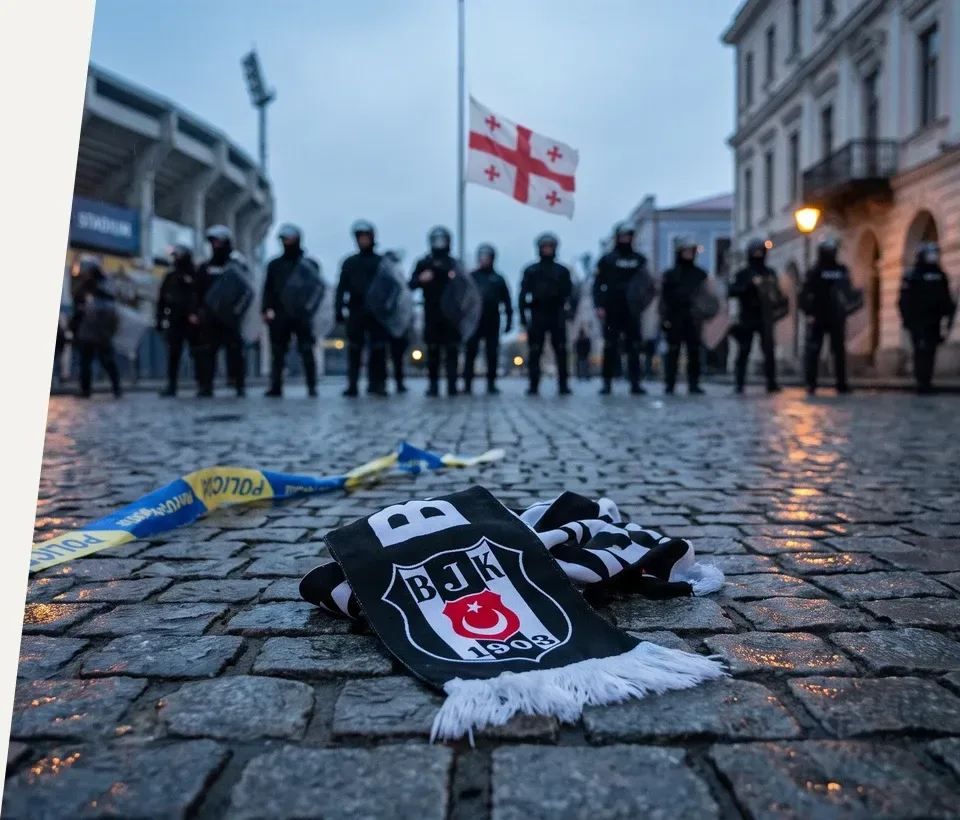
On the evening of November 26, 2026, I watched footage of Georgian police using force against Turkish supporters during the Union of European Football Associations (UEFA) Europa League match between Beşiktaş and Israel's Hapoel Beer-Sheva in Batumi. I spoke by telephone with several friends who were there. Later, I watched footage of Turkish Interior Minister Mustafa Çiftçi's conversation with his Georgian counterpart.
I felt ashamed.
As a former athlete, I believe sport and art should remain separate from political and military conflicts. I do not oppose Israeli teams competing internationally, just as I oppose the exclusion of Russian athletes and the isolation of athletes from the Turkish Republic of Northern Cyprus (TRNC).
My concern lies elsewhere.
For more than two decades, a section of Turkish society has been encouraged to believe that Türkiye is a global power and that its president is a world leader.
What happened in Batumi was a painful reality check.
Just across the border
Georgia is one of the few countries Turkish citizens can enter using only their national identity cards. Türkiye is its largest individual trading partner, with extensive economic ties spanning tourism, investment, energy and transport.
Beyond legitimate commerce, Turkish criminal indictments have also set out allegations of Türkiye-linked illegal betting and money laundering operations based in Batumi.
I mention these facts without any intention of diminishing Georgia or its people.
Yet it was in this very country that we watched ordinary police officers beat Turkish citizens and use pepper spray so heavily that some of the officers themselves appeared to be affected.
Beşiktaş condemned the disproportionate use of force. Georgian authorities reported 16 detentions and injuries to three police officers, while UEFA attributed the initial intervention to clashes among Beşiktaş supporters.
Any criminal conduct by supporters must be investigated. The police must be held to the same legal standard.
But how can a country that claims global leadership find its citizens subjected to such treatment just across its border, in a country with which it has such close ties?
Two neighbors, one uncomfortable question
Consider the two countries with which Türkiye prides itself on maintaining exceptionally close relations: its brotherly ally Azerbaijan and its neighbor Georgia.
On October 30, Azerbaijani President Ilham Aliyev did not attend the Organization of Turkic States (OTS) summit in Ankara. Earlier that month, on October 2, he stated that Azerbaijan had received no help when it needed it and had purchased its weapons at international market prices, down to the last bullet.
He did not explicitly name Türkiye, but his remarks deserve attention.
Differences over Israel are among the documented sources of tension between Ankara and Baku. Georgia, meanwhile, maintains close relations with Israel. The match against an Israeli club was moved to Batumi after Turkish authorities declined to host it in İstanbul.
When Turkish and Israeli interests diverge, where do Baku and Tbilisi place their priorities? Can Ankara assume that its close relationships with either country give Turkish interests precedence?
For a country claiming global leadership, these are questions worth asking.
A telephone call after the humiliation
There was Türkiye's interior minister, in his white shirt, sharing footage on social media of a telephone conversation with his Georgian counterpart that, to me, resembled an informal chat over coffee.
He was appealing for the fair treatment of Turkish supporters and their safe return home.
I found that spectacle humiliating.
Diplomatic intervention is necessary when citizens encounter difficulties abroad. Their safety and lawful rights, however, are responsibilities of the state. They should never be treated as personal favors requested from foreign officials.
Imagine Olympique Lyonnais or Club Brugge playing against an Israeli team in Batumi. Would Georgian police have acted with the same apparent disregard for diplomatic consequences had French or Belgian citizens been involved?
Belgium does not claim to lead the world.
Nor does Georgia. Yet Georgian citizens with ordinary biometric passports enjoy visa-free access to the Schengen area for short stays. Turkish citizens with ordinary passports still require visas, and European Commission statistics show that more than 183,000 of the 1.26 million applications submitted in Türkiye in 2025 were refused.
Drones do not pay electricity bills
Türkiye's defense industry has achieved significant technological advances. As a journalist who regularly covers these developments, I recognize their strategic value.
But Turkish citizens do not need to travel to Batumi to encounter the reality behind the rhetoric.
They encounter it at the supermarket, when electricity bills arrive, when rent is due, when credit card debts become unmanageable and when their cars are seized because they can no longer meet their financial obligations.
They encounter it in visa queues and in the uncertainty surrounding their savings.
Every day, life settles the argument.
Yet television screens continue to showcase new drones, missiles and weapons systems, accompanied by declarations of national greatness.
Türkiye's geopolitical importance, its geography and historical weight are genuine. They belong to the country and its people. No political leader can claim personal ownership of them.
The question is what that importance delivers for ordinary Turkish citizens.
The power to prevent humiliation
When a police officer anywhere in the world is about to mistreat a Turkish citizen, that officer should think twice. There should be a genuine fear of the diplomatic and legal consequences of arbitrary detention, humiliation or unlawful violence against a citizen of the Republic of Türkiye.
Turkish citizenship should carry that weight.
Every Turkish citizen must respect the laws of the country they visit. They must also know that their state will stand firmly behind them when their lawful rights are violated.
National power also means having the capacity to deter such abuses before they occur.
Putting on a white shirt, making a telephone call and posting the footage on social media after your citizens have been beaten is no substitute for that capacity.
There can be no satisfaction in the suffering of our fellow citizens. Knowing Georgia's legal system, I am particularly concerned about those detained and the proceedings they may face.
The day foreign authorities understand that mistreating a Turkish citizen will carry serious consequences, we can begin to speak seriously about global leadership.
Flying four drones and proclaiming world leadership on television is considerably easier.
I do not need a political leader to tell me that I should be proud of being Turkish.
I expect my state to give the world reasons to respect its citizens.