
By Bosphorus News Türkiye Desk
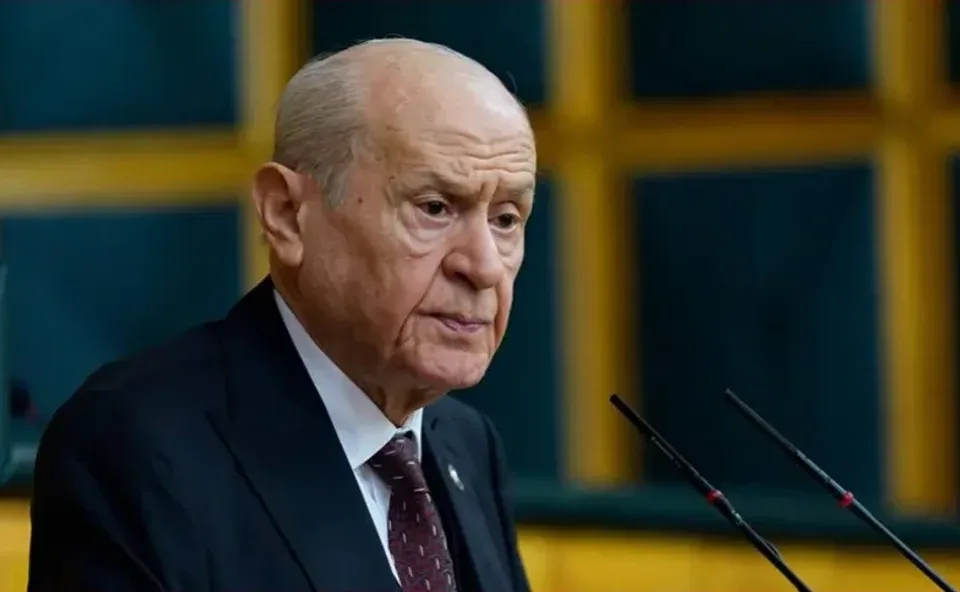
Türkiye's ruling Justice and Development Party (AK Party) backed Nationalist Movement Party (MHP) leader Devlet Bahçeli's 50-point assessment of the "Terror-Free Türkiye" initiative on November 16. Parliament is also preparing a commission to monitor the PKK disarmament law, whose provisions on criminal cases still require formal confirmation of weapons surrender.
AK Party spokesperson Ömer Çelik urged the public to read all 50 points, saying they contained principles, a roadmap and approaches to the initiative. He spoke a day after their publication in Türkgün on November 15.
Türkgün published Bahçeli's direct remarks alongside a numbered account of the initiative, much of it written in the third person. The points revisit earlier political decisions, parliamentary work and the MHP's position on national unity. They announce neither a new bill nor a timetable for weapons surrender.
The chronology reaches back to Bahçeli's October 2024 handshake with lawmakers from the Peoples' Equality and Democracy Party (DEM Party) and covers the Kurdistan Workers' Party's (PKK) May 2025 declaration that it would dissolve and disarm. The PKK is designated as a terrorist organization by Türkiye, the United States and the European Union. The MHP presents the initiative as a way to end armed violence and pursue political demands through democratic channels without compromising Türkiye's constitutional order.
Judicial measures await security verification
Law No. 7595, adopted on August 10 and in force since August 18, sets the conditions for deferrals. Security institutions must establish that the PKK, the Kurdistan Communities Union (KCK) and related formations have ended their effective existence and surrendered the weapons and ammunition under their control. A National Security Council decision confirming that finding must then be published in the Official Gazette.
Only then can the deferral rules apply. Under Article 3, investigations and prosecutions involving offences carrying a maximum prison term of 15 years or less can be deferred for five years; those involving higher penalties, life imprisonment or aggravated life imprisonment can be deferred for ten. Article 6 uses the same periods for deferring the execution of sentences, based on whether the total prison term is 15 years or less or exceeds that threshold. Both provisions exclude intentional killings committed in the course of organizational activity, as well as specified crimes committed before June 1, 2005 that carry life or aggravated life imprisonment.
Preparatory work has begun. A board chaired by the vice president established four implementation subcommittees in August to handle legal coordination, monitoring, social integration and disarmament. Establishing the board did not activate the conditional deferrals.
Parliament prepares its monitoring commission
Law No. 7595 also provides for a parliamentary Monitoring Commission. Turkish Grand National Assembly Speaker Numan Kurtulmuş said on November 16 that two parties remained to be consulted. He hoped to complete those talks during the week of November 16 before settling the commission's membership and working rules.
Kurtulmuş also expressed hope that disarmament would soon be formally confirmed. Once established, the commission would monitor implementation and make recommendations. The board chaired by the vice president would continue coordinating executive work and reporting to parliament.
Çelik links the process to Syria, Iraq and Iran
Çelik said the integration process involving the Syrian Democratic Forces (SDF) was continuing in Syria. SDF commander Mazloum Abdi had announced on August 25 that the force was dissolved as an independent military organization following its incorporation into Syrian army brigades. Syrian officials subsequently said the wider agreement still required administrative and institutional work. Çelik also referred to decisions concerning the withdrawal of the Sinjar Resistance Units (YBŞ) from Sinjar in Iraq and raised the Iran-based Party for a Free Life in Kurdistan (PJAK).
The three countries could require different approaches, Çelik said, linking them to the government's regional disarmament objective. He announced no new agreement or timetable. The MHP's 50 points also discuss security in Iraq and Syria without setting out new cross-border measures.
Sources: Türkgün, AK Party, Turkish Grand National Assembly, Syrian Arab News Agency, Law No. 7595, Bosphorus News review and reporting.