
By Murat Yıldız
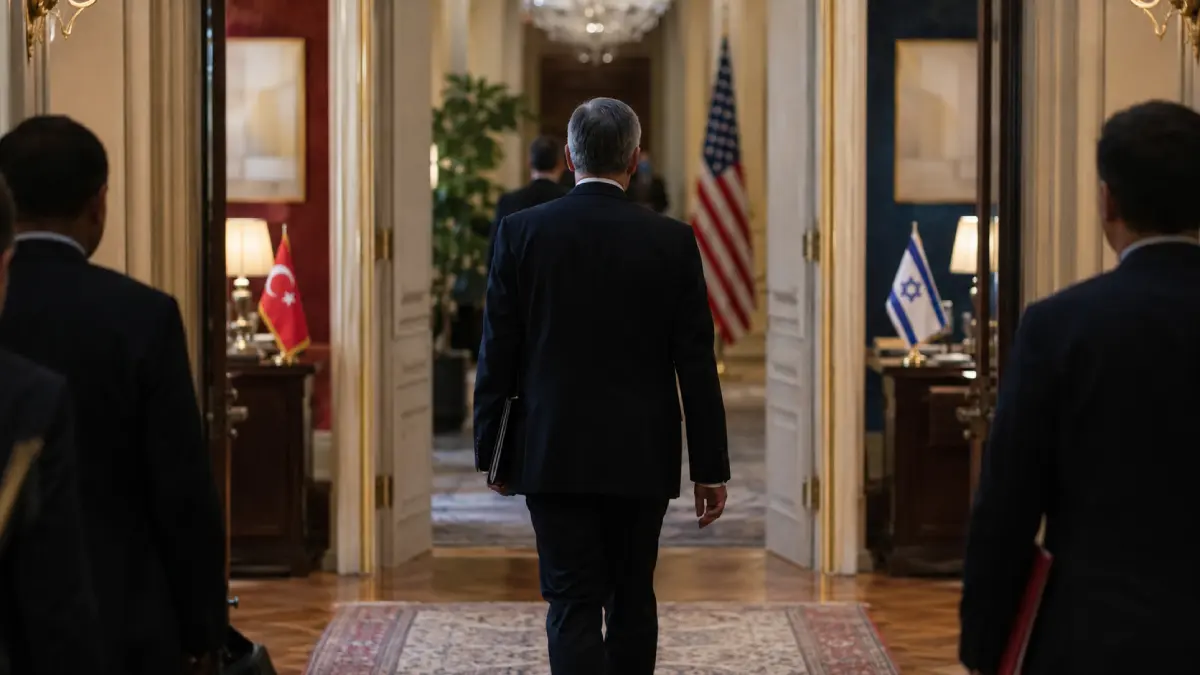
Donald Trump may be preparing to bring Recep Tayyip Erdoğan and Benjamin Netanyahu back into direct political contact.
No meeting has been publicly confirmed. Yet the possibility now rests on a visible diplomatic structure. Erdoğan and Netanyahu opened a leaders' track shortly before October 7. Turkish and Israeli officials later maintained security communication over Syria. Trump has offered to mediate between them, relied on Ankara during Gaza negotiations and served as an intermediary when Netanyahu sought to influence Erdoğan.
Former Israeli diplomat Nadav Tamir has now added a public argument for engagement. Writing in The Times of Israel's independent blog section, Tamir urged Israel to use Türkiye and Qatar's access to Hamas and regional actors as diplomatic leverage rather than place them in the same category as Iran. Tamir is executive director of J Street Israel, a Mitvim board member and a former adviser to Israeli President Shimon Peres.
Trump would not be starting from zero. He would be raising a security and diplomatic relationship that survived the political rupture back to direct political contact.
The Türkevi track
Erdoğan and Netanyahu met at Türkevi in New York on September 19, 2023, during the United Nations General Assembly. It was their first face-to-face meeting as leaders after Türkiye and Israel restored full diplomatic relations in 2022.
They discussed political and economic relations, the Israeli-Palestinian file, energy and regional affairs. The meeting was intended to lead to further engagement, including possible reciprocal visits. Erdoğan subsequently spoke about Turkish-Israeli cooperation on energy exploration and routes carrying Eastern Mediterranean gas to Europe.
The Hamas-led attack on Israel came 18 days later. The Gaza war buried the normalization process before the proposed visits and energy discussions could develop.
Türkiye recalled its ambassador and later halted direct bilateral trade. Erdoğan directed increasingly severe language at Netanyahu, while the Israeli government began presenting Türkiye as a growing regional security concern.
The leaders stopped speaking. Communication between the two states continued at lower levels.
The channel survived below the political level
Türkiye and Israel have repeatedly relied on security institutions when open diplomacy became politically difficult.
The clearest recent evidence emerged in Syria. Turkish and Israeli officials held talks in Azerbaijan in April 2025 to establish a mechanism aimed at preventing military clashes and misunderstandings. Foreign Minister Hakan Fidan confirmed that technical discussions were taking place and made clear that they did not amount to political normalization.
The talks had a narrow operational purpose. That narrowness made them useful. The two governments could still establish working rules during one of the most hostile periods in their recent relationship.
Syria gave both sides an immediate reason to preserve contact. Türkiye was developing security ties with the new authorities in Damascus, while Israel was striking Syrian military sites and opposing Turkish deployments that could restrict Israeli operations.
A technical mechanism could reduce the danger of an unintended encounter. It could not settle disputes over military bases, southern Syria, air operations or the country's future security order.
Those decisions sit above the level of military officers and technical delegations.
Trump has already offered to mediate
Trump publicly placed himself between Erdoğan and Netanyahu during the Israeli prime minister's White House visit in April 2025.
Netanyahu raised concerns about Türkiye's growing role in Syria. Trump praised Erdoğan, emphasized his relationship with the Turkish president and suggested that he could help resolve the dispute between Türkiye and Israel.
Washington later drew directly on Ankara's regional access. Erdoğan said Trump asked Türkiye to persuade Hamas to support the US president's Gaza plan. Turkish intelligence chief İbrahim Kalın joined negotiations in Egypt, placing Ankara inside a US-backed process alongside Qatar and other mediators.
Türkiye's contacts with Hamas remain a source of Israeli anger. They also give Ankara access that Israel and the United States may need when negotiations require Hamas participation.
The gap between public opposition and private accommodation may already have appeared in Gaza diplomacy.
Netanyahu publicly objected when the Trump administration included Fidan and Qatari diplomat Ali Al-Thawadi on a Gaza executive board. Israeli officials said the composition conflicted with government policy. Haaretz later reported, citing Israeli sources, that the board's makeup had been coordinated with Netanyahu and that his public criticism was largely intended for domestic consumption.
If that account is accurate, it offers a recent example of the same pattern: confrontation in public, accommodation inside a US-led process.
This is the practical logic behind Tamir's intervention. Israel may distrust Türkiye's regional relationships while still finding them useful in negotiations it cannot conduct directly.
A Turkish-Israeli political line could connect decisions taken in Washington with Israeli security requirements and Türkiye's influence in Gaza and Syria.
Trump between Netanyahu and Erdoğan
Before Trump travelled to Ankara for the July 2026 NATO summit, Netanyahu asked him to use his influence to restrain Erdoğan's increasingly hostile stance toward Israel.
The request showed that Netanyahu viewed Trump as a route to the Turkish president despite his opposition to Ankara's regional policies.
Trump's visit to Ankara strengthened that triangular structure. He praised Erdoğan, announced plans to lift sanctions imposed over Türkiye's S-400 purchase and opened the door to reconsidering Turkish access to the F-35 programme. His position provoked Israeli objections over the regional military balance.
Netanyahu later confirmed that he had warned Trump against restoring Türkiye's access to the F-35. In a CNN interview cited by Foreign Policy, he described Türkiye as a regime "infected with the Muslim Brotherhood" and hostile to the United States.
The language makes renewed political contact harder. It also increases Trump's importance as the only actor with direct leverage over both leaders.
Netanyahu's government has not adopted Tamir's approach. It continues to view Türkiye's military capacity, relationship with Hamas and influence in Syria as security concerns.
Any Trump-brokered opening would therefore begin with crisis management rather than reconciliation. Gaza, Syria and defence tensions provide a limited agenda without requiring either leader to abandon his public position.
Erdoğan has reopened harder relationships
Erdoğan's record weakens the assumption that his language toward Netanyahu permanently rules out contact.
He declared in May 2022 that Greek Prime Minister Kyriakos Mitsotakis "no longer exists" for him. The two leaders later resumed regular meetings, and Erdoğan hosted Mitsotakis in Ankara in May 2024, saying the two countries had no insoluble problems.
The reversal with Egyptian President Abdel Fattah al-Sisi went further. Years of personal denunciations were followed by restored ambassadorial relations and reciprocal presidential visits.
Neither case is equivalent to Gaza. The war carries far greater political and emotional weight in Türkiye. The precedents establish a narrower point: Erdoğan has not treated personal denunciation as an irreversible restriction on state diplomacy.
Netanyahu provides an even closer example. Erdoğan had repeatedly attacked him before their Türkevi meeting. Direct engagement became possible when both governments saw value in energy cooperation, regional coordination and improved ties with Washington.
A second meeting would be more difficult, but it would follow an established pattern in Erdoğan's diplomacy: severe rhetoric in public, discreet contact beneath it and political engagement when circumstances create sufficient leverage.
Tamir's Israeli argument
Tamir does not represent Netanyahu's government. He belongs to a diplomatic current outside Israel's governing right.
His article matters because it presents Türkiye's regional relationships as assets Israel could use. Ankara can reach Hamas, the authorities in Damascus and actors involved in Gaza arrangements. Washington values that access even when Israeli officials distrust it.
Tamir's proposal rests on utility rather than confidence. Israel would engage Türkiye because some regional files cannot be managed without it.
That reasoning fits Trump's approach. He does not need Erdoğan and Netanyahu to trust each other. He needs both leaders inside a process he can influence.
A first step could involve intelligence chiefs, presidential advisers or foreign ministers. Syria deconfliction, Gaza ceasefire implementation, humanitarian access and the prevention of direct Turkish-Israeli escalation would provide a workable agenda.
Full normalization would require far more. Gaza continues to shape Turkish public opinion, while Netanyahu's government opposes a Turkish role in postwar security arrangements and remains alarmed by Ankara's defence ambitions.
Political contact could resume without resolving those disputes.
No public evidence confirms that Trump has arranged an Erdoğan-Netanyahu meeting or secured an agreement to revive formal negotiations. But any such effort would already have something to build on: the Türkevi precedent, continued security communication after Gaza, military deconfliction in Syria, private accommodation inside US-led Gaza mechanisms and Trump's position between the two leaders.
The Turkish-Israeli channel survived beneath the political rupture. Trump may now be preparing to bring Erdoğan and Netanyahu back into direct contact.
Sources: Reuters, Axios, Foreign Policy, Haaretz, The Times of Israel Blogs, Turkish and Israeli official records, Bosphorus News review and reporting.