
By Bosphorus News Defense Desk
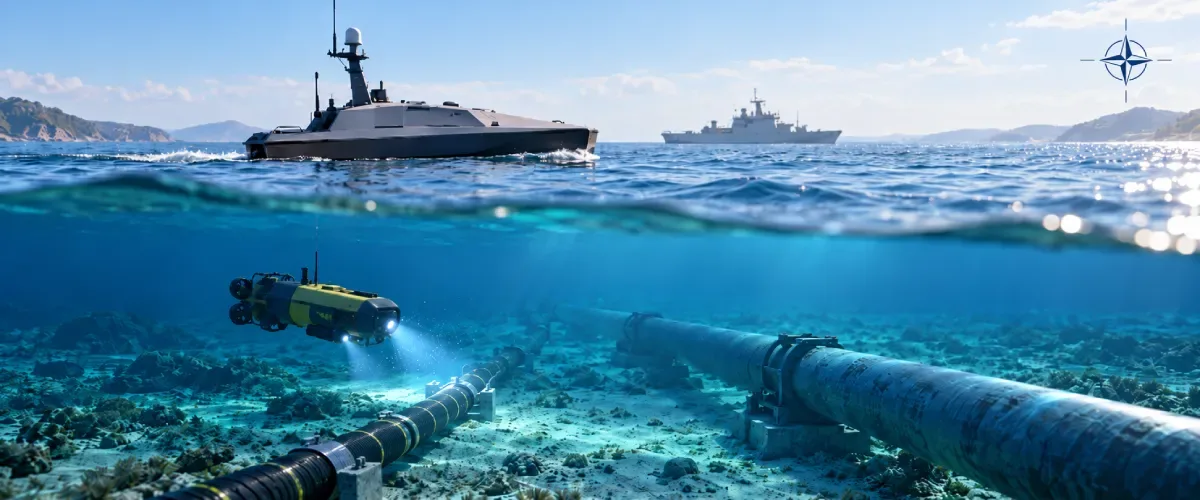
NATO has added companies to its network for protecting undersea cables and pipelines. NATO partners from the Indo-Pacific and Middle East also joined its talks for the first time at a meeting in Rostock, Germany, on October 20–21.
The Critical Undersea Infrastructure (CUI) Network brought together allied officials, the European Union, industry and partner countries to discuss information sharing and responses to incidents at sea. NATO did not name the new companies or the partner countries attending for the first time.
Private Operators and Maritime Surveillance
Much of the infrastructure is privately owned or operated. The meeting examined how information from those companies could help naval authorities detect threats and respond to incidents.
"Data is our means of ensuring real-time situational awareness," said Jean-Charles Ellermann-Kingombe, NATO's assistant secretary general for cyber and digital transformation and special coordinator for hybrid threats. He called for closer information sharing among governments, operators and the alliance.
An industry demonstration in Germany featured uncrewed surface and underwater vessels, modular uncrewed vessels and mine-countermeasures equipment. NATO announced no contracts or deployment plans for the systems shown.
The CUI Network was created in May 2024 alongside NATO's Maritime Centre for the Security of Critical Undersea Infrastructure at Allied Maritime Command in the United Kingdom. NATO launched Baltic Sentry in January 2025, using ships, aircraft and maritime drones to strengthen surveillance around Baltic Sea infrastructure.
Existing Tools and Türkiye's Role
Allied Maritime Command has used MAINSAIL since December 2024 to combine shipping data, satellite observations and other intelligence. It helps operators examine unusual vessel movements near sensitive infrastructure. NATO is also testing SINBAD, a commercial satellite-imagery analytics pilot. Allied Command Transformation said in February that maritime-relevant SINBAD data had already been integrated into MAINSAIL. The pilot has not been presented as an alliance-wide operational system.
Türkiye led work involving seabed warfare and critical undersea infrastructure at Allied Command Transformation's SHINE 2026 experimentation event in Canada on October 5–9. Türkiye's Secretariat of Defence Industries and Allied Command Transformation signed a memorandum of understanding on further cooperation. The agreement was separate from the Rostock meeting.
In July, Türkiye, Romania and Bulgaria signed an amendment extending their trilateral mine-countermeasures group's remit to critical undersea infrastructure, according to Romania's Defence Ministry. It expanded an existing regional arrangement, not a NATO-operated mission, and built on the countries' Black Sea mine-countermeasures cooperation.
Separately, Bulgaria called for a Black Sea shipping moratorium on October 15 after attacks on merchant vessels and sought stronger surveillance from NATO and the EU. The trilateral mine-countermeasures group has no standing mandate to escort commercial ships or defend them against aerial attacks.
The Rostock meeting announced neither a new NATO naval operation nor a timetable to deploy the equipment demonstrated there.
Sources: NATO, NATO Allied Command Transformation, Romanian Ministry of National Defence, Bosphorus News review and reporting.