
By Bosphorus News Life Desk
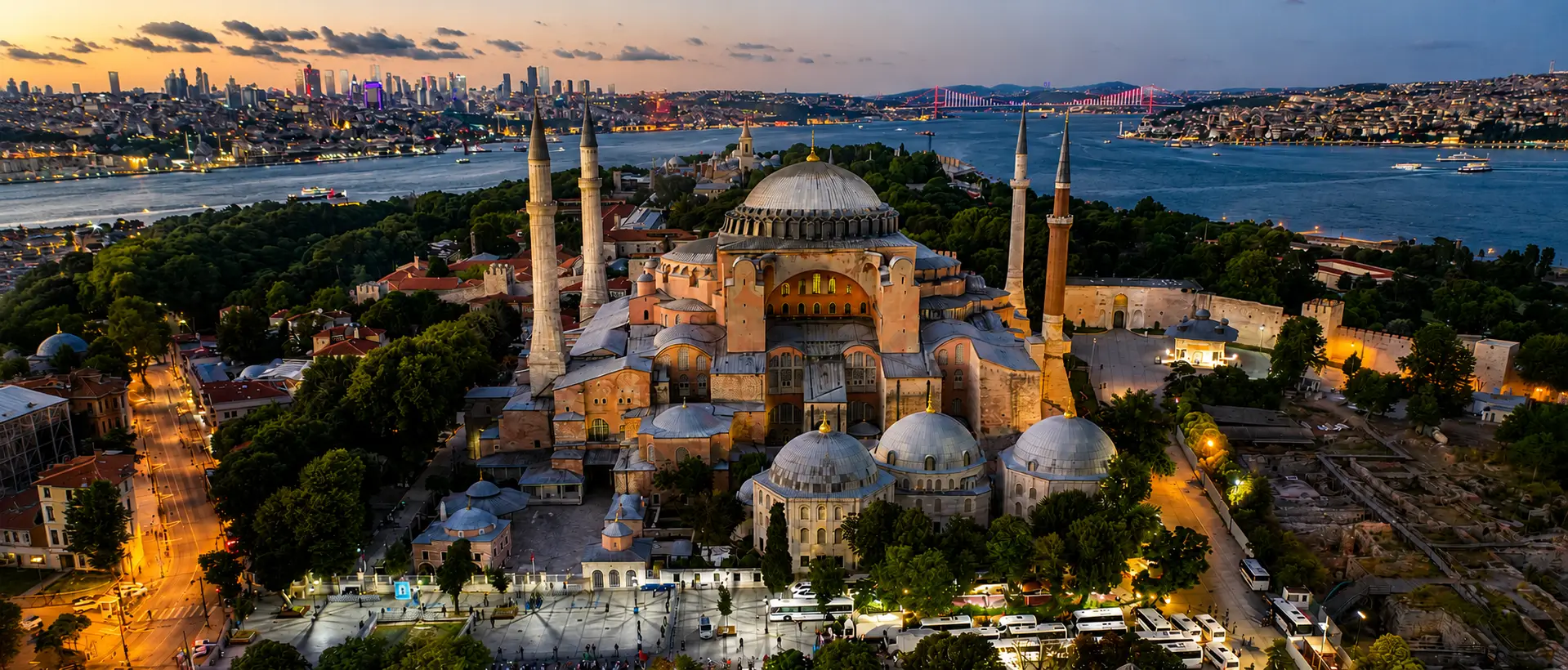
Türkiye has removed the lead covering from Hagia Sophia's main dome and partially dismantled its northeast minaret as a restoration program increasingly focused on structural reinforcement moves through the building.
Culture and Tourism Minister Mehmet Nuri Ersoy inspected the site on August 28 and said three of the project's four stages had been completed. The work now ranges from earthquake strengthening and mosaic documentation to excavations in tunnels beneath the complex, with Hagia Sophia remaining open for worship.
Main Dome Reinforced From Above
The main dome is being strengthened from the exterior because mosaics cover much of its inner surface.
Ersoy said structural analyses were carried out on the dome and semi-domes before reinforcement projects were prepared and approved by the conservation board.
Removing the existing lead covering was necessary to reach the structure from above. A temporary steel frame was installed over the dome and covered to protect both the exposed fabric and the mosaics below from rain and seasonal weather during the work.
Inside Hagia Sophia, a steel platform supported by four main columns carries the scaffolding used for restoration higher in the building. The arrangement allows prayers to continue below while conservation work proceeds overhead.
The mosaics have been recorded by laser scanning and photogrammetry. According to Ersoy, the scans identified repairs made during different periods and those findings were transferred to the restoration drawings.
A structural monitoring system has also been installed and is now producing data from the building.
Completed in the sixth century under Byzantine Emperor Justinian I, Hagia Sophia became an imperial mosque after the Ottoman conquest of Constantinople in 1453. It served as a museum from 1935 until 2020, when it was reopened as a mosque.
Northeast Minaret Partly Dismantled
The northeast minaret required a more invasive intervention after static analysis.
Engineers dismantled it in a controlled operation down to a predetermined level. Ersoy said the removal began at the copper finial and continued through six courses of stone in the shaft, together with the steps connected to them.
Stainless steel plates and rod systems were then installed to improve the minaret's performance under earthquake loading.
Numerical modelling and georadar scans have also been used on the building's walls to identify areas requiring additional reinforcement. Work has begun on the northeast and southeast stair towers.
The emphasis on earthquake resistance reflects the particular demands of maintaining a structure that has survived repeated seismic events, rebuilding campaigns and architectural interventions over nearly 1,500 years.
Work Moves Below Ground
Restoration has also reached the underground parts of the complex.
Excavations and documentation are under way in the hypogeum beneath the north courtyard and in tunnels numbered one through five.
Cleaning in the Vezir Bahçe and Batı Bahçe areas is about 90 percent complete, while excavation in Vezir Bahçe has finished.
Nine tunnel structures have been identified in Batı Bahçe. Fill soil has been removed from all but tunnels two and eight.
In the 56-metre structure identified as Mekan-2, damaged vaults along an 18-metre section were repaired using material selected to match the original fabric.
Stainless steel reinforcement has been completed along 50 metres of Tunnel-4, while similar work is continuing along a 90-metre section of Tunnel-5.
The underground program shows how far the project has moved beyond visible surface conservation. Engineers are examining the building from the dome downward, including spaces that have long remained inaccessible to visitors.
Gallery Floor Reopens to Visitors
A separate stage of the project prepared Hagia Sophia's gallery floor for public access.
The ministry installed new entry and exit arrangements, a temporary entrance tunnel and ticketing and security systems, while conservation teams worked on marble, timber, plaster and original balustrades. Lighting, camera and emergency announcement infrastructure were also renewed.
The new circulation system allows visitor access, worship and restoration to continue at the same time without closing the monument entirely.
Ersoy described the overall program as the most extensive restoration in Hagia Sophia's history and referred to the building as both a legacy of Mehmed II and part of a shared cultural heritage.
The ministry had previously described the ongoing work as the largest conservation, restoration and structural reinforcement program undertaken at Hagia Sophia during Türkiye's republican period.
The August 28 statement gave no overall cost, completion date or principal contractor.
Sources: Türkiye's Culture and Tourism Ministry, Anadolu Agency, TRT Haber, Bosphorus News review and reporting.