
By Bosphorus News Türkiye Desk
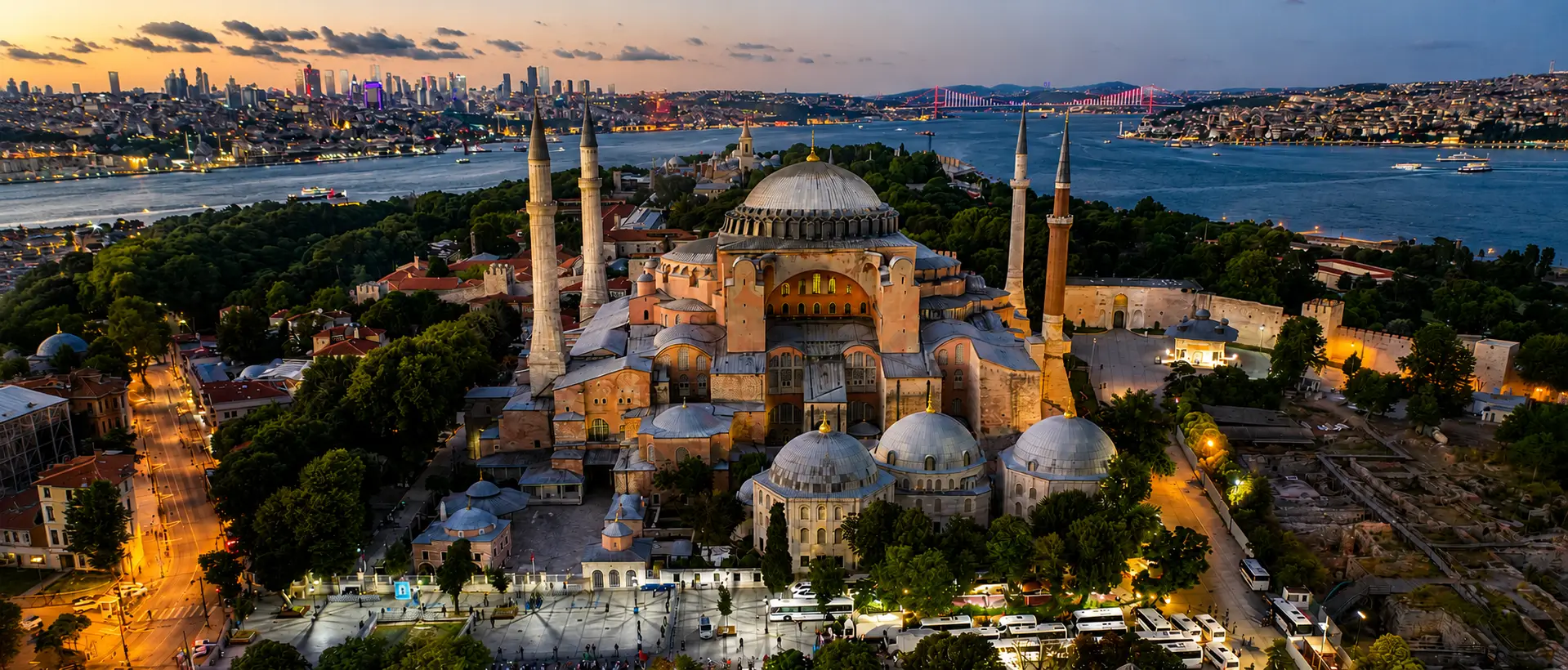
On July 24, 2026, President Recep Tayyip Erdoğan marked the sixth anniversary of Hagia Sophia's reopening as a mosque, describing the 2020 decision as a "revival" and a return to the monument's "original identity" while major restoration work continues on its central dome.
Erdoğan said reopening Hagia Sophia for Muslim worship had been granted to his government and linked the decision to an older Islamist political campaign associated with poet and ideologue Necip Fazıl Kısakürek.
"We had the honor of bringing it back to the Islamic world," Erdoğan told reporters after Friday prayers in Istanbul.
In a separate anniversary message, he referred to an 86-year separation and said the call to prayer would continue at Hagia Sophia "for eternity."
Six years after the conversion, Türkiye's presidency and state institutions still present the 2020 decision as the recovery of a historical status that should not be reversed.
The official Hagia Sophia website uses similar language, describing the monument as having been restored to its original character and linking its mosque status to the foundation charter attributed to Ottoman Sultan Mehmed II.
Culture and Tourism Minister Mehmet Nuri Ersoy also described Hagia Sophia as a legacy of the conquest of Istanbul and said the 2020 decision returned it to its original identity.
The wording places the conversion inside a state narrative built around conquest, sovereignty, religious continuity and the reversal of the 1934 museum decision.
Legal Decision Becomes Part of State Memory
Hagia Sophia operated as a museum after a November 24, 1934 decision by Türkiye's Council of Ministers.
On July 10, 2020, the Council of State annulled that decision after ruling that the building had been registered as a mosque in the foundation charter and could not lawfully be used for another purpose.
Erdoğan signed an order transferring Hagia Sophia to the Presidency of Religious Affairs the same day. The first Friday prayer was held on July 24, 2020.
Justice Minister Akın Gürlek also marked the July 24 anniversary, describing Hagia Sophia as the "living memory" of Türkiye's foundation civilization and praying that the call to prayer from its minarets would continue "until the end of time."
Earlier, on July 10, Gürlek had described the Council of State ruling as a judicial response to a long-standing public demand and presented the reopening as an expression of national sovereignty and popular will.
The two statements reinforce the government's portrayal of the 2020 conversion as a legal, political and civilizational restoration, not only a religious decision.
Main Dome Enters New Restoration Phase
The anniversary coincides with a new phase in what the Culture and Tourism Ministry describes as the most extensive conservation and structural reinforcement program undertaken at Hagia Sophia during the republican period.
Engineering reviews found that the main dome required strengthening. Its lead covering is being renewed while conservation work proceeds on the mosaics below.
A temporary steel roof and protective membrane have been installed above the dome so the work can continue without exposing the structure or interior surfaces to rain and seasonal conditions.
The ministry says the project is being carried out under the guidance of a scientific committee while Hagia Sophia remains open to worshippers and visitors.
Erdoğan said the restoration would continue without closing the monument to Muslims, Christians or international visitors.
More Than 30 Million Visitors Since 2020
More than 30 million people have visited Hagia Sophia since its reopening as a mosque, according to figures released for the anniversary.
The building functions simultaneously as an active mosque, one of Istanbul's principal visitor sites and part of the UNESCO-listed Historic Areas of Istanbul.
That volume increases pressure on access, crowd management and conservation as restoration work proceeds.
Turkish religious authorities have also expanded the building's role as a working Islamic institution through Quranic instruction, religious guidance and organised recitations.
A Symbol Read Differently in Greece and Türkiye
Hagia Sophia remains one of the most politically charged historical symbols in Türkiye-Greece relations.
Built in the sixth century as the principal cathedral of the Byzantine Empire, it became a mosque after the Ottoman conquest of Constantinople in 1453 and a museum under the Turkish Republic in 1934.
The museum period became associated internationally with secular republican policy and the presentation of the monument as shared cultural heritage.
Erdoğan's conservative and Islamist supporters celebrated the 2020 conversion as the fulfilment of a decades-long political demand.
Greece and Orthodox institutions condemned the decision, viewing Hagia Sophia through the memory of Byzantium, the fall of Constantinople and the loss of one of Eastern Christianity's central monuments.
Greek Prime Minister Kyriakos Mitsotakis said at the time that the conversion offended Hagia Sophia's universal character and would affect Türkiye's relations with Greece, the European Union, UNESCO and the wider international community.
UNESCO said the status had been changed without prior consultation and warned that access, management and physical interventions must not damage the site's outstanding universal value.
The language used by Türkiye's presidency, Justice Ministry, Culture Ministry and official Hagia Sophia platform on the sixth anniversary presents the 2020 conversion as a permanent part of state identity rather than a reversible administrative decision.
Sources: Presidency of Türkiye statements, Türkiye's Culture and Tourism Ministry, Türkiye's Justice Ministry, official Hagia Sophia website, UNESCO, Greece's Prime Minister's Office, TRT Haber, Anadolu Agency, Bosphorus News review and reporting