
By Bosphorus News Geopolitics Desk
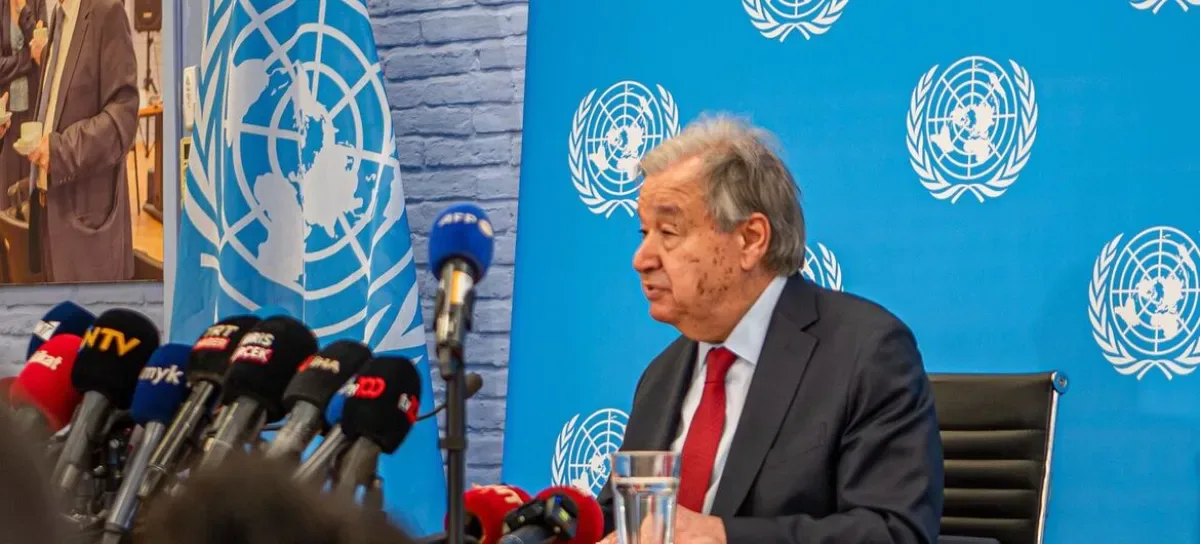
António Guterres leaves office as United Nations secretary-general on December 31. His Cyprus team has four months to decide how much of the current process can be fixed in place before responsibility passes to a successor who will inherit the island's dispute but not necessarily Guterres' people, timetable or diplomatic method.
That work is already under way. The United Nations is trying to establish an agreed record of the convergences reached before the Cyprus talks collapsed at Crans-Montana in 2017, while Turkish Cypriot leader Tufan Erhürman and Greek Cypriot leader Nikos Christodoulides have begun weekly meetings intended to prepare the ground for another enlarged 5+1 meeting.
At the same time, the Security Council is choosing the person who will take over on January 1. Two informal straw polls have been held, but no candidate has yet assembled the nine supportive votes needed for a recommendation without encountering a veto from one of the five permanent members.
The succession race and the Cyprus process will now advance through the same four-month window.
The UN Is Trying to Set the Starting Point
Guterres made the problem explicit during his July 27-29 visit to Cyprus. He said another enlarged meeting would require preparation on confidence-building measures, methodology and substance, and that previously achieved convergences had to be taken into account.
On August 26, Erhürman and Christodoulides agreed to meet weekly and more often when necessary.
At the same time, the UN is reconstructing the negotiating record.
Local reporting says Canadian constitutional scholar John McGarry has been working from UN records to bring the convergences accumulated through Crans-Montana into a single document, in contact with both sides. María Ángela Holguín, Guterres' Personal Envoy on Cyprus, has also said she has spent months examining the record of earlier talks.
The United Nations has not published such a document or formally established what status it would carry. A compilation prepared by the UN is not automatically an agreement between the sides, and it cannot turn disputed positions into negotiated acquis simply by recording them.
Its potential value is more practical. Cyprus negotiations have repeatedly lost time arguing over whether previous understandings still bind a new leader, a new round or a new political moment. A document accepted as an accurate account by both sides would reduce the scope for reopening old chapters before talks reach the issues that remain unresolved.
Erhürman has already made preservation of earlier convergences part of his methodology. His position, reflected in Guterres' January good offices report, is that understandings reached on the road to Crans-Montana should not be renegotiated. He has paired that demand with political equality, effective participation, a results-oriented timetable and safeguards against another indefinite process.
The Greek Cypriot side also argues that negotiations should resume from where they stopped in 2017 and within the existing federal framework.
If both sides accept the compilation, one of Erhürman's central procedural demands would already be reflected in the record used to restart negotiations.
That overlap does not remove the deeper disagreement over what the two sides believe a renewed Cyprus negotiation is supposed to produce. It does give Guterres an opportunity to settle part of the procedural argument before another 5+1 meeting is called.
An Earlier Attempt Did Not Settle the Matter
The UN has tried to preserve Cyprus convergences before.
Alexander Downer's team spent roughly a year cataloguing the agreements and understandings accumulated during the 2008-2012 negotiations. The resulting Convergences 2008-2012 document distinguished between established convergences, agreements in principle, common understandings and positions considered capable of being bridged.
The exercise did not prevent later disputes over what remained valid.
Nicos Anastasiades, after taking office in 2013, resisted being treated as bound by understandings reached under his predecessor Demetris Christofias. Derviş Eroğlu also challenged aspects of the compilation, even as the Turkish Cypriot side sought to preserve individual convergence papers produced during the earlier talks.
That history places a limit on what McGarry and Holguín can achieve through documentation alone.
Its value will depend less on how much history it records than on whether Erhürman and Christodoulides accept it as the record they will negotiate from. Without that political acceptance, another compilation risks becoming one more document whose status has to be negotiated.
The Next Secretary-General Inherits the Mandate, Not the Method
A change at the top of the United Nations does not rewrite the Cyprus framework on January 1.
The secretary-general's good offices operate inside an established Security Council framework, and the United Nations Peacekeeping Force in Cyprus (UNFICYP) has its own Security Council mandate. Its current authorization runs until January 31, 2027, one month beyond Guterres' departure.
A successor therefore cannot simply replace the existing settlement parameters with a different model.
What can change is how the office is used: whether Holguín remains in place, how quickly another 5+1 is pursued, how much preparatory agreement is required beforehand and how much political weight the new secretary-general places behind the process.
The successor will also decide when Türkiye, Greece and the United Kingdom are brought back into an enlarged meeting and how much groundwork must be completed before the three guarantor powers return to the table.
The mandate survived previous successions, but Cyprus diplomacy changed with the secretary-general occupying the office. Javier Pérez de Cuéllar, Boutros Boutros-Ghali, Kofi Annan and Guterres each used the same institutional authority differently.
Holguín's position makes the transition especially relevant. She is Guterres' personal envoy. Her mandate does not automatically carry into the next secretary-general's term, even if the wider UN good offices mission continues.
The Security Council Has Not Shown Its Veto Map Yet
The Security Council has held two informal straw polls, but the results still do not reveal which candidates can survive the permanent members.
Carolyn Rodrigues Birkett of Guyana led the August 21 ballot with eight "encourage" votes. Costa Rica's Rebeca Grynspan and Argentina's Rafael Grossi received seven each. Grynspan had led the first poll on July 30.
At this stage, ballots do not distinguish the votes of China, France, Russia, the United Kingdom and the United States from those of the ten elected Security Council members. A candidate can therefore appear competitive while still facing a permanent-member veto that has not yet become visible.
There is little value yet in assigning a Cyprus policy to candidates who may not survive the selection process. What matters to the island now is the calendar.
By the time the Security Council reaches the decisive stage of the succession race, Holguín is expected to have returned to Cyprus, the leaders should have accumulated several weeks of direct meetings, and the UN's work on earlier convergences should be much clearer than it is now.
Guterres Can Still Reduce What Has to Be Reopened
A settlement before December 31 is not a realistic measure of Guterres' remaining Cyprus work.
A more useful handover would leave the next secretary-general with functioning leader-level talks, progress on confidence-building measures, an agreed method for moving toward another 5+1 and a record of earlier convergences that the two sides are prepared to use rather than reopen.
That would not settle the disagreements that stopped the process in 2017. Security, guarantees, political equality, governance, property, territory and the wider regional environment would still have to be negotiated.
It would remove one familiar source of lost time: returning to the beginning whenever the political cast changes.
The McGarry work matters for that reason, not because another UN document is being prepared. If Erhürman and Christodoulides can recognize a common record of what was already achieved, the next secretary-general will inherit a negotiation with a defined starting point. If they cannot, the transition in New York will arrive while the sides are still contesting the record of the negotiation Guterres himself hosted nine years earlier.
The Security Council will choose his successor. What Guterres can still influence is how much of the Cyprus file that person will have to reconstruct after taking office.
Sources: United Nations, United Nations Security Council, United Nations Good Offices Mission in Cyprus, UNFICYP, Security Council Report, Politis, Cyprus Mail, Reuters, Bosphorus News review and reporting.