
By Bosphorus News Geopolitics Desk
Between August 31 and September 3, Greece signed a €3.035 billion air defense agreement with Israel, exchanged diplomatic notes with Türkiye, briefed European Union partners on the Aegean and answered a new warning from President Recep Tayyip Erdoğan over island militarization. The hardware is unusually specific; the threat language stops short of identifying a country.
On August 31, the Hellenic Ministry of National Defence and the Israel Ministry of Defense signed an intergovernmental agreement in Tel Aviv for an anti-aircraft, anti-ballistic and counter-drone dome built around a unified command and control system. Greece put the total budget at €3,035,000,000. Major General Ioannis Bouras, General Director of Defence Investments and Armaments, signed for Greece.
The two ministries described the same agreement in almost entirely different terms.
The Greek release names no individual weapons system or deployment geography. It gives the budget, states that 19 Greek companies are already involved, puts their participation above 25 percent and at €750 million, and provides for a production base in Greece with export potential. Defense Minister Nikos Dendias supplies the strategic language, arguing that ballistic missiles, satellite communications, unmanned systems, cyber threats and hybrid warfare had rendered existing defense doctrines obsolete. Rapid change, he said, had become necessary for "national survival" against revisionism and evolving threats.
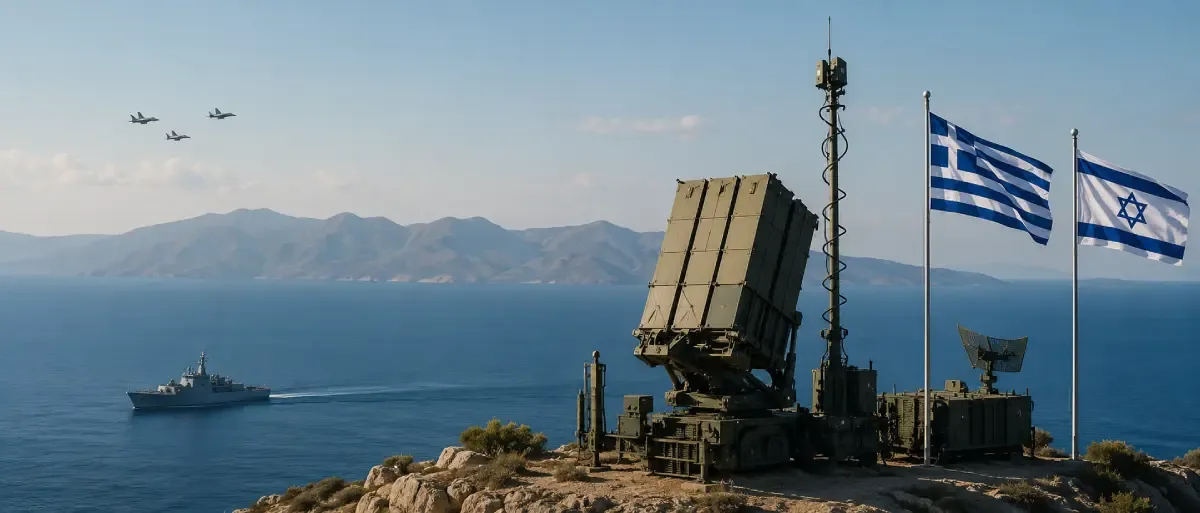
The Israeli release names the hardware. It lists David's Sling, developed by the Israeli Missile Defense Organization with Rafael as prime developer; Israel Aerospace Industries' BARAK MX; Rafael's SPYDER; ELTA Systems' MMR multi-mission radars; and a new national command and control system to be developed by Rafael. A supplementary €26 million agreement for Rafael's Drone Dome was signed at the same meeting.
Israel's Defense Ministry called Achilles Shield the largest defense export deal in the history of Israeli-Greek relations and tied it to a policy of expanding production lines and stockpiles through defense exports. Defense Minister Israel Katz supplied the political language, referring to "actors with hegemonic ambitions" seeking to expand their influence and undermine regional stability. He also linked the agreement to his earlier visit to Greece as Dendias' guest.
Neither announcement mentions Türkiye.
In Athens in January, Katz also left Türkiye unnamed when he warned against destabilisation through proxies without naming Ankara. Air defense, counter-drone systems and cyber security were on that agenda. Two are now under contract.
Dendias' wording has followed a similar path. In a November 28 speech, he said the main threat to Greece's security came from another member of NATO and then identified Türkiye directly. In May, from Agathonisi, an eastern Aegean island roughly five miles from the Turkish coast, he warned against "revisionist ambitions" and claims of non-existent rights without naming the country he was addressing. In July he said Greece had fallen behind because an unnamed threat had moved far ahead. On August 31, revisionism entered the Achilles Shield announcement with no country attached to it.
What is now under contract is also narrower than the doctrine that produced it. Bosphorus News noted in February that the five-layer concept covering anti-missile, anti-aircraft, anti-drone, anti-ship and anti-submarine roles was doctrine language rather than a contract list, and would serve as a benchmark for what followed.
The signed agreement covers three of those five areas. Neither ministry lists the naval layers. Artificial intelligence, frequently attached in Greek reporting to the command layer, also appears in no official description of the agreement.
Greece's parliamentary armaments committee approved Achilles Shield alongside a wider group of defense programs in March. On July 23, the Government Council for Foreign Affairs and Defence (KYSEA) approved Achilles Shield and ten other procurement programs. Dendias said at the time that the air defense systems would cost slightly more than €3 billion. The agreement signed on August 31 fixed the program budget at €3.035 billion.
The industrial share is already under parliamentary scrutiny. A question filed on September 1 asks how the 19 Greek companies were selected and whether the €750 million assigned to Greek participation represents binding and enforceable contractual obligations or work that could change as the program develops.
The diplomatic paperwork was moving at the same time.
Greek diplomatic sources said the Greek Embassy in Ankara delivered a protest démarche on September 1 over Türkiye's public objections to Greek spatial planning frameworks and the August 15 presidential decisions establishing two marine national parks. During the same encounter, the Turkish Foreign Ministry handed over notes verbales restating positions Ankara had already made publicly.
Milliyet reported the Turkish note over the planning dispute on September 2, a day before the Greek account became public. The Greek version places the Turkish notes inside the same embassy encounter. The chronology indicates that the two reports described opposite sides of one reciprocal diplomatic exchange rather than separate incidents.
The exchange capped an August in which the two foreign ministries repeated the same argument three times over Greek planning frameworks for tourism, renewable energy, and industry and supply chains. Athens also rejected Türkiye's marine park declarations wherever it considers them to extend beyond Turkish jurisdiction.
Foreign Minister George Gerapetritis brought the defense agreement into the argument on September 1. In an interview with Ta Nea, he cited the deal signed with Israel the previous day as one reason Greece was in a more advantageous position than three years earlier, while defending continued dialogue with Türkiye.
The following day, at the informal meeting of European Union foreign ministers in Wicklow, Ireland, Gerapetritis briefed counterparts on the Eastern Mediterranean and the Aegean and raised what Greece considers violations of international law.
There was an operational maritime dispute as well. Türkiye's Antalya station issued NAVTEX 0862/26 for scientific research by R/V TÜBİTAK MARMARA from September 1 to 15 in waters southwest of Kastellorizo. Greece's Heraklion station had responded on August 31 with NAVWARN 1036/26, calling the Antalya station unauthorized for the area and saying one of the declared positions lay over the Greek continental shelf. The research vessel proceeded into the wider area without a warship escort and remained under Greek monitoring.
On September 2, Erdoğan was asked about Greek military deployments on eastern Aegean islands that Türkiye considers subject to demilitarization provisions under international treaties. Speaking to journalists on his return from the Shanghai Cooperation Organisation summit in Bishkek, he said Türkiye would "do what is necessary" and called on Greece to stop arming the islands.
Prime Minister Kyriakos Mitsotakis responded on September 3 after meeting European Council President António Costa in Athens. He said Greece would accept instructions from no one on how it strengthens its defenses. Mitsotakis also recalled that participation by third countries in the European Union's Security Action for Europe (SAFE) program is conditional on the security and defense interests of member states not being harmed, and said Türkiye's European path must proceed alongside good-neighborly relations with Greece.
A quieter channel remained open. Turkish security sources said on September 3 that National Intelligence Organization head İbrahim Kalın had met Themistoklis Demiris, Director-General of Greece's National Intelligence Service (EYP), in Athens the previous week. Their discussions covered the Aegean and Western Mediterranean, NATO security, intelligence cooperation, terrorism, organized crime, irregular migration and human trafficking, alongside wider regional files. Neither intelligence service issued a formal statement on the meeting.
By September 3, Achilles Shield had moved from doctrine to contract while Greece and Türkiye traded diplomatic notes, navigational warnings and leader-level warnings and their intelligence chiefs kept a separate channel open. The contract now names the systems. The political threat language around it still does not name Türkiye.
Sources: Hellenic Ministry of National Defence, Israel Ministry of Defense, Hellenic Republic Ministry of Foreign Affairs, Office of the Greek Prime Minister, Hellenic Parliament, Greece's National Intelligence Service, Greek diplomatic sources, Turkish security sources, Turkish Official Gazette, Milliyet, Anadolu Agency, Kathimerini, ProtoThema, Bosphorus News review and reporting