
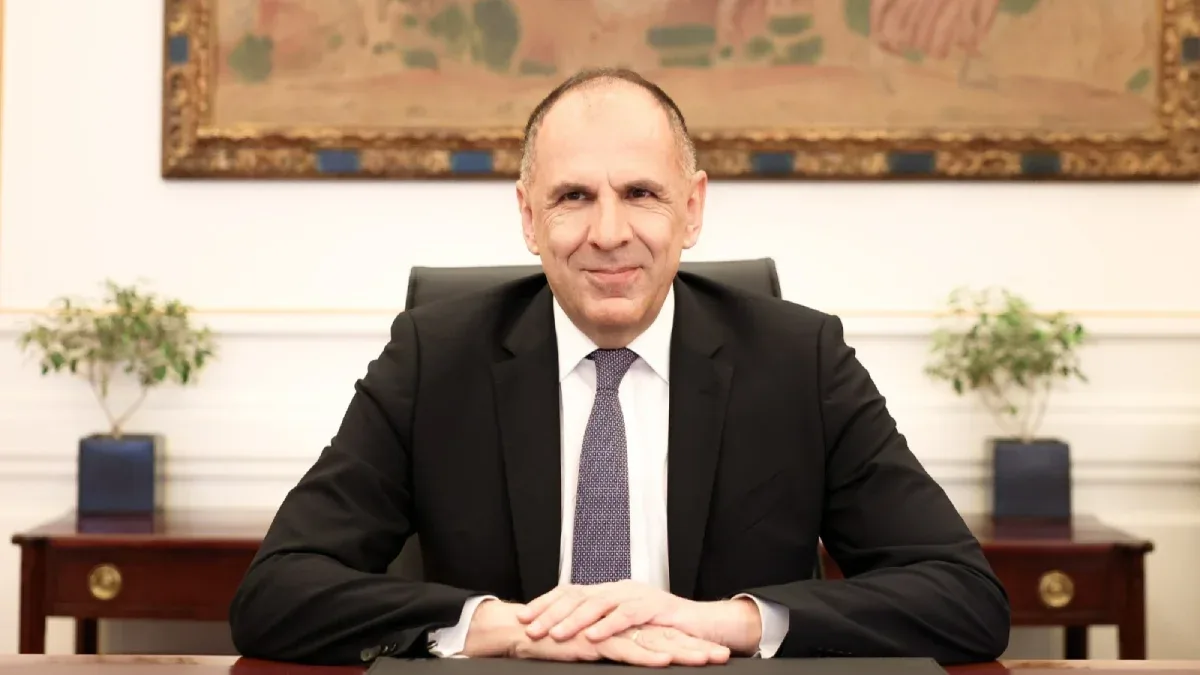
By Bosphorus News Geopolitics Desk
Greek Foreign Minister George Gerapetritis said the European Union's mutual-defense clause applies when a member state faces armed aggression, declining to say that obstruction of the Greece-Cyprus electricity cable would by itself meet that threshold.
Asked whether Greece could invoke Article 42(7) of the Treaty on European Union if work on the Great Sea Interconnector (GSI) were blocked, Gerapetritis said it would be wrong to connect the clause in advance to a hypothetical incident at sea.
Article 42(7) requires EU member states to provide aid and assistance when another member is the victim of armed aggression on its territory. Gerapetritis said discussions were already under way inside the EU on clearer procedures for using the provision, including a roadmap for what would follow after it was invoked.
He did not rule out other responses if work on the cable is obstructed.
Greece has diplomatic, legal, European and defense means available under international law, its EU membership and its partnerships, he said. He added that Greece, France and the Republic of Cyprus support the project politically and would take the steps needed for its implementation.
France now also has a direct commercial stake in the project. Infrastructure investor Meridiam agreed in August to become majority shareholder in the GSI project company. Bosphorus News reported on August 5 that Greece's Independent Power Transmission Operator would remain a strategic shareholder and retain technical leadership.
Gerapetritis cited Meridiam's majority position while arguing that the interconnector is a European project rather than a bilateral Greek-Cypriot undertaking. GSI is designated as a Project of Common European Interest, and he said EU governments and institutions were being kept informed about its progress.
Nothing in his answer amounted to an automatic French or EU security guarantee for the cable. He kept Article 42(7) tied specifically to armed aggression.
The issue has become entangled with unfinished survey work near Kasos and unresolved Greek-Turkish maritime claims. Athens says Greece authorizes work in areas it considers to fall under its maritime jurisdiction and does not require Turkish permission. Türkiye contests Greek positions in parts of the Aegean and Eastern Mediterranean where maritime boundaries have not been delimited.
On September 1, Gerapetritis said the cable route crosses the Greek continental shelf and an undelimited exclusive economic zone, while insisting that authorization for the project would come only from Greece. He also linked the dispute to Athens' push for maritime delimitation agreements with neighboring states.
The legal-diplomatic track remains blocked over the scope of the dispute. In a September 4 interview examined by Bosphorus News, Gerapetritis said Greece and Türkiye had not agreed on which issues could eventually be submitted to international adjudication.
Athens considers continental shelf and exclusive economic zone delimitation the only bilateral dispute suitable for international adjudication. Türkiye says the Aegean file contains other unresolved issues.
On September 12, Gerapetritis repeated the Greek position, saying conditions still did not exist for substantive negotiations on a compromis that could send the maritime dispute to an international court. He described Turkish claims involving Greek sovereignty as arbitrary and unfounded, reflecting the Greek government's position.
Asked whether Greece might move more quickly to extend its territorial waters to 12 nautical miles south of Crete, he announced no such step. He repeated that Athens regards extension to 12 nautical miles as a unilateral right and said Greece would decide its timing and method.
For GSI, Gerapetritis kept Article 42(7) tied to armed aggression. Greece says other diplomatic, legal, EU and defense tools remain available if the project is obstructed, but he did not say that interference with cable operations would trigger the clause.
Sources: Hellenic Republic Ministry of Foreign Affairs, EUR-Lex, Bosphorus News review and reporting.