
By Bosphorus News Geopolitics Desk
Two Abu Dhabi Visits, One Corridor Map
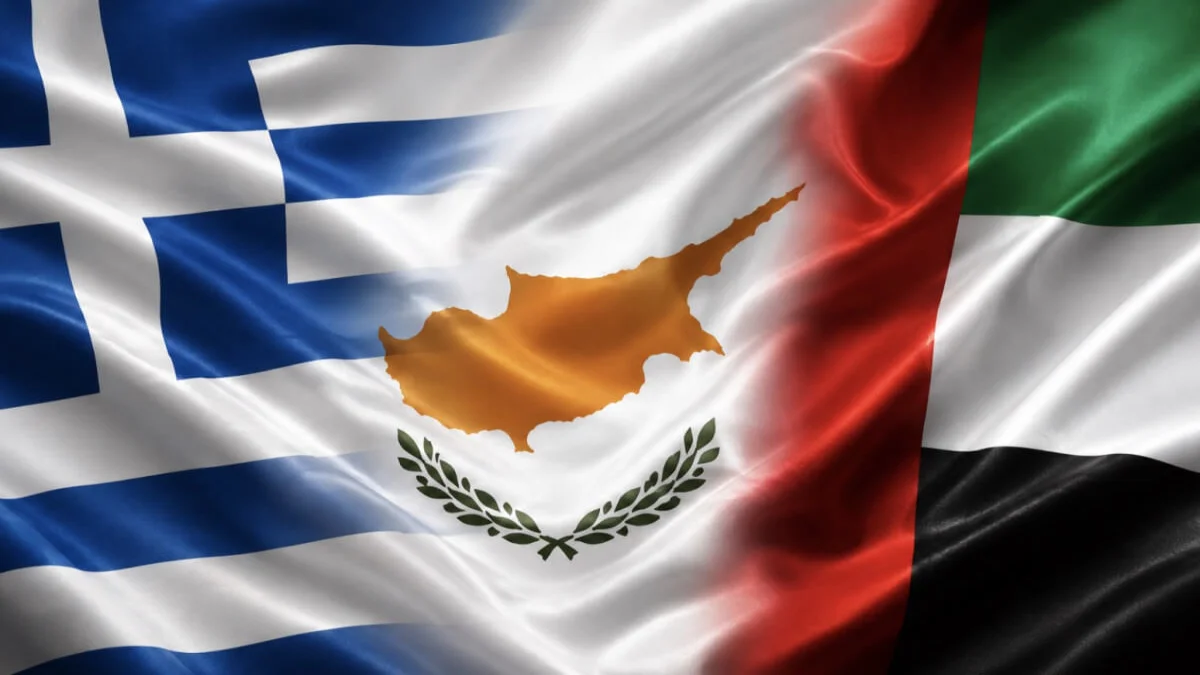
Greek Prime Minister Kyriakos Mitsotakis met UAE President Sheikh Mohamed bin Zayed Al Nahyan in Abu Dhabi on May 6. Cypriot President Nikos Christodoulides followed the next day with a separate working visit to the same counterpart.
Both meetings were confirmed by the UAE state news agency WAM.
Mitsotakis was the first European Union leader to visit the UAE following Iranian strikes on Emirati civilian infrastructure. He condemned the attacks and called for a diplomatic solution. The two leaders discussed freedom of navigation under the United Nations Convention on the Law of the Sea as a prerequisite for international peace, supply chains and economic prosperity. Greece and the UAE signed a Memorandum of Cooperation on Artificial Intelligence and Technology, exchanged by UAE Minister of Industry and Advanced Technology Sultan Al Jaber and Greek Foreign Affairs Minister George Gerapetritis.
Christodoulides met Sheikh Mohamed bin Zayed the following morning under the framework of the UAE-Cyprus Comprehensive Strategic Partnership. WAM confirmed the talks covered economy, trade, investment, technology, renewable energy, education and tourism. Christodoulides raised Cyprus's current EU Council Presidency and its role in supporting UAE-EU partnership relations. He reiterated Cyprus's condemnation of Iranian attacks, describing them as "a violation of state sovereignty, international law and the UN Charter."
US Senate Places EastMed Inside IMEC
One week before the Abu Dhabi visits, US Senators Cory Booker (D-NJ) and Dave McCormick (R-PA), both members of the Senate Foreign Relations Committee, introduced the Eastern Mediterranean Gateway Act on May 1.
The bipartisan bill seeks to codify US support for ports, digital corridors and strategic infrastructure across the Eastern Mediterranean as part of IMEC, the India-Middle East-Europe Economic Corridor. IMEC, launched at the 2023 G20 Summit in New Delhi, is a proposed multimodal trade route connecting India through the Arabian Gulf, overland via Saudi Arabia and Jordan to Israel's Haifa port, then onward to Piraeus in Greece and into Europe. The Hormuz crisis has added urgency to that architecture, as Bosphorus News has reported. Cyprus and Greece have separately been advancing the same corridor logic through the trilateral format with Jordan, framing the Eastern Mediterranean as a working hub between Europe and the Arab region, as Bosphorus News covered from the Amman summit.
"Operation Epic Fury showed that the Eastern Mediterranean is not on the sidelines of the Middle East," Senator McCormick said. "Our critical regional partners like Greece, Cyprus, Israel, and Egypt stepped up with critical defense, intelligence, and logistical support when it mattered most. The Eastern Mediterranean Gateway Act strengthens these partnerships, makes the region a bigger priority for the US, and helps secure the India-Middle East-Europe Economic Corridor, so critical trade and energy routes aren't left vulnerable to Iran, China, or other adversaries."
The legislation formally defines Greece, Cyprus, Israel, Egypt and the UAE as Eastern Mediterranean countries under US law, and calls for the 3+1 diplomatic framework, the existing format among the US, Greece, Israel and Cyprus, to resume at foreign minister level.
Türkiye Outside the Formal Map
IMEC's proposed route bypasses Türkiye entirely. The corridor runs through the Arabian Peninsula and Israel to Piraeus, with no overland segment through Turkish territory. Türkiye was not included in the 2023 G20 memorandum that launched the project, and is not listed among the defined Eastern Mediterranean countries in the Senate bill. The same geographic logic shapes the EastMed energy debate, where pipeline routes that avoid Turkish territory have gained renewed attention since the Hormuz disruption, a tension Bosphorus News examined in detail. Cyprus's institutional weight inside the EU adds another layer: Ankara has long argued that Nicosia uses its veto power to block Türkiye's inclusion in European frameworks, a frustration Foreign Minister Hakan Fidan expressed directly after a NATO meeting in Brussels in December 2025.
At the G20 in New Delhi in September 2023, President Recep Tayyip Erdoğan said the corridor "cannot be materialised without Turkey" and announced plans to advance an alternative. Türkiye subsequently intensified work on the Iraq-Türkiye Development Road, a $17 billion rail and highway link running from Iraq's Grand Faw Port in Basra to the Turkish border and onward into Europe. Iraq, Türkiye, Qatar and the UAE signed a preliminary agreement for the project in Baghdad in April 2024.
The Senate bill has not yet been scheduled for a hearing. The Abu Dhabi visits produced no single corridor agreement. But Greece and Cyprus are deepening Gulf ties at the same moment Washington is trying to give the Eastern Mediterranean a formal place inside IMEC. Türkiye remains outside that map, which is why the corridor question is no longer only about trade routes.
***Sources: UAE state news agency WAM (May 6–7, 2026); Greek Prime Minister's Office statement via New Greek TV (May 6, 2026); US Senator Cory Booker's official press release (May 1, 2026); bill text via Congress.gov (S.4443, 119th Congress); Erdoğan IMEC objection via Middle East Eye (September 2023); Development Road MoU via The National (April 2024).