
By Bosphorus News Geopolitics Desk
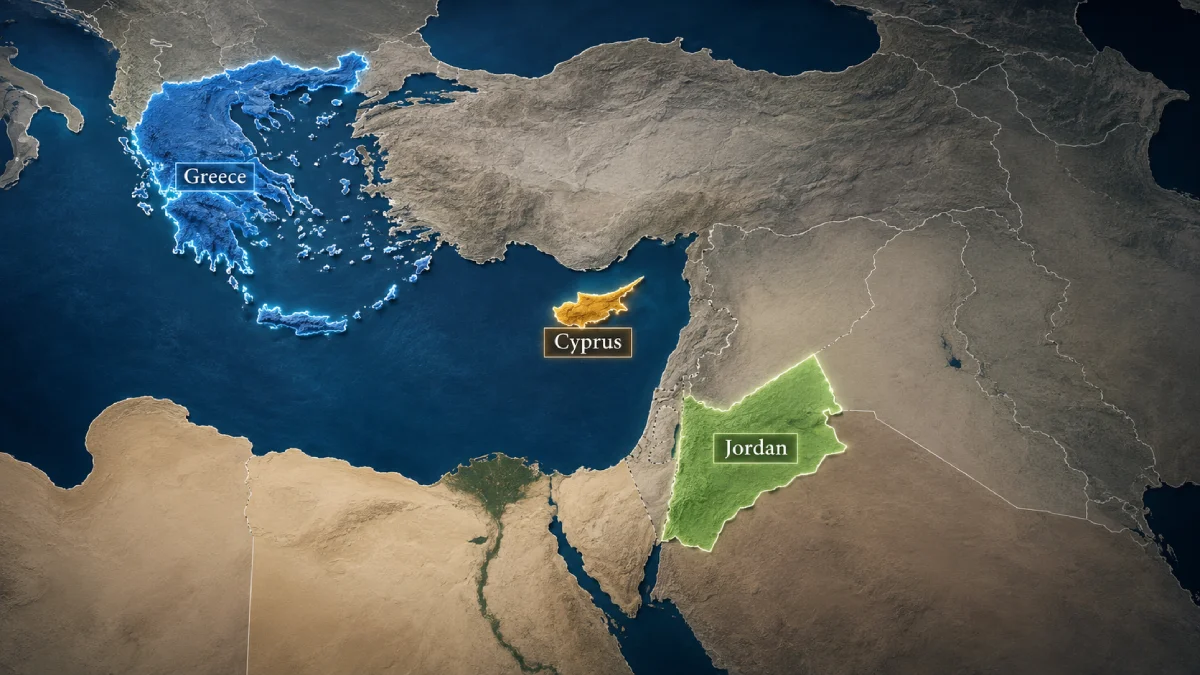
Cyprus, Greece and Jordan used their fifth trilateral summit in Amman to push the Eastern Mediterranean beyond its familiar energy frame and present it as a working corridor between Europe and the Arab region.
King Abdullah II, Cyprus President Nikos Christodoulides and Greek Prime Minister Kyriakos Mitsotakis met in the Jordanian capital on May 6, with Crown Prince Hussein also attending. The joint declaration issued after the summit placed trade, energy, investment, culture, transport, logistics infrastructure, food security and water security inside the same regional agenda.
The language went beyond a standard diplomatic communiqué. The three governments described the Eastern Mediterranean as a vital hub linking Europe and the Arab region, with emphasis on secure trade routes, supply chain resilience and transport infrastructure. That gives the format a larger function at a time when war risk, shipping disruption and energy pressure are pushing regional connectivity into daily diplomacy.
Hormuz gave the summit a sharper edge. The declaration underlined the importance of maintaining the ceasefire between the United States and Iran and protecting freedom of navigation through the Strait of Hormuz under international law and the United Nations Convention on the Law of the Sea. For Greece, whose shipping sector carries global weight, the issue is economic as much as diplomatic.
The leaders also discussed Gaza, the West Bank, Jerusalem, Lebanon, Syria, Iraq and Iran. Their message centred on de escalation and preventing regional crises from spreading. Jordan's role gave that language immediate weight. Amman is directly exposed to the consequences of the Syrian conflict, refugee pressure, Gaza diplomacy and instability along the Levant's trade and security routes.
Cyprus added the European layer. The declaration welcomed Cyprus's assumption of the Council of the European Union presidency on January 1, 2026, and presented the trilateral mechanism as a bridge between the region and the EU. Nicosia is using its presidency to give Eastern Mediterranean files more visibility inside Brussels, including migration, climate pressure, disaster response, connectivity and regional security.
The summit also carried an India Middle East Europe Economic Corridor, or IMEC, dimension. Cypriot reporting said the leaders discussed expectations tied to the planned trade route linking India, the Gulf, Jordan, Israel and Europe through Greece. IMEC was not the formal centre of the joint declaration, but it runs close to the summit's language on routes, logistics and Europe Arab connectivity.
That is where the Türkiye angle becomes visible, even though Ankara was not named in the communiqué. The trilateral format does not need to target Türkiye directly to matter for Türkiye. Greece is positioned as a European entry point. Jordan sits on the Middle Eastern land route. Cyprus brings EU access, maritime geography and the political weight of its 2026 Council presidency.
Türkiye has challenged IMEC's exclusionary geography since the corridor was announced, with President Recep Tayyip Erdoğan previously arguing that there can be no durable corridor without Türkiye. Ankara has promoted the Iraq Türkiye Development Road as a rival Gulf Europe route, while seeking a larger role in Mediterranean and Gulf connectivity debates shaped by energy security, trade resilience and war risk.
The Amman declaration avoids that contest directly. The overlap is still clear. The same region is now being drawn through several competing maps: IMEC, the Development Road, EastMed energy debates, Hormuz security, Red Sea instability and post Assad Syria. Each map gives different weight to Greece, Cyprus, Jordan and Türkiye.
Food and water security gave the summit another layer. The declaration called for deeper cooperation and expertise sharing in both fields, reflecting a region where climate pressure, refugee flows, agricultural stress and infrastructure gaps are now part of security policy. The three leaders also highlighted the Cyprus Regional Aerial Firefighting Station in Paphos, formally opened on April 23, as a practical contribution to regional disaster response.
Syria remains central to the format's regional logic. The declaration referred to reconstruction, stability and the need to support Jordan as it continues to host Syrian refugees. Reduced international support for refugee hosting states has become a growing concern for Amman, and the trilateral mechanism gives Jordan another channel to link that burden to European and Eastern Mediterranean diplomacy.
The next summit will be held in Greece, keeping the mechanism active as Cyprus's EU presidency continues and the region absorbs the effects of the Iran crisis, Gaza diplomacy and Syria's transition. The Amman meeting did not announce a new corridor or a security bloc. It gave the Eastern Mediterranean a more practical role in the language of regional diplomacy: trade routes, water, food, disaster response, maritime access and Europe Arab connectivity are now being treated as parts of the same strategic map.