
By Bosphorus News Defense Desk
The source code associated with the command-and-control system at the center of Greece's Achilles Shield was not included in the licensing agreement described by Moshe Patel, director of the Israel Missile Defense Organization (IMDO). His answer, published on September 6, conflicts with conditions publicly set by Greek Defense Minister Nikos Dendias before the €3.035 billion agreement was signed.
In an interview with Kathimerini journalist Athanasios Katsikidis, Patel was asked directly whether Greece would have access to the source code associated with command-and-control (C2) capabilities.
"No," Patel replied. "Because the source code was not part of the licensing agreement." Israel would provide support, maintenance and further assistance where required, he said.
The answer leaves a contractual question that cannot be settled from the documents made public: what software rights Greece ultimately secured, and whether Greek and Israeli statements refer to exactly the same C2 software baseline, licensing package or proprietary components within a network containing a Rafael-developed national command system and separate controls embedded in individual weapons.
Dendias made source code a condition
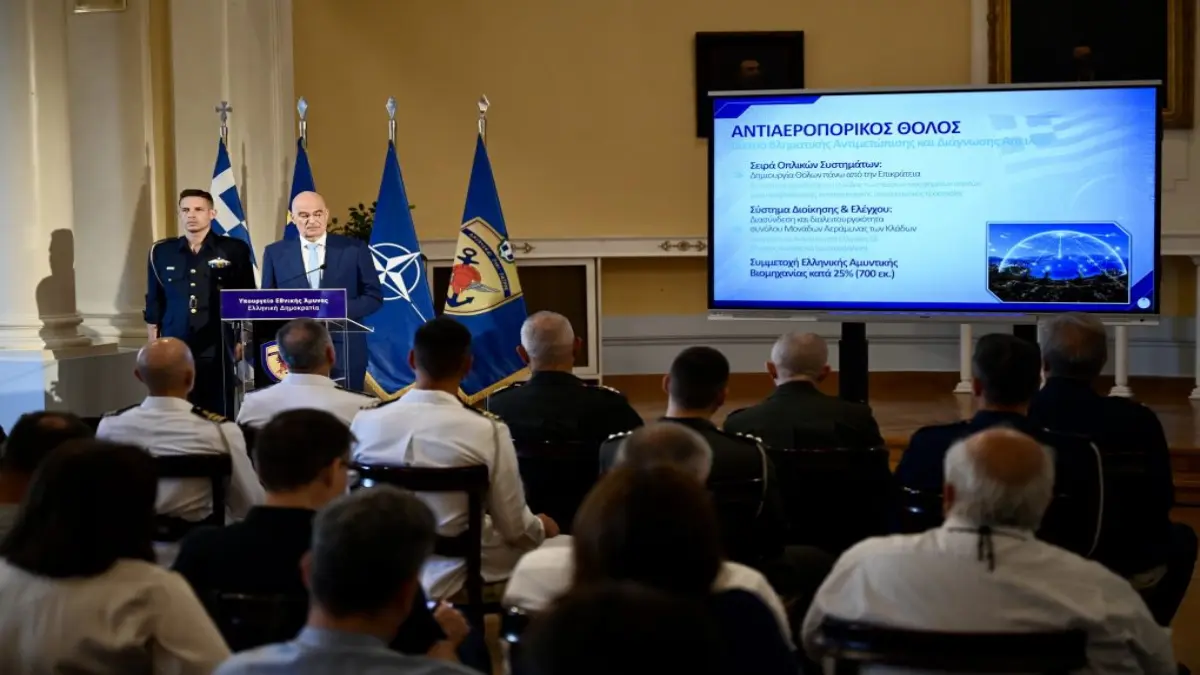
Dendias faced essentially the same question on July 23, after Greece's Government Council for National Security, known as KYSEA, approved the procurement programs for the new air-defense dome.
Asked specifically whether the Hellenic Armed Forces would acquire the source code for the Achilles Shield command-and-control system, Dendias said a standing instruction applied. Greece would not acquire systems whose source code it did not possess, apart from narrowly specialized exceptions.
He drew a sharper line around command and control. The armed forces could not operate a system with the capabilities he had just described without possessing the source code and being able to intervene in its architecture and development, he said, because that would risk making Greece a "hostage" even to the friendliest foreign country or ally.
"For anything acquired for the country, if not indicated otherwise, we have the source code," Dendias said.
Minutes earlier, he had described Greece's move from the older C4I model to C5ISRT: Command, Control, Compute, Communicate and Cyber, combined with Intelligence, Reconnaissance, Surveillance and Targeting. The system he outlined would draw information from sensors across the country, process and prioritize that data and support targeting and response decisions.
The July briefing also set a minimum 25% Greek industrial participation requirement, an issue Bosphorus News examined after the KYSEA approval.
Dendias returned to the software issue on August 30, one day before the agreement was signed. He described Achilles Shield as a network-centric architecture spanning sea, land, air, cyberspace and space, with an integrated C2 system at its base. He said Greece placed particular weight on technology and production transfer to its defense industry and on access to the source code of the systems involved.
Greek Defense Ministry sources said the issue was settled
Three days before the signing, Kathimerini's Dora Antoniou reported that outstanding issues in the negotiations had been resolved.
Citing sources at Greece's Ministry of National Defense, the August 28 report identified two of them as the 25% Greek industrial share and the transfer of source code. The provision, it said, was intended to allow the Hellenic Armed Forces to retain control over software operating the electronic subsystems of the air-defense network.
The newspaper maintained that position after the agreement was signed. In a September 1 report, Vassilis Nedos wrote that the package contained a C2 system "for which Greece will possess the source code," describing this as giving Athens full national ownership.
Five days later, Patel said the source code associated with C2 was not part of the licensing agreement.
No public version of the agreement or its technical annexes has been released. The available record therefore does not establish whether the Greek reports and Patel are discussing precisely the same source code, different software layers or different categories of access and licensing rights.
Signing notices omit source code
The intergovernmental agreement was signed in Tel Aviv on August 31.
The Hellenic Ministry of National Defence put the program budget at €3.035 billion and described an anti-aircraft, anti-ballistic and counter-drone dome containing a unified and holistic command-and-control system. It said 19 Greek companies were already participating in the relevant procedures, with Greek participation exceeding 25% and totaling €750 million. A production base with export potential is also planned in Greece.
The ministry's signing announcement did not mention source-code transfer or software ownership.
The Israeli Ministry of Defense identified David's Sling, developed by IMDO with Rafael as prime developer; Barak MX from Israel Aerospace Industries (IAI); SPYDER from Rafael; multi-mission radars from IAI subsidiary ELTA Systems; and a new national command-and-control system to be developed by Rafael.
The Israeli announcement said the new C2 would consolidate Greece's full range of air-defense capabilities. It also referred to expanded industrial cooperation and transfer of knowledge and technology to Greek industry, but did not state that source code would be transferred. A separate €26 million agreement for Rafael's Drone Dome counter-drone systems was signed alongside the main package.
Katsikidis's interview was subsequently updated online by Kathimerini after publication of the Sunday edition, following additional information from the Israeli Ministry of Defense concerning the source-code issue.
The added note said the Israeli side would transfer know-how and provide joint use of software and technology with the Hellenic Armed Forces, with cooperation extending to Greek companies participating in co-production. It did not say Greece would receive the source code.
Several command-and-control layers
Patel's description shows that Achilles Shield contains more than one command-and-control layer.
SPYDER forms the lower tier and is intended for islands farther from the mainland. Barak MX will cover more islands closer to it, while David's Sling has a larger footprint covering the mainland and additional island areas. External ELTA multi-mission radars supplement the sensors attached to the individual systems.
Patel said each of the weapon systems also comes with its own radar and command-and-control system. The package adds another C2 system controlling the systems and radars across the network. Israel's Defense Ministry separately identifies Rafael as the developer of the new national C2.
The public material does not establish whether Dendias's requirement and Patel's answer concern exactly the same C2 software baseline, licensing package or proprietary components within the wider architecture.
Nor does it disclose Greece's rights to modify the software, develop it independently, control interfaces or integrate additional systems without approval from the original supplier.
Patel said negotiations had run for close to four years, with Greek air force and planning officers repeatedly visiting Israel and Israeli teams travelling to Athens. Radar and interceptor locations were designed using planning tools that account for terrain, radar performance and interceptor capability. Greece will receive the planning tool and be able to conduct its own analysis and adjust deployment planning, he said.
David's Sling carries a US approval requirement
Patel said all the Israeli systems have Link 16 capability and can be connected to other equipment operated by Greece.
David's Sling carries an additional restriction. Under Israel's licence from the United States government, connecting the system to other NATO countries or systems requires an integration plan and US government approval, Patel said. SPYDER and Barak MX do not require the same US authorization.
He declined to disclose interception-performance figures or component costs. He also gave no date for full operational readiness, saying a detailed timetable had been agreed during negotiations and incorporated into the contract but was not being published under Greek rules.
Dendias said on July 23 that the system would be fully operational within 35 months, with deliveries taking place in stages. Kathimerini reported on August 28 that the 35-month implementation period would begin when the contracts entered into force.
Iron Beam is not part of the current package. Patel said the laser system could be added to the architecture later if Greece requested it.
Greek work share remains undisclosed
The precise division of the €750 million Greek industrial share has not been published.
Patel said Israeli companies had begun working with prospective Greek partners but declined to identify which components would be produced or developed by them. The official Greek announcement confirms the value, percentage and participation of 19 companies without separating hardware, software, integration, maintenance or C2 work.
There is therefore no public evidence that Rafael's core C2 source-code development forms part of the Greek 25% share. There is also no basis for describing the Greek share as hardware-only.
Parliament and opposition seek clarification
Questions over control of the system had reached the Greek parliament before Patel's interview appeared.
PASOK lawmaker Michalis Katrinis submitted a parliamentary question and request for documents on September 1 seeking details on who would control the architecture, configuration and future development of the central C2, and what rights Greece would receive over software, source code, intellectual property, interfaces and technical data.
He also sought clarification on whether Greece could modify and upgrade the system independently, integrate Greek, European or allied third-party systems and employ another integrator without requiring approval from the original foreign supplier. The PASOK intervention also questioned the contractual status and allocation of the €750 million Greek industrial participation.
The issue produced a further political response after Patel's interview. In a joint statement sent to Bosphorus News on Sunday, the foreign policy and defense sectors of the Greek Left Alliance (ELAS), the party led by former prime minister Alexis Tsipras, called on the government to clarify whether Greece has access to the C2 source code and what control it ultimately holds over the system. ELAS contrasted Patel's answer with Dendias's statements on July 23 and August 30.
ELAS also questioned the publication history of the Kathimerini interview, saying the source-code exchange had been absent from the initial online version before being added later. Kathimerini's own note says the online interview was subsequently updated following additional information from the Israeli Ministry of Defense.
As of publication, the Hellenic Ministry of National Defence had issued no public clarification addressing Patel's source-code statement.
Sources: Hellenic Ministry of National Defence, Israel Ministry of Defense, dendias.gr, Kathimerini, Greek Left Alliance statement sent to Bosphorus News, parliamentary material, Bosphorus News review and reporting.