
By Murat Yıldız
A Greek legal debate over a possible extension of territorial waters to 12 nautical miles has returned to a basic Aegean question: which passage regime would apply to routes enclosed by territorial sea after an extension? Under the United Nations Convention on the Law of the Sea (UNCLOS), qualifying international straits are governed by transit passage. Other territorial waters may be subject to innocent-passage rules.
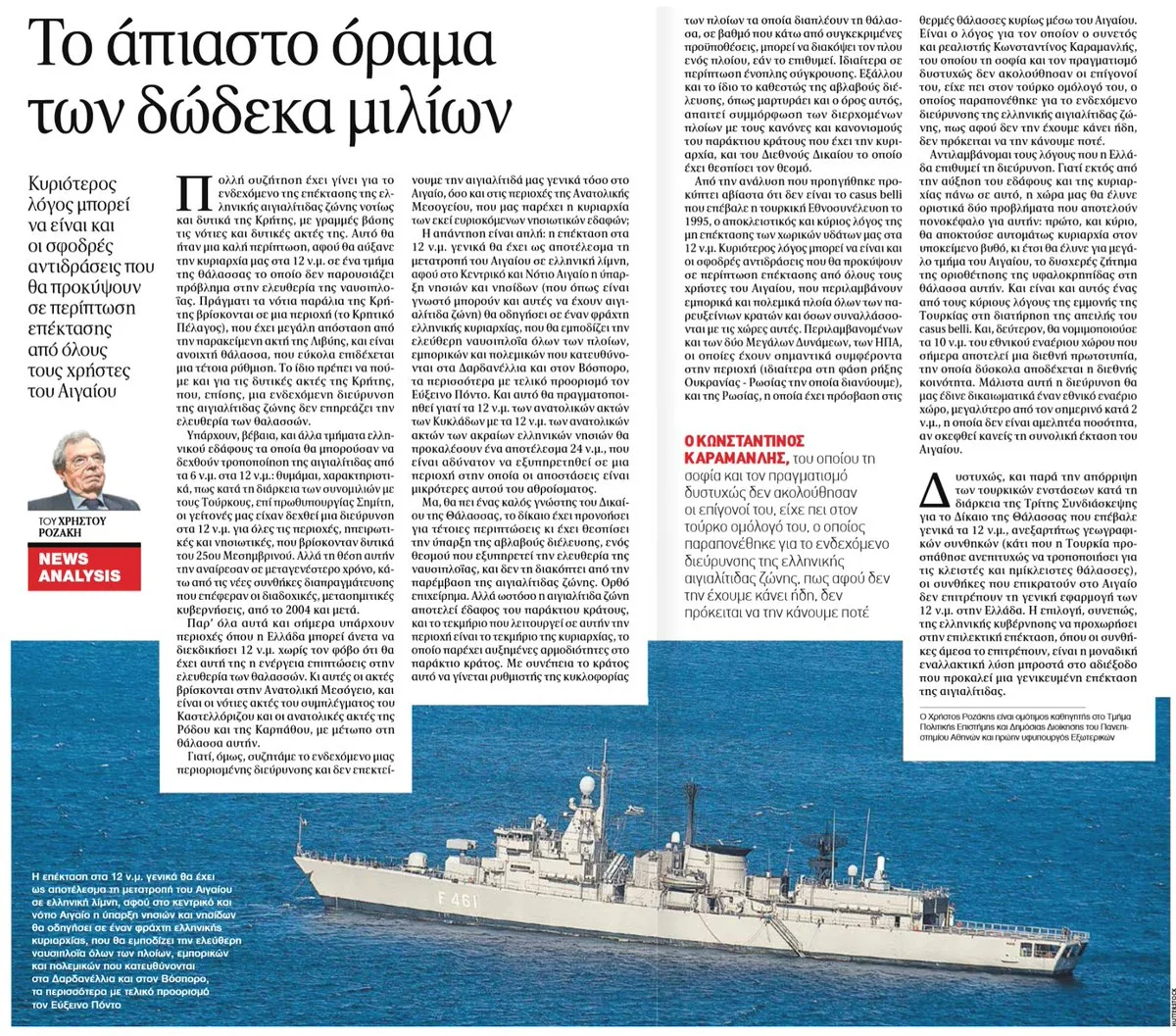
Christos Rozakis, professor emeritus at the University of Athens and a former deputy foreign minister, argued in Ta Nea on October 4 that Greece could extend selectively in areas where navigation would not be materially affected, including south and west of Crete and parts of the Eastern Mediterranean. He warned against a general extension across the central and southern Aegean.
Rozakis Warns of a "Greek Sovereignty Fence"
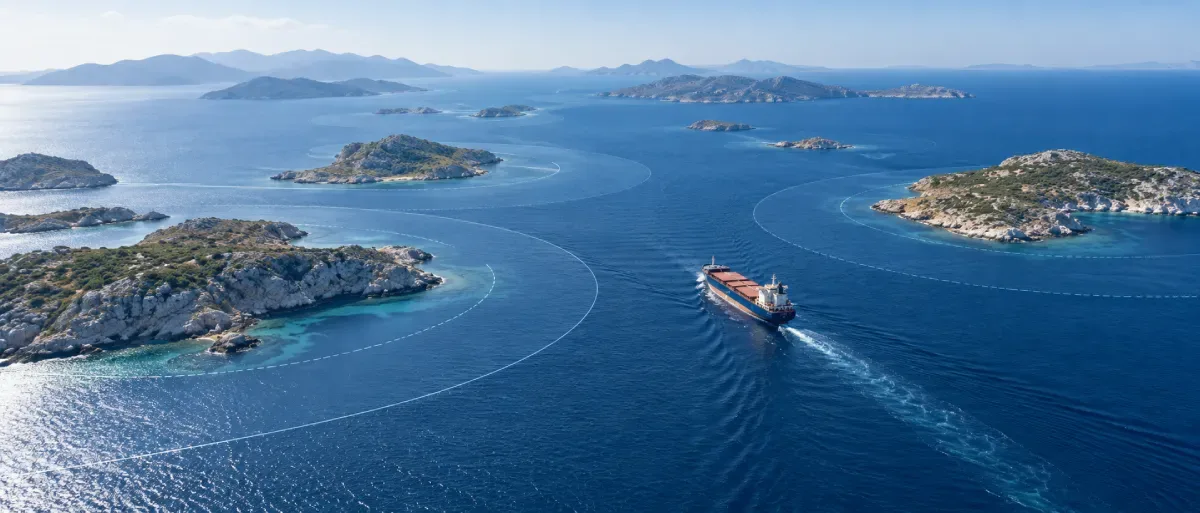
Rozakis argued that a blanket 12-nautical-mile extension could turn much of the Aegean into what he called a "Greek lake." With Greek islands and islets spread across the basin, he said overlapping territorial seas could create a "fence of Greek sovereignty" across routes used by commercial and naval traffic heading to the Dardanelles, the Bosphorus and the Black Sea.
Rozakis said objections would not necessarily be limited to Türkiye. He pointed to the United States, Russia and other maritime users that cross the Aegean before reaching the Turkish Straits and the Black Sea.
Rozakis acknowledged the right of innocent passage but emphasized coastal-state powers in territorial waters. Under Part II of UNCLOS, coastal states may regulate innocent passage. Article 25 allows temporary suspension in specified areas when essential for security, provided the suspension is duly published. Submarines exercising innocent passage must navigate on the surface and show their flag.
International straits can fall under a different regime.
The Counterargument Relies on Transit Passage
Greek lawyer Nikodimos Kallintieris, writing in Geopolitico on October 5, challenged Rozakis's reliance on ordinary innocent passage. He cited Part III of UNCLOS, which governs straits used for international navigation.
Articles 37 and 38 provide for transit passage through qualifying straits connecting one part of the high seas or an exclusive economic zone with another. Ships and aircraft enjoy navigation and overflight for continuous and expeditious transit, while Article 44 says states bordering such straits shall not hamper transit passage and that it cannot be suspended.
Transit passage allows ships to proceed in their normal mode and includes overflight. Submarines using innocent passage, by contrast, must surface. States bordering a transit-passage strait may regulate navigation safety, pollution and traffic separation, but those rules may not deny, hamper or impair transit passage.
Part III does not apply to every channel inside territorial waters. Article 36 excludes straits where a route through the high seas or an exclusive economic zone of similar convenience exists. Article 38 contains an exception for certain straits formed by an island and the mainland where a similarly convenient seaward route exists. Article 45 applies non-suspendable innocent passage to specified other international straits. The governing regime depends on the route.
Greece's Straits Declaration and Türkiye's 1995 Objection
Greece made an interpretative declaration on international straits when it signed UNCLOS in 1982 and confirmed it upon ratification in 1995. The declaration says that where numerous scattered islands form multiple alternative straits serving the same international route, the coastal state has a responsibility to designate the route or routes through which foreign ships and aircraft may exercise transit passage, while meeting international navigation, overflight and security requirements.
Türkiye objected in a notification registered with the United Nations on December 21, 1995. Ankara argued that Part III already defines the legal regime of international straits and rejected what it described as an attempt to create a separate category of alternative straits. The notification said the Greek interpretation could exclude some straits linking the Aegean and the Mediterranean from transit passage. Türkiye reserved its rights under international law.
Greece replied in a communication received by the United Nations on June 30, 1997. Athens said that because Türkiye had neither signed nor acceded to UNCLOS, the Turkish notification could have no legal effect. It rejected the Turkish allegations and said the Greek declaration did not create a separate category of international straits or circumvent the Convention.
The disagreement predates the current 12-mile debate. Greece's declaration sets out Athens' interpretation of transit passage among numerous islands. Türkiye's notification rejects that interpretation and the discretion it could give the coastal state.
Article 41 governs sea-lane and traffic-separation designation. Proposed sea lanes and traffic-separation schemes must conform to generally accepted international regulations and be referred to the competent international organization with a view to their adoption before designation. Where the waters of more than one state border a strait, the states concerned must cooperate in formulating proposals.
Territorial-Sea Breadth and Delimitation Are Separate Questions
Article 3 of UNCLOS allows a coastal state to establish a territorial sea up to 12 nautical miles. Greece says this right also reflects customary international law and has repeatedly said it will decide when and where to exercise it.
A 12-nautical-mile maximum does not resolve delimitation where opposite or adjacent coasts are less than 24 nautical miles apart. Article 15 provides that, absent an agreement to the contrary, neither state is entitled to extend its territorial sea beyond the median line, unless historic title or other special circumstances justify a different line.
Greece's Foreign Ministry says Article 15 reflects customary international law. It maintains that the equidistance or median-line principle applies from the Evros area south to Samos and Ikaria where no specific bilateral agreement exists, and that boundaries south of Samos between the Dodecanese and the Turkish coast are governed by the 1932 Italy-Türkiye instruments inherited by Greece. Türkiye's Foreign Ministry states more broadly that no territorial-sea delimitation exists between the two countries in areas of opposite and adjacent coasts.
Why the Percentages Change So Sharply
Both countries currently apply a six-nautical-mile territorial sea in the Aegean. Türkiye's Foreign Ministry calculates that Greek territorial waters now account for about 40 percent of the sea, Turkish territorial waters for less than 10 percent and roughly 51 percent remains high seas. Under a Greek extension to 12 nautical miles, Ankara says Greece's share would rise above 70 percent, Türkiye's would remain below 10 percent and the high-seas area would shrink to about 19 percent.
Those are Türkiye's published official figures, not a jointly agreed allocation. The change reflects the Aegean's island geography: territorial seas may be measured from islands as well as mainland coasts, subject to rules on baselines and delimitation where claims overlap.
Greece says its right to extend territorial waters follows from UNCLOS and customary international law. Türkiye is not a party to UNCLOS and rejects a unilateral Greek extension across the Aegean, citing the sea's geography and the distribution of islands.
The Legal Effect Goes Beyond Merchant Shipping
An extension would affect more than commercial shipping. Sovereignty over territorial sea extends to the airspace above it and to the seabed and subsoil below it. Navigation and overflight rights would then operate across a larger area under coastal-state sovereignty, subject to the passage regimes and other limits imposed by international law.
The 12-mile issue also sits alongside the two governments' wider disagreements over continental shelf claims, marine spatial planning and marine parks, where Athens and Ankara have already rejected each other's legal positions.
Rozakis focuses on the expansion of territorial sovereignty and coastal-state jurisdiction. Kallintieris focuses on the passage rights that remain where waters fall under coastal-state sovereignty.
A 12-nautical-mile extension would not eliminate international navigation rights by itself. Transit passage would continue in straits governed by Part III and could not be suspended. Article 45 preserves non-suspendable innocent passage in specified other international straits. Ordinary territorial waters remain subject to Part II. Article 15 separately addresses territorial-sea delimitation where opposite or adjacent coasts overlap.
The legal result depends on the location of each route, the type of strait involved and the applicable delimitation line. The Greek and Turkish filings placed on the United Nations record in the 1980s and 1990s already reflect that disagreement.
Sources: Ta Nea, Geopolitico, United Nations Convention on the Law of the Sea, United Nations Treaty Collection, Hellenic Republic Ministry of Foreign Affairs, Republic of Türkiye Ministry of Foreign Affairs, Bosphorus News review and reporting.