
By Bosphorus News Geopolitics Desk
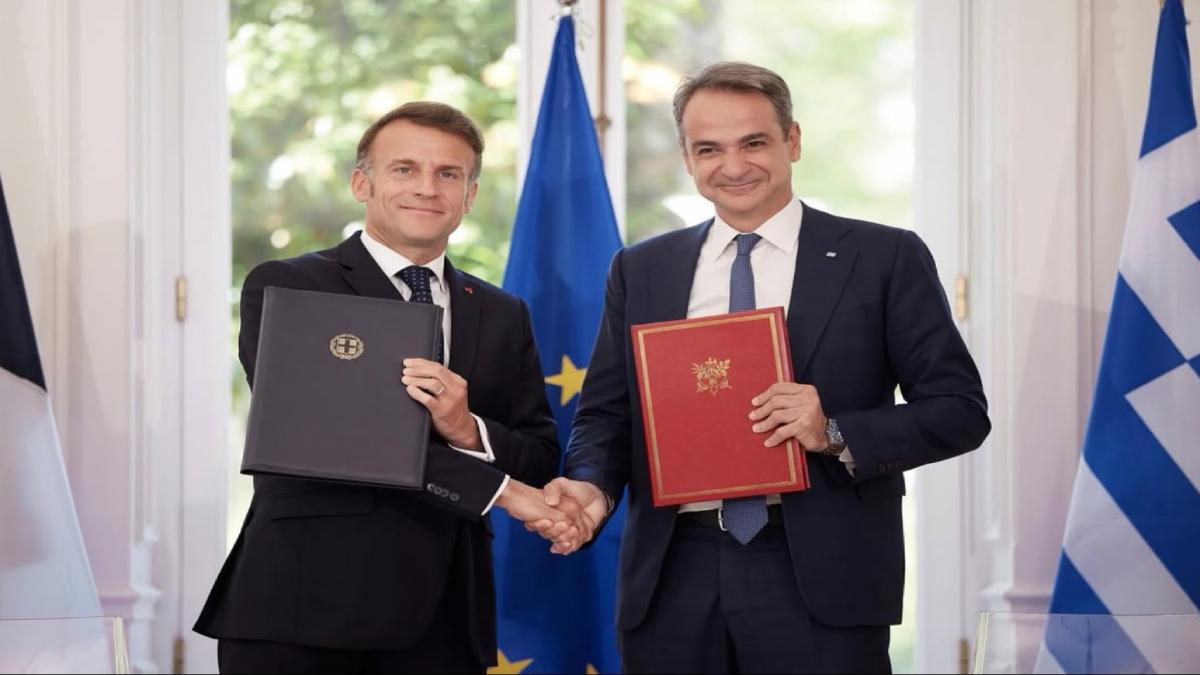
On April 27, in Athens, French President Emmanuel Macron and Greek Prime Minister Kyriakos Mitsotakis presented their defence coordination as part of NATO's European pillar, insisting that the European Union's push to expand its defence capacity is not designed to compete with the alliance but to reinforce it. The message was calibrated, but the operational picture it sits on tells a more complicated story for Türkiye.
The two leaders confirmed the renewal and deepening of the France-Greece defence pact, pointing to joint procurement, interoperability and mutual assistance commitments that have steadily expanded since the original agreement. Cyprus was implicitly folded into that framework, with references to regional stability and security cooperation across the Eastern Mediterranean, where European assets and coordination mechanisms have visibly increased over the past year.
This positioning reflects a broader European effort to build strategic autonomy without formally breaking from NATO structures. Yet the model emerging on the ground increasingly separates operational reliance from industrial participation. As detailed in Bosphorus News coverage of the widening EU-NATO defence gap., alliance planning continues to depend on Türkiye's military scale and geographic position, while EU-level defence financing and procurement mechanisms remain politically constrained, effectively limiting Ankara's access to the industrial layer of the same security architecture.
The debate echoes a question already raised in a recent Bosphorus News analysis on Türkiye's NATO role, which examined whether the country's expanding commitments across alliance missions risk stretching its own strategic priorities at a time when regional security demands are intensifying simultaneously across the Black Sea, Eastern Mediterranean and Middle East theatres.
Developments around Cyprus illustrate how this dual structure is taking shape. As previously covered by Bosphorus News, the island has been moving beyond its role as an energy hub toward a forward-positioned security node, hosting an expanding mix of European and US-linked military activity. This evolution intersects directly with the France-Greece defence axis, giving it a geographic anchor that extends beyond bilateral cooperation.
The alignment also fits into a wider regional pattern. As explored in Bosphorus News reporting on Greece, Cyprus and Israel coordination, defence and maritime security cooperation among these actors has deepened in parallel with Europe's push to consolidate its own security capacity. The France-Greece layer adds a European core to what had already been forming as a multi-node security network across the Eastern Mediterranean.
Macron's insistence that European defence is not an alternative to NATO is therefore less a reassurance than a framing choice. The structures now being built do not replace NATO, but they do reconfigure influence within it. For Türkiye, the issue is not whether NATO remains central, but how emerging European defence mechanisms reshape access, decision-making weight and long-term industrial participation inside that system.
Ankara's response has so far combined continued operational engagement with parallel diplomatic positioning. As outlined in Bosphorus News coverage of the Antalya Diplomacy Forum, Türkiye has sought to maintain its role as a central convening actor even as European security structures consolidate in formats where it is not fully included.
The result is a layered security environment in which Türkiye remains indispensable to NATO operations while facing structural limits within the European defence ecosystem that is being built alongside it.