
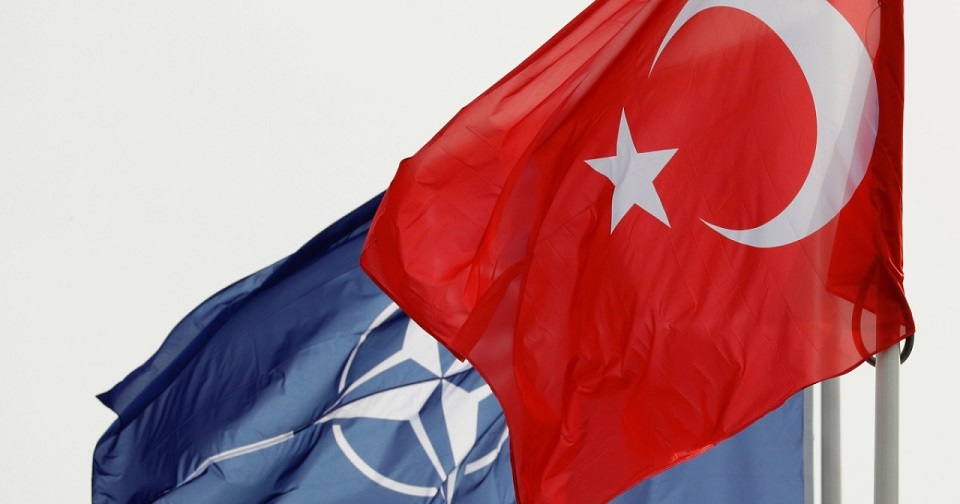
Türkiye's expanding role in NATO naval and air missions has increased Ankara's visibility within Europe's security architecture. Amphibious task force command, Black Sea mine countermeasures operations, and air policing missions along the Baltic and Black Sea corridors demonstrate operational capacity and alliance discipline.
Yet visibility is not strategy. The central question is not whether Türkiye contributes to NATO, but whether its security priorities remain aligned with the risks accumulating in its immediate environment.
Two Security Timelines Are Moving at Different Speeds
Türkiye's NATO commitments are structured around the alliance's eastern flank and collective defence logic. At the same time, the security environment in the Aegean and the Eastern Mediterranean is evolving along a separate and faster track.
Defence cooperation among Greece, Israel, and the Greek Cypriot administration has moved beyond episodic coordination. Joint exercises, defence procurement, training frameworks, and regularised political-military dialogue point to a security arrangement that is becoming durable. For Ankara, the problem is not symbolic exclusion but the quiet consolidation of a format in which Türkiye is structurally absent.
What was once provisional is being embedded.
In the Aegean, Statements Lag Behind Force Posture
In the Aegean, unresolved disputes are not stabilised. They are layered. The debate over extending territorial waters to 12 nautical miles, the militarisation of islands, and the expansion of military infrastructure now form a coherent pattern rather than isolated frictions.
What distinguishes the current phase is the clarity of intent on the Greek side. Foreign Minister George Gerapetritis has framed the issue in unambiguous terms, stating that Greece's maritime claims are "a core expression of sovereignty" and "not subject to negotiation," adding that Athens will act "within international law, when and where it deems appropriate."
This framing matters. It signals that the 12-nautical-mile issue is not a theoretical legal position but a kept-alive political option, reinforced by long-term planning.
The military dimension is equally explicit. Defence Minister Nikos Dendias has repeatedly underlined that the task of the armed forces is to ensure that "every inch of Greek territory and maritime space can be defended at all times." This doctrine has translated into sustained investment in island infrastructure, force posture adjustments, and interoperability with partners.
Athens has thus paired legal argumentation with material preparation. Türkiye's responses, by contrast, have largely remained declaratory. The issue is not tone or restraint, but sequence. Planning produces permanence; signalling does not.
Over time, the gap compounds.
Alliance Discipline Does Not Equal Regional Leverage
This divergence feeds a growing critique. Türkiye appears predictable, aligned, and task-oriented within NATO, yet increasingly reactive in its immediate neighbourhood.
Alliance credibility matters. But alliance credibility does not substitute for deterrence close to home. NATO contributions do not automatically convert into leverage in the Aegean or the Eastern Mediterranean. In practice, the two trajectories have begun to separate.
When Policy Outputs Miss Strategic Intent
At this stage, the issue can no longer be framed as abstract risk. What is becoming visible is a disconnect between policy design and strategic effect.
Türkiye's NATO-centric prioritisation has not counterbalanced shifts in its surrounding security environment. Instead, it has coincided with the consolidation of opposing military arrangements and the normalisation of Türkiye-excluding security formats.
This is not an argument about capacity or institutional weakness. Türkiye retains both. The problem lies in outcomes. Current policy outputs are not producing the strategic balance they were meant to secure.
When choices narrow rather than expand room for manoeuvre, the issue moves beyond risk management. It becomes a matter of prioritisation generating counterproductive effects.
A Question of Emphasis, Not Capability
Regional assessments followed by Bosphorus News point to a clear pattern. Türkiye's challenge is not insufficient power, but misplaced emphasis.
European security contributions matter only insofar as they reinforce deterrence in Türkiye's immediate environment. When that link weakens, influence inside the alliance grows while leverage at the periphery erodes.
As Türkiye concentrates its effort on alliance missions, its posture in the Aegean and the Eastern Mediterranean has become increasingly reactive, with developments in both theatres being shaped by others. Military planning, force posture, and coordination on Türkiye's periphery continue to advance, while Ankara's responses remain largely declaratory.
This reactive posture is not confined to the maritime domain. Frictions with Israel, the growing risk of physical confrontation in Syria, and the uncertainty surrounding Iran's regional posture are also reshaping Türkiye's security environment in ways that demand more than declaratory responses.
The Turkish side is not blind to these dynamics. Foreign Minister Hakan Fidan has explicitly warned that exclusionary alignments in the Eastern Mediterranean carry consequences if addressed too late:
"There are alliance formations being built in the Mediterranean, in the Eastern Mediterranean, against Türkiye. We see them, and we develop diplomatic measures in response. If you fail to develop diplomatic measures in time on certain issues, the matter is handed over to the military, to the security institutions, and more follows. That is why diplomatic measures must be taken in advance."
This warning is revealing. It acknowledges both the existence of emerging alliance structures and the cost of delayed sequencing. The emphasis is not escalation, but control. Once diplomacy lags, political management narrows and security policy shifts toward harder instruments.
This raises a more basic question. Is Türkiye responding adequately to the security challenges forming closest to its borders, or is it assuming that activity within NATO is sufficient to offset them?
At a deeper level, the issue concerns mandate and priority. Is the primary task of Türkiye's armed forces and diplomacy to protect the country's own security environment, or to serve the broader requirements of European and NATO security, even when the two begin to diverge?
How Ankara answers that question will determine not its standing within the alliance, but whether it retains the capacity to shape security outcomes in arenas that directly affect Türkiye itself.