
By Bosphorus News Geopolitics Desk
The drone strike on the British airbase at Akrotiri in early March triggered a rapid military response that initially looked contained and tactical. Within days, European air-defence, naval and counter-drone assets were positioned in and around Cyprus. The immediate aim was to protect installations and stabilise the airspace. What followed began to reshape the island's role in the Eastern Mediterranean.
Cyprus sits outside NATO's formal architecture, a structural reality that continues to shape every security response around the island. As explored in Cyprus NATO Membership any accession path remains constrained by political conditions tied to the Cyprus dispute and Türkiye's position. This gap defines how external actors operate. When threat pressure rises, responses do not move through NATO's collective system. They form through parallel coordination among European states acting without a single command structure.
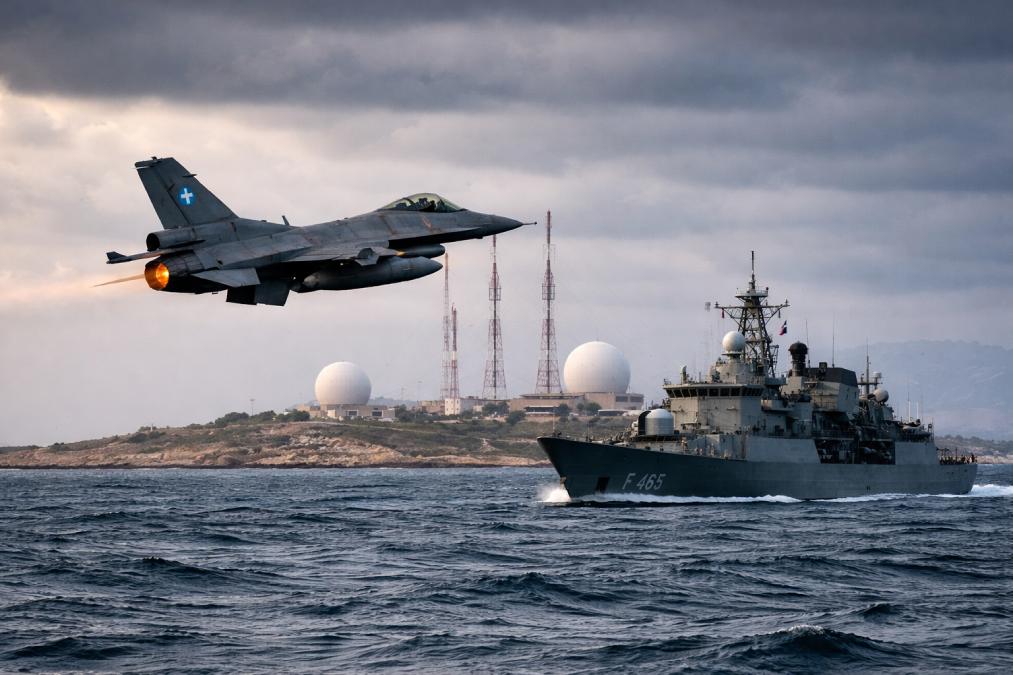
The deployments seen after the Akrotiri strike reflect that pattern. Air and naval assets have not been limited to point protection. They extend surveillance, interception and deterrence across a wider operational space. The shift is visible in the way missions are carried out. What began as base defence now operates closer to theatre-level coverage, linking airspace monitoring with maritime positioning across the Eastern Mediterranean.
This direction was already in motion before March. As outlined in How Cyprus Is Locking In Its Security Choices, Nicosia has been steadily deepening its defence alignment with European partners through structured cooperation and long-term planning. These steps point to a deliberate policy trajectory rather than a reactive posture. The current deployments have accelerated that trajectory and made it visible on the ground.
The same pattern appears in capability development. Reporting in Republic of Cyprus Strengthens Naval Capabilities Through EU SAFE Programme shows Cyprus embedding itself more directly into European defence frameworks through procurement and financing channels. This extends beyond short-term security needs and ties the island into longer-term planning cycles within Europe's defence ecosystem.
These strands now converge into a clearer picture. Cyprus is no longer only an exposed outpost on the edge of regional instability. It is being integrated into a forward defence logic that operates alongside NATO but does not depend on NATO's formal structure. Its geography makes this role functional. The island sits close to the Levant, key maritime routes and the air corridors through which drone and missile threats have increasingly travelled.
This evolving structure also changes how developments are interpreted in Ankara. The growing presence of foreign military assets is one part of the equation. More consequential is the formation of a security layer in which Cyprus functions as a platform for European coordination outside NATO's institutional framework. Each deployment, procurement decision and integration step reinforces that pattern and gradually anchors the island within a defence geography that is expanding toward the Eastern Mediterranean.
A dual-track structure is taking shape. NATO continues to define the formal architecture of the southern flank. Alongside it, a European security practice is emerging through crisis-driven deployments and longer-term integration centred on Cyprus. The boundary between the two is not fixed, but the direction is increasingly clear. As regional threat pressure persists, Cyprus is being repositioned from a passive fault line into an operational node within a European defence layer that sits adjacent to NATO rather than fully inside it.