
By Bosphorus News Geopolitics Desk
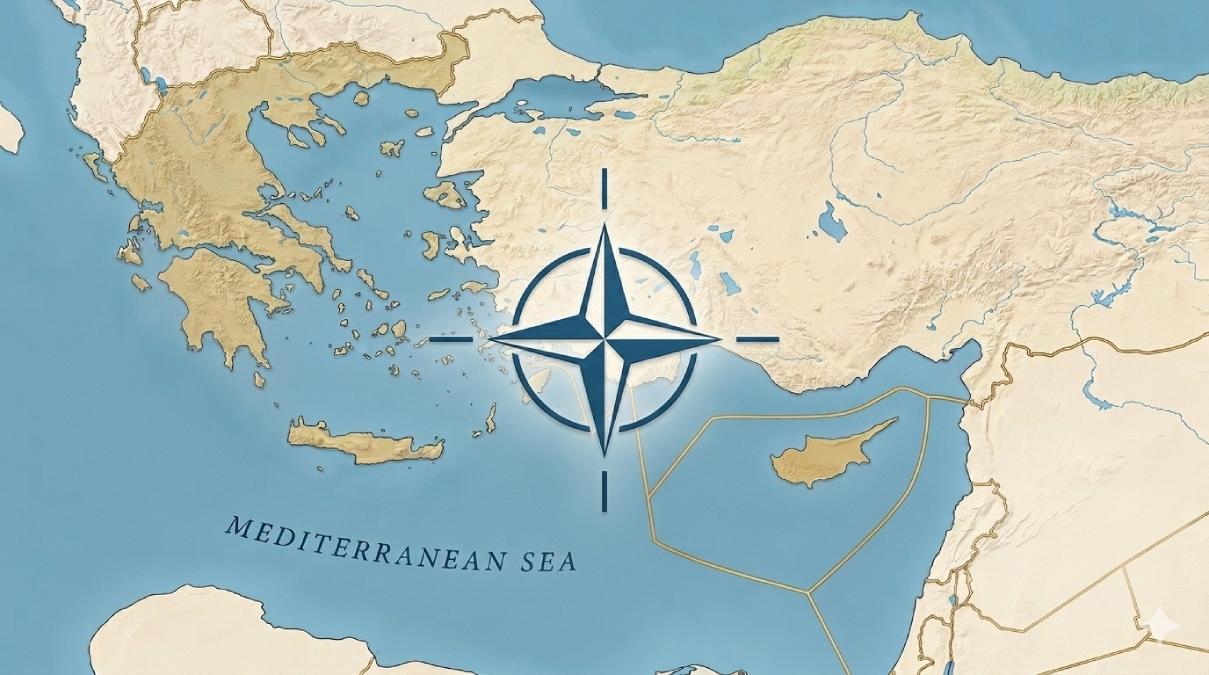
When Cypriot President Nikos Christodoulides told Greek television that his country would apply to join NATO "even tomorrow" if circumstances allowed, he was not announcing a new ambition. He was acknowledging a structural reality that has defined the island's security since 1974. "We can't right now," he said, "because the political circumstances are not in place given Türkiye's position." The frankness was striking. So was the timing: Christodoulides spoke as Iranian drones were targeting British bases on his island and European warships were sailing toward Cypriot waters to fill a security gap that NATO, as an institution, cannot fill for Cyprus.
1952 and what followed
Türkiye and Greece joined NATO in the same year, 1952, as the alliance sought to anchor its southeastern flank during the Cold War. For the first two decades the arrangement held, uneasily. The 1974 crisis broke it. Following a Greek-backed coup in Cyprus aimed at uniting the island with Greece, Türkiye conducted a military operation on the island under the 1960 Treaty of Guarantee, which recognised Türkiye, Greece and the United Kingdom as guarantor powers with the right to intervene. The operation resulted in the division of the island, with the northern third coming under Turkish Cypriot and Turkish military control, a status that has persisted ever since. Greece responded to the events of 1974 by withdrawing from NATO's integrated military command, a status it maintained until 1980. The return was not smooth. Türkiye resisted Athens' reintegration, contesting the terms of Greece's re-entry into the command structure, particularly the allocation of responsibilities over the Aegean. A compromise was eventually brokered, but it resolved nothing of substance. The files that generated friction in 1980 remain open today.
The unresolved Aegean
The disputes that defined Türkiye's resistance to Greece's NATO reintegration are the same disputes that generate friction today. Greece claims ten nautical miles of national airspace from its coasts, a position established by presidential decree in 1931 and maintained ever since. Türkiye has refused to recognise anything beyond six nautical miles since 1974, arguing that airspace boundaries must coincide with territorial waters boundaries under international civil aviation rules. The four nautical miles between these two positions is contested daily, with Turkish military aircraft regularly flying in that zone and Greek jets intercepting them, producing a continuous low-level confrontation between two NATO allies over the Aegean.
The territorial waters dispute carries even greater strategic weight. Both countries currently apply a six nautical mile limit in the Aegean, but Greece maintains that under the 1982 UN Convention on the Law of the Sea it is entitled to extend its territorial waters to twelve nautical miles. It has acted on that position in the Ionian Sea, extending to twelve miles in 2021, but has refrained from doing so in the Aegean. The reason is straightforward: in 1995 the Turkish parliament passed a resolution declaring any such extension a casus belli, a formal justification for war. The geometry explains the stakes. Under the current six mile regime, Greek territorial waters cover roughly 43 percent of the Aegean. An extension to twelve miles would bring that figure to approximately 71 percent, reducing Turkish access to international waters to a narrow corridor and effectively blocking Ankara's freedom of movement in the sea. Türkiye has held this line ever since, and Greece, while insisting on its claimed right, has chosen not to test it. The deployment of a Patriot battery to Karpathos this week, and Türkiye's formal protest of that deployment, is the same argument conducted in real time, under active conflict conditions.
The architecture of mutual blockage
Cyprus sits at the centre of a second layer of institutional deadlock that runs through both NATO and the European Union, in opposite directions. Türkiye does not recognise the Republic of Cyprus, maintains troops in the northern part of the island, and has used its NATO membership to block Cyprus from joining even the alliance's Partnership for Peace programme, a preparatory framework that links non-member states to the alliance through joint exercises and defence reform, and which served as a stepping stone for countries including Sweden and Finland before their full accession. Cyprus cannot access even this threshold because Türkiye, as a full NATO member, exercises a veto.
Within the European Union, the blockage runs the other way. Cyprus and Greece have used their EU membership to veto Türkiye's participation in SAFE, the Security Action for Europe programme launched in 2025 that allocates 150 billion euros for weapons procurement and defence infrastructure across member states and select partners. Greece has stated its position explicitly: as long as Türkiye maintains a 1995 parliamentary resolution declaring any Greek extension of territorial waters in the Aegean beyond six nautical miles a casus belli, Athens will not permit Ankara's participation. Nicosia has taken the same position. Two institutions, two vetoes operating in opposing directions, and a single underlying dispute that neither side has been willing or able to resolve.
The gap Iran exposed
The current conflict has made the consequences of this deadlock visible in a way that diplomatic communiqués cannot. Cyprus is an EU member state, the closest EU country to Lebanon and Israel, and it has been struck by Iranian-made drones. Cyprus has been an EU member since 2004, but that membership has not filled the security gap that NATO membership would close. The EU's mutual defence clause, Article 42/7 of the Lisbon Treaty, obliges member states to aid a fellow member under attack, but it carries none of the operational weight of NATO's Article 5. It has no integrated command structure, no standing rapid reaction force, and no automatic military trigger. The protection Cyprus has received this week did not flow from Article 42/7. It came from individual governments making individual decisions.
Greece's deployment was not an improvised show of solidarity. It was a formal defence decision taken by KYSEA, Greece's National Security Council, and it marked the first operational activation of the Greece-Cyprus Common Defence Doctrine since its establishment in the 1990s. The Kimon, Greece's most advanced frigate and the first of its new Belharra-class, sailed to Cypriot waters alongside the frigate Psara, while four F-16 Viper jets landed at the Andreas Papandreou Air Base in Paphos. For decades the Common Defence Doctrine existed largely as a deterrence signal. Its activation this week turned it into something operational.
Christodoulides was candid about one further frustration. He said there was open irritation in Nicosia over early British statements that appeared to downplay the possibility that the Akrotiri base could become a target. The remark pointed to a deeper tension: Cyprus hosts British sovereign base areas but has no formal say in how they are used, and found itself exposed to Iranian retaliation partly because of decisions taken in London without Nicosia's input. That asymmetry has sharpened the case, in Cypriot eyes, for the kind of institutional membership that would give the island a seat at the table rather than a role as host.
Christodoulides said his government is doing the preparatory work at the military, operational and administrative levels so that Cyprus will be ready to apply when political conditions allow. That work is not ceremonial. It is aimed specifically at raising Cyprus' interoperability with NATO standards, so that if the political obstacle is removed, the technical gap can be closed rapidly. The political condition that does not allow it is Türkiye's veto, and that veto rests on a dispute that both countries have been unable to settle since 1974, and that NATO has been unable to bridge since both joined the alliance in 1952.
Not everyone reads Nicosia's moves as defensive necessity. From Ankara's perspective, and from commentary in the Turkish press, Cyprus is using the cover of a regional war to accelerate a strategic realignment it has been pursuing for years, turning a security crisis into a membership campaign. The criticism has a point worth taking seriously: Cyprus is not a passive victim of circumstance. It is a government with a defined strategic objective, and the events of the past week have given it an opportunity to advance that objective faster than any diplomatic process would have allowed. Whether that constitutes opportunism or rational statecraft depends entirely on where one stands on the underlying dispute.
Türkiye's objection to Cypriot membership is not purely tactical. Türkiye is one of three guarantor powers under the 1960 Treaty of Guarantee, alongside Greece and the United Kingdom, a status that gives it the legal basis for its military presence on the island and a formal role in Cyprus' security arrangements. NATO membership for the Republic of Cyprus, which Türkiye does not recognise, would effectively render that guarantor role redundant, replacing a trilateral framework in which Türkiye has a seat with an alliance structure in which Cyprus would be the member and Türkiye the obstacle. The position of Turkish Cypriots, whose political status and rights remain unresolved since 1974, is a precondition Türkiye has consistently attached to any settlement, and Nicosia's membership agenda addresses none of it. That position was not formed in response to the current crisis. In November 2024, Türkiye's Ministry of National Defence stated that even the attempt to pursue NATO membership was unacceptable, warning that such a move would upset the delicate balance in the Cyprus issue and damage prospects for negotiation.
The warships now anchored off Limassol, the jets on the runway at Paphos, the Patriot battery on Karpathos, the carrier group in the Eastern Mediterranean: none of this resolves what 1974 left unfinished, what 1980 papered over, or what fifty years of diplomacy has failed to close. The Iranian strikes did not create this problem, they simply made it impossible to look away.