By Murat Yıldız
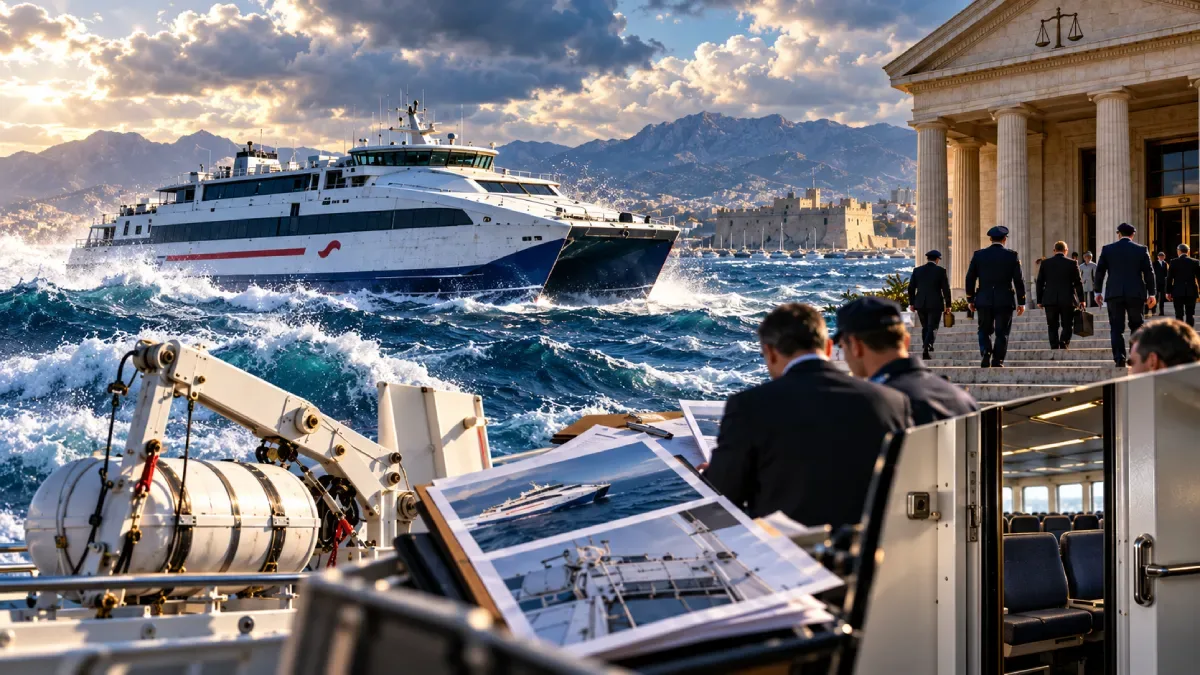
Filo Jet crew members discussed locking passenger-saloon doors in rough weather, a missing life-jacket instruction video and faults in equipment used to lower liferafts, according to police testimony at Kyrenia District Court on October 30. The conversations were recorded before the high-speed catamaran sank off northern Cyprus on August 30.
The ferry had left Kyrenia for Taşucu with 267 people aboard. By October 30, 27 bodies had been recovered and three-year-old Anni Asel Hilaloğlu remained missing. At the tenth hearing, the court extended the detention of nine suspects, including the master, crew members and a company director, by another seven days.
Passenger Evacuation Under Scrutiny
Assistant Police Inspector Mehmet Mannaş described a July exchange recovered from the vessel's voyage data recorder (VDR). In the account published by MYK Haber on October 30, the master asked whether the saloon doors had been locked again. A crew member replied that they had, explaining that passengers moved around when the weather worsened.
Police were examining that exchange closely because passengers had said the doors were closed on the day of the sinking, MYK Haber reported. The passengers' account concerns August 30, but closed doors are not necessarily locked doors, and the published testimony does not establish whether those exits could be opened during the evacuation. BRTK reported Mannaş's view that more passengers might have survived had the doors been open. No published reconstruction has established how the saloon doors affected the loss of life.
Watertight compartment doors are a separate part of the inquiry. At the October 2 hearing, police said suspects had acknowledged leaving those doors open before departure. Mannaş told the court that closing them might have slowed water spreading between compartments and allowed more time to evacuate. The saloon-door conversations concern passenger access; the watertight-door evidence concerns flooding inside the hull. The available evidence does not establish how either set of doors affected the loss of life.
Crew members also complained that a requested video explaining how to use life jackets had never been produced. One said passengers should be able to watch it in an emergency. The conversation does not establish whether other safety instructions, demonstrations or announcements were given during the final voyage.
Accounts of the October 30 hearing describe another July conversation about water entering the motor or electrical unit used to lower liferafts. The available reports do not establish whether the fault was repaired, whether the system worked on August 30 or whether it affected the evacuation.
The second officer also complained in a recording disclosed on October 30 that bad weather was approaching despite a scheduled sailing. The report does not tie that exchange to the August 30 departure. Earlier police testimony described passengers warning the master on a previous crossing that the ferry was taking on water and asking him to turn back.
An Earlier Impact and the Hull's Repair History
At the October 16 hearing, police recounted a recorded conversation suggesting the ferry had struck something in the Yumurtalık area under a previous master. The account gave no verified date, exact location or damage assessment. Investigators have not publicly connected that reported incident to the sinking or to any particular repair.
Police had already presented photographs dated June 17, discussed at the September 18 hearing, that reportedly showed makeshift work on the ferry's forward port-side structure. The photographs postdate the June 2 Türk Loydu annual survey, but they cannot establish when the damage occurred, whether it existed during that inspection or whether the repair was adequate. Police said the images had been sent to the master and a company representative. They were examining whether the damage and repair had been reported to the Ports Department.
A different crew conversation, also described at the October 16 hearing, concerned a steering failure the previous year and an approaching vessel said to have come within 200–300 metres. Bosphorus News has not received navigation records corroborating that distance. The reported near-collision and the Yumurtalık impact remain separate incidents in the available accounts.
Bosphorus News's earlier examination of registry, clearance and insurance records also identified an Istanbul commercial-court judgment referring to 29 deficiencies in Türk Loydu material from 2018. Those findings cannot establish the ferry's condition in August 2026. The available documents do not establish how those earlier deficiencies were addressed.
The June Survey and Departure Documents
Bosphorus News obtained part of Filo Jet's class certificate before a fuller release by Erhan Arıklı, then the Turkish Cypriot transport minister. The complete certificate records an annual survey at Taşucu on June 2, 2026, and class validity extending beyond the sinking, subject to the requirements for retaining class. It contains no survey findings, list of corrective work or outstanding conditions of class. The certificate refers to a separate Ship Status Report for those details, which Bosphorus News has requested but not received.
The documents released after the disaster include a Turkish Cypriot endorsement based on the master's Honduras-issued certificate. They do not include the separate craft-and-route type rating described in the applicable High-Speed Craft Code. The released documents therefore do not establish whether that rating was issued.
A Turkish Cypriot parliamentary investigation committee was established on September 10 and met on September 23, September 29, October 7 and October 13. Parliamentary announcements and public-service reports identify acting Gazimağusa chief pilot and port officer Kemal Yapıcı among those heard at the last three meetings, alongside police, meteorological and maritime personnel. The published announcements confirm who attended but provide neither full testimony nor committee findings.
At the October 30 hearing, Mannaş also said Kemal Yapıcı, a Ports Department official, had boarded and inspected the ferry before the accident, according to MYK Haber. The published account gives no date, scope or findings for that inspection, or whether it formed part of the final departure clearance.
Neither the publicly reported committee sessions nor the court hearings have disclosed the June survey findings, the complete repair history or the final departure file. Police told the court in September that the ferry's papers had been checked and were in order. That account does not identify the survey observations, the work checked after June 2 or the official who authorized departure following the initial hold at Kyrenia.
Bosphorus News first wrote to Turkish Cypriot maritime authorities and Türkiye's maritime administration on August 30, then sent further questions to those bodies, Türk Loydu and Filo Denizcilik on August 31. None had replied when Bosphorus News published its October 28 investigation. No later response has been confirmed for this update. The requests sought the Ship Status Report, class conditions and repairs, craft-and-route qualifications, insurance or financial security, weather assessments and the record of who cleared the final sailing.
The Honduras Conversation and the Silent Recorder
Police also described a recorded conversation about obtaining a Honduran maritime qualification for payment. BRTK reported a $3,000 figure in an exchange involving a person sought by investigators. Other accounts attributed the remarks to the master and gave the sum as $3,500. They do not establish whether any payment took place or which document the crew members were discussing.
Bosphorus News has verified the Honduras-issued certificate and Turkish Cypriot endorsement among the papers released after the disaster. Nothing in the reported conversation establishes that the released certificate was improperly obtained. The master's separate craft-and-route qualification remains undocumented in the material made public.
Police previously told the court that the VDR's bridge audio stopped on August 28, two days before the sinking. No public finding explains the interruption. At the October 30 hearing, Mannaş said investigators had examined 48 days of recordings and still had roughly 20 days to review, according to BRTK and MYK Haber. Earlier reports gave the total recording period as 66 days, with some accounts citing 68. The published accounts do not explain the difference.
The court reports describe selected conversations through police testimony. The recordings themselves have not been made public, and no full transcript has been released. Investigators also recovered evidence of an August 28 email sent by the second officer to four company representatives. Earlier hearing accounts said it appeared to have been opened, but its contents could not be retrieved. Who, if anyone, opened it, what it contained and whether it concerned the last voyage remain unknown.
Mannaş told the court on October 30 that two academics in northern Cyprus, one a master mariner and the other a marine engineer, had been assigned to prepare an expert report on the sinking. Separately, four specialists had been selected from a list for a delegation from Türkiye, with correspondence about their dispatch still under way, according to MYK Haber. BRTK reported that the delegation was expected to assess the existing findings. Investigators were also examining recovered vessel fragments. Outside the courthouse, relatives of those lost renewed their calls for accountability, Türk Ajansı Kıbrıs and BRTK reported.
Police have presented the court with crew conversations about faulty equipment, locked passenger doors and earlier damage. Yet the June survey findings and final departure records remain undisclosed. Without them, it is still unclear what the authorities knew about Filo Jet's condition before allowing it to sail on August 30.
Sources: BRTK, Türk Ajansı Kıbrıs, MYK Haber, Bugün Kıbrıs, Türk Loydu documentation, Bosphorus News review and reporting.