
By Bosphorus News Geopolitics Desk
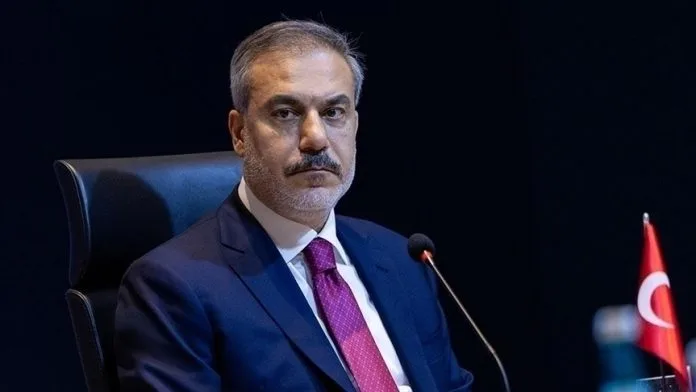
Foreign Minister Hakan Fidan told reporters in El Alamein on August 14 that Greece, Cyprus and Israel had built a security partnership aimed at Türkiye before Ankara signed its own defense pact with Saudi Arabia and Pakistan. "Before we signed our own alliance, Israel, the Greek Cypriot administration and Greece came together and created a security alliance in the Mediterranean," he said, standing alongside Egyptian Foreign Minister Badr Abdelatty. He argued the trilateral had tried to draw a line through the Eastern Mediterranean, with Türkiye on one side and Egypt on the other.
It was not a new line. Fidan made nearly the same claim in April at the Antalya Diplomacy Forum, saying Muslim countries in the region were concerned about the same three-way partnership and that no one had offered Ankara assurances it wasn't directed against Türkiye.
Egypt itself has endorsed neither framing. Abdelatty said Cairo was still studying the Mecca Pact "from legal and constitutional perspectives" before deciding whether to join, according to Egypt's state-run Al-Ahram. Fidan, for his part, called the agreement a "historic moment" that "does not target any party" and said Türkiye hoped Egypt would sign on.
The Contradiction Ankara Hasn't Answered
Bosphorus News examined this framing in May, when Fidan first described the network as an "anti-Islam alliance." The label sits uneasily next to the record. Egypt has trained alongside Greece, Cyprus and Saudi Arabia in the MEDUSA naval exercises since 2024. The UAE signed a defense cooperation agreement with Greece in 2020 and with Cyprus in 2021. Saudi Arabia has appeared in Greece's INIOCHOS air exercises alongside Qatar and Jordan. Kazakhstan and Cyprus opened reciprocal embassies in 2025, and Uzbekistan held political consultations with Nicosia in 2024, even as Ankara pushes for greater recognition of the Turkish Republic of Northern Cyprus within the Turkic world. If the Greece-Cyprus-Israel network were built against Muslim states, much of the Muslim world is either unaware of it or working with parts of it anyway.
Athens Pushes Back, Quietly Recalculates
Kathimerini, one of Greece's leading dailies, reported that the Mecca Joint Defense Agreement caused genuine unease in Athens, coming despite years of Greek outreach to Riyadh. Greek officials told To Vima they read the pact as an expected move given the fluid situation with Iran rather than a surprise shift, and pushed back on the idea that Greece was reacting out of fear. "Greece does not define itself in relation to others," officials said, adding that it remains the country with the strongest ties to Middle Eastern states.
The recalculation is visible in specifics rather than rhetoric. Greece's Patriot missile battery protecting Saudi energy infrastructure, deployed since 2021 and previously reviewed annually, will now be reassessed monthly, according to Kathimerini. Athens is also reported to be preparing to send Apache attack helicopters to Saudi Arabia, expanding rather than scaling back its Gulf footprint even as opposition parties call for the Patriot system's withdrawal.
Jerusalem Splits Between Caution and Hawkish Commentary
Israel's response separates into two distinct tracks that should not be read as the same thing. A Jerusalem Post editorial on August 10 treated the Mecca Pact as a serious complication for Saudi-Israel normalization, warning that a defense partnership with countries whose leaders speak of military unity against Israel "will inevitably cast a shadow" over that process, while urging Jerusalem to keep the door to Riyadh open.
Separately, opinion writers pushed further. Dr. Oshrit Birvadker, a senior fellow at the Jerusalem Institute for Strategy and Security, wrote in Israel Hayom that Türkiye now poses a threat "no less significant than Iran" and called for Israel to lean on its existing Mediterranean partnership with Greece and Cyprus while building a parallel axis with the UAE and India. In a separate Jerusalem Post opinion piece on August 14, strategy consultant Shay Gal described the Greece-Cyprus-Israel triangle as institutionalized through a 2026 military work plan and a planned joint rapid-response force, and floated a named contingency for confronting Turkish forces if Ankara "weaponizes" northern Cyprus. Neither piece reflects a stated Israeli government position.
The Architecture Behind the Rhetoric
The partnership Fidan describes has a real institutional footprint. In June, Greece, Cyprus, Israel and the United States launched the Eastern Mediterranean Energy Center at Rice University in Houston, part of what officials call a "3+1" framework covering energy security, offshore gas and infrastructure protection. The three Mediterranean states are also advancing the Great Sea Interconnector, an electricity link Washington increasingly views as part of a wider corridor tying the Eastern Mediterranean to the India-Middle East-Europe Economic Corridor.
Türkiye has cast that architecture as containment. Fidan has offered no evidence beyond the absence of assurances to the contrary, and Greek officials describe their posture as continuity rather than confrontation. Egypt, the country Fidan places on the other side of his line, has yet to say which side it stands on.
Sources: Cyprus Mail, To Vima, Kathimerini, Greek City Times, The Jerusalem Post, Israel Hayom, Al-Ahram Online, Anadolu Agency, Bosphorus News review and reporting.