
By Murat Yıldız
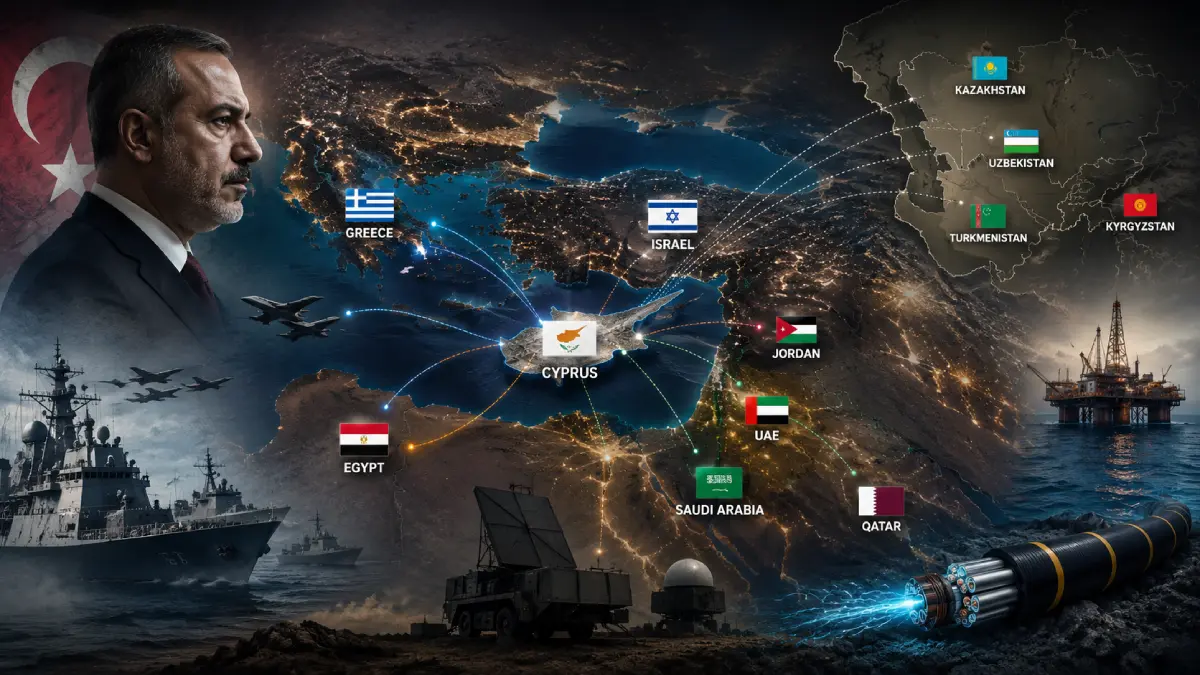
Hakan Fidan's warning about an "anti-Islam alliance" in the Eastern Mediterranean captured Ankara's alarm over the military cooperation linking Israel, Greece and Greek Cyprus. It also exposed a contradiction Ankara has not answered. If that architecture is directed against Muslim countries, why have Egypt, the United Arab Emirates, Saudi Arabia, Qatar and Jordan built defence, energy and maritime links with Greece and Cyprus?
The problem now reaches beyond the Arab world. Ankara has worked for years to give the Turkish Republic of Northern Cyprus greater visibility in the Turkic world. Yet Central Asian Turkic states are upgrading diplomatic and economic ties with the Republic of Cyprus. That does not make them hostile to Türkiye. It shows that Ankara's language is no longer strong enough to organise the map it wants others to see.
Fidan is not wrong to identify a military architecture. In remarks published by the Turkish Foreign Ministry, he said Greece, Israel and Southern Cyprus were deepening military cooperation in the Eastern Mediterranean, with joint exercises, air defence coordination, intelligence sharing and base usage increasingly coming to the fore. Ankara has reason to watch that structure closely.
But the alarm and the label are not the same thing. "Anti-Islam alliance" may capture Ankara's anger. It does not explain why Arab Muslim-majority states and Turkic governments are engaging with pieces of the same Greece-Cyprus network.
Egypt built the military backbone
The clearest contradiction begins with Egypt.
The Greece-Egypt military relationship has grown for years through the MEDUSA exercise series, which moved from bilateral naval and air training into a wider Greece-Cyprus-Egypt platform. By 2024, MEDUSA 13 brought together Greece, Egypt, Cyprus, France and Saudi Arabia in Crete and the Aegean Sea. Egyptian media reported the participation of air, naval and special forces, while Bahrain and Morocco appeared among observer countries.
That progression matters because MEDUSA is no longer a narrow drill between two militaries. It has become a recurring Eastern Mediterranean security platform, placing Greece and Cyprus in regular operational contact with Egypt and Gulf actors.
Cairo's motives are not religious. They are strategic: Libya, maritime security, energy, regime stability and Eastern Mediterranean gas. Egypt can work with Greece and Cyprus in one file, manage ties with Israel in another, and seek a working relationship with Türkiye when necessary. That is not ideological confusion. It is statecraft.
Abu Dhabi opened the Gulf layer
The UAE made the Gulf dimension more explicit.
On 18 November 2020, Greece and the United Arab Emirates signed an agreement in Abu Dhabi on joint foreign policy and defence cooperation. The agreement is registered in the United Nations Treaty Collection, giving it formal weight beyond diplomatic rhetoric. The Greek Prime Minister's Office said at the time that the partnership included a high-level committee and defence collaboration.
Cyprus followed with its own UAE defence channel. In January 2021, Nicosia and Abu Dhabi signed their first military cooperation agreement, with Defence News reporting that it covered joint military manoeuvres, training programmes and consultations on operational cooperation.
This is one of the central pieces of the puzzle. The Republic of Cyprus is not merely an appendix to Greece. It is building its own Gulf-facing security links, and those links are being built with a Muslim-majority Arab state.
Saudi Arabia made the cooperation operational
Saudi Arabia adds another layer because the relationship is not limited to summits and exercises.
Riyadh has participated in the MEDUSA framework, including later editions involving Greece, Egypt, Cyprus, France and Saudi forces. In 2025, Saudi Arabia's official news agency reported Royal Saudi Naval Forces participation in MEDUSA 14 in Egypt, while Egypt's Defence Ministry described a main phase attended by the military leadership of Egypt, Greece, Cyprus, Saudi Arabia and France.
This is operational maritime training, not symbolic diplomacy. Scenarios reported around MEDUSA 14 included naval infrastructure protection, anti-submarine operations, asymmetric warfare, speedboat attacks, sea landings and helicopter landings.
Saudi Arabia has also appeared in Greece's INIOCHOS air exercise environment. INIOCHOS 2023 included Saudi Arabia and Jordan alongside Greece, Cyprus, the United States and European participants. INIOCHOS 2024 brought Qatar and Saudi Arabia into the same Greek-hosted training picture.
If the Eastern Mediterranean architecture is simply an anti-Islam front, Riyadh's visible participation in these military formats becomes impossible to explain without admitting that states in the region are not using Ankara's vocabulary to define their own interests.
Qatar and Jordan widen the map
Qatar should be treated with care. Its role is more limited than Egypt, the UAE or Saudi Arabia, but it is not absent. Qatar appeared in INIOCHOS 2024, and in April 2026 Greece and Qatar agreed to deepen trade, energy and defence ties, according to Reuters. Doha's logic is more about diversification, energy diplomacy and multiple channels into Europe than about a fixed regional camp.
Jordan is different again. Its value lies less in hard military integration and more in corridor politics, regional stability and the Greece-Cyprus-Jordan trilateral mechanism. The 2026 Amman summit highlighted secure trade routes, transport infrastructure, maritime corridors and regional stability, language shaped by Red Sea disruption, Hormuz risk and the search for safer East-West connectivity.
The map has moved beyond classic Eastern Mediterranean rivalry. It now stretches into energy, logistics, air defence, ports, cables and maritime security. That wider map is exactly where the "anti-Islam" label begins to fail.
The Turkic layer Ankara cannot easily explain
The contradiction does not stop with Arab states. It reaches into the Turkic world, where the diplomatic picture is even more uncomfortable for Ankara.
Türkiye has pushed for the Turkish Republic of Northern Cyprus to gain greater visibility in the Organization of Turkic States. That effort produced symbolic gains, including observer status. Central Asian Turkic states, however, have not turned Ankara's Cyprus policy into their own diplomatic position.
Kazakhstan and Cyprus opened reciprocal embassies in 2025, a step described by the Cypriot side as an important milestone in bilateral relations. Uzbekistan held political consultations with the Republic of Cyprus in Tashkent in July 2024, with participation from economic, investment and tourism bodies. Turkmenistan and Kyrgyzstan have also maintained official diplomatic channels with Nicosia.
This does not mean Central Asian Turkic governments are turning against Türkiye. That would overstate the case. It means they are pursuing their own foreign policies, especially as EU-Central Asia ties deepen. They can value Türkiye, participate in Turkic platforms and still maintain formal relations with the Republic of Cyprus under the existing international framework.
This is the harsher lesson for Turkish diplomacy. The issue is no longer only why Arab states cooperate with Greece and Cyprus. It is also why Turkic states are unwilling to turn Ankara's Cyprus position into their own diplomatic line.
Cyprus is becoming a hub
Cyprus must therefore be read as more than a Greek partner in the Eastern Mediterranean.
Nicosia has built defence links with the UAE, energy links with Egypt, trilateral diplomacy with Jordan, maritime and military channels with Lebanon, and formal diplomatic pathways with Central Asian states. Cyprus is also positioning itself as an evacuation hub, an energy connector, an EU-Arab interface and a logistical node between Europe and the Levant.
None of this erases Türkiye's concerns over the militarisation of the island or the Greece-Cyprus-Israel axis. It does show that the Republic of Cyprus is becoming embedded in a wider network than Ankara's language sometimes allows.
Energy reinforces the same pattern. The Greece-Egypt GREGY electricity cable, Cyprus-Egypt gas frameworks, the Great Sea Interconnector and maritime corridor discussions all point to a region where infrastructure and security are increasingly fused. Subsea cables, LNG flows, offshore gas, evacuation routes and naval protection now belong to the same strategic conversation.
What Fidan gets right, and what Ankara misses
Fidan's warning identifies something real. Greece, Cyprus and Israel are deepening military habits. Joint exercises, air defence coordination, intelligence sharing and base access are not minor developments. Ankara would be negligent if it ignored them.
The difficulty lies in the vocabulary. "Anti-Islam alliance" captures anger more effectively than it explains the map. Egypt, the UAE, Saudi Arabia, Qatar and Jordan are not behaving as if Greece and Cyprus are untouchable members of an anti-Muslim front. Central Asian Turkic states are not behaving as if diplomatic ties with the Republic of Cyprus are incompatible with Turkic identity.
The contradiction is now too large to hide behind vocabulary. If the Greece-Cyprus-Israel axis is an "anti-Islam alliance," then Egypt, the UAE, Saudi Arabia, Qatar and Jordan are either blind to it or choosing to work with parts of it anyway. Neither reading helps Ankara.
The Turkic layer is even more uncomfortable. Central Asian Turkic states have not converted Ankara's Cyprus policy into their own diplomatic line. They have kept the Turkish Republic of Northern Cyprus inside symbolic Turkic language, while building formal state-to-state relations with the Republic of Cyprus. That is not a minor nuance. It is a diplomatic failure for Türkiye's Cyprus strategy.
Fidan is right that a military architecture is forming in the Eastern Mediterranean. But the "anti-Islam alliance" label does not explain why Arab Muslim-majority states are inside the wider security map, nor why Turkic governments are deepening ties with Nicosia. The label may serve domestic politics. It does not survive contact with the regional record.
Türkiye's problem is not that Greece and Cyprus are building networks. States do that. Türkiye's problem is that its own language increasingly describes the world it wants to see, not the world its rivals are successfully organising.