
By Bosphorus News Defense Desk
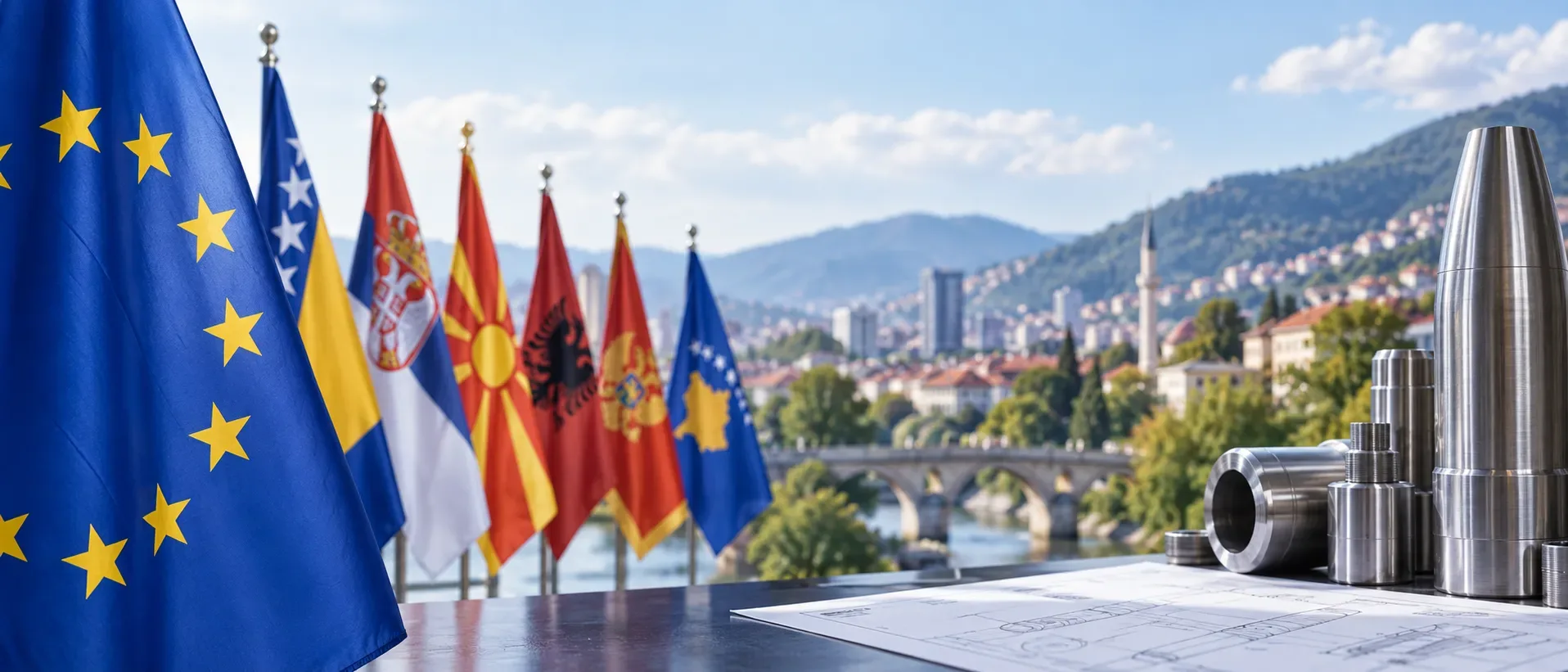
On Sept. 4, EU Special Representative Luigi Soreca told the Sarajevo Security Conference that more than 200 defense companies across the Western Balkans can produce ammunition compliant with NATO standards. He said much of that capacity is concentrated in Bosnia and Herzegovina and Serbia.
But the industrial map does not match the EU's political and security relationships across the region. Serbia is one of the two production centers Soreca singled out, yet it has no bilateral European Peace Facility assistance package. Kosovo scarcely appears in the production discussion; its security framework rests instead on EULEX, NATO-led KFOR and the Belgrade-Pristina dialogue.
At the Sept. 4-6 conference, Soreca argued that the Western Balkans should move from being "security beneficiaries" to security contributors. Ammunition production was only part of the picture. He also pointed to defense supply chains, cyber networks, dual-use infrastructure and participation in EU missions.
The approach extends a trend already visible in Europe's defense and security policy toward the Western Balkans.
Europe's annual ammunition production capacity, Soreca said, is now six times what it was three years ago. He also cited joint procurement and the EU objective of sourcing at least half of defense equipment from European suppliers.
Some of the production capacity Brussels is looking for is already in the Balkans.
Bosnia's Defense Industry Already Supplies NATO Markets
Bosnia and Herzegovina has one of the region's established defense industries.
Binas in Bugojno, BNT in Novi Travnik and Pretis in Vogošća are among its main manufacturers. Defense Minister Zukan Helez visited all three on Aug. 6 with NATO Headquarters Sarajevo commander Brig. Gen. James C. Fowler.
Helez said Bosnian production had moved from what he called the old "eastern variant" toward NATO standards. He also said more than 80 percent of the sector's exports now go to NATO member states.
The export figure comes from Helez rather than an independently published trade breakdown. The factory visits, however, show the industrial base behind Soreca's remarks.
"NATO standard" does not imply NATO membership. It refers here to specifications, codification, compatibility and interoperability that allow ammunition and equipment to enter logistics systems used by NATO militaries.
Bosnian factories do not have to wait for the country's political accession process to move at the same pace.
Serbia Has Industrial Weight Without the Same EU Alignment
Serbia is harder to fit into the same institutional pattern.
Soreca named it with Bosnia as a center of NATO-compatible ammunition production. Serbia also has a National Codification Bureau certified at Tier 2 in the NATO Codification System, allowing Serbian military products to be codified within that logistics framework.
Serbia remains militarily neutral.
It also has no bilateral EPF assistance package comparable to those approved for Albania, Bosnia and Herzegovina, North Macedonia and Montenegro. Its connection to the facility includes participation in the regional Balkan Medical Task Force.
Foreign-policy alignment with the EU varies by issue. Belgrade joins some EU positions but continues to stay outside others, most notably sanctions against Russia.
So one of the Western Balkans' largest defense-industrial bases is potentially useful to European rearmament without being matched by equivalent political alignment with Brussels.
Serbia's defense industry may therefore move closer to European supply chains faster than its political relationship with the EU.
Kosovo's Security Link Runs Through EULEX and KFOR
Kosovo follows another route.
Soreca did not identify it among the region's principal ammunition-production centers. Nor does Kosovo have a bilateral EPF package comparable to those given to four neighboring Western Balkan partners.
Its European security relationship is nonetheless extensive.
EULEX is the EU's largest civilian Common Security and Defence Policy mission. NATO-led KFOR provides the military security presence. Relations with Serbia remain under the EU-facilitated Belgrade-Pristina dialogue.
In April, the chairs of the NATO and EU Military Committees travelled together to Pristina and Sarajevo. NATO described KFOR and EUFOR Althea as complementary parts of the two organizations' regional engagement, a linkage examined in the Bosphorus News Western Balkans security front.
Kosovo is therefore deeply embedded in the regional security architecture, but through missions and security guarantees rather than the industrial route Soreca emphasized in Sarajevo.
Current EPF Measures Add Up to €134 Million
Soreca put European Peace Facility support for the Western Balkans at €98 million, including €35 million for Bosnia and Herzegovina.
The Bosnia figure matches current Council measures. The regional total needs qualification.
Approved bilateral measures amount to €35 million for Bosnia and Herzegovina, €49 million for Albania, €38 million for North Macedonia and €6 million for Montenegro. Another €6 million supports the Balkan Medical Task Force.
The nominal total is €134 million.
Soreca's speech does not state the cut-off date or accounting method behind the €98 million figure. It should therefore be attributed to him rather than used as the current regional total. Council decisions now cover a larger amount.
Candidate Status Does Not Give Full SAFE Industrial Access
The EU's Security Action for Europe, or SAFE, offers another route into joint defense procurement.
SAFE loans go to EU member states. Acceding countries, candidate countries and potential candidates can take part in common procurements with participating EU countries.
That does not automatically give companies in those countries full access to SAFE-funded contracts.
Broader industrial participation requires additional agreements with the EU.
The same limitation applies to Türkiye. Its candidate-country status allows participation in eligible common procurement structures, but Turkish defense companies do not currently enjoy full industrial access under SAFE. Ankara has sought a bilateral arrangement with Brussels; none has yet been concluded.
SAFE can therefore deepen procurement cooperation before accession without opening the entire EU-financed defense market to candidate-country producers.
The mechanism sits alongside Brussels' policy of gradual Western Balkan integration before full membership.
Security Integration Extends Beyond Procurement
The Sarajevo discussion was not limited to factories.
North Macedonia signed a Security and Defence Partnership with the EU in November 2024, followed by Albania in December. Soreca said Montenegro is next. Four Western Balkan partners also contribute troops or experts to EU Common Security and Defence Policy missions and operations.
Cybersecurity and dual-use infrastructure were part of the same discussion.
That mix is reflected in the Sarajevo Security Conference program itself. From Sept. 4-6, panels cover European security architecture, intelligence, cyber threats, artificial intelligence and defense industry. Its Industry Day brings companies into direct contact with military officials and policymakers.
Enlargement policy and defense planning are increasingly overlapping.
The Western Balkans' defense industry is not new. What has changed is Brussels' willingness to treat it as part of Europe's own defense capacity.
Bosnia already combines NATO-oriented production with direct EU military assistance. Serbia has much of the industrial capacity Soreca wants Europe to tap, but without the same foreign-policy alignment. Kosovo is heavily embedded in EU and NATO security structures while playing little part in the production argument presented in Sarajevo.
SAFE adds another layer of differentiation. Candidate countries can join procurement arrangements, but their industries do not automatically gain full access to EU-financed contracts.
What is taking shape is not a single Western Balkan security model. It is a set of overlapping arrangements built around factories, military assistance, missions, procurement, codification and political alignment.
For parts of the region, practical integration into European security may advance well before full EU membership is settled.
Sources: European External Action Service, Council of the European Union, European Commission, NATO, NATO Headquarters Sarajevo, Bosnia and Herzegovina Ministry of Defence, Serbia Ministry of Defence, EULEX Kosovo, KFOR, Sarajevo Security Conference, Bosphorus News review and reporting.