
By Bosphorus News Geopolitics Desk
Türkiye began the weekend with a new main opposition group after Özgür Özel and 90 lawmakers formed Yeni Parti. Greece and the Republic of Cyprus also coordinated their positions before United Nations Secretary-General António Guterres travelled to the island.
Greek personnel operating a Patriot battery intercepted ballistic missiles and unmanned aircraft over Saudi Arabia's Yanbu energy hub, while Iran accused Ukraine of killing a sailor in an attack on a commercial vessel in the Caspian Sea.
Yeni Parti Becomes Türkiye's Main Opposition Group
Özgür Özel and 90 lawmakers who left the Republican People's Party, or CHP, formed Yeni Parti with 91 seats in Türkiye's 600-member parliament.
The new formation became the largest opposition group and the second-largest parliamentary bloc after the ruling Justice and Development Party. The departures reduced the CHP to 44 lawmakers.
The reorganization followed the legal dispute over the CHP's 2023 congress and Özel's removal from the party leadership. His supporters described the process as judicial interference in opposition politics.
Özgür Özel's Yeni Parti also received backing from European socialist figures, allowing Özel to retain established political contacts in Europe after leaving the CHP.
Yeni Parti has not yet defined separate positions on the European Union, Greece, Cyprus or NATO.
Greece and Republic of Cyprus Coordinate Before Guterres Visit
Greek Prime Minister Kyriakos Mitsotakis and Republic of Cyprus President Nikos Christodoulides met at Maximos Mansion in Athens on July 25 ahead of Guterres' three-day visit to Cyprus.
Mitsotakis backed the resumption of substantive negotiations under United Nations Security Council resolutions. Christodoulides said talks should resume from the point reached in 2017 and remain within the United Nations framework and European Union law.
The meeting followed contacts by UN envoy María Ángela Holguín Cuéllar with European Commission Executive Vice-President Raffaele Fitto in Brussels and Turkish Foreign Minister Hakan Fidan in Ankara.
Greece and the Greek Cypriot side support a bizonal, bicommunal federation. Türkiye and the Turkish Cypriot side say sovereign equality and equal international status must be accepted before formal negotiations begin.
The Athens meeting produced a coordinated position but did not narrow the disagreement over the basis of a settlement.
Greek Patriot Battery Defends Saudi Energy Hub
A Patriot battery operated by the Hellenic Force in Saudi Arabia intercepted two ballistic missiles launched from Yemen toward refinery infrastructure in Yanbu on July 25.
The battery later intercepted two unmanned aircraft approaching the same area. Greece has maintained the deployment in Saudi Arabia since 2021 to help protect critical infrastructure.
Saudi Defense Minister Khalid bin Salman thanked Greek Defense Minister Nikos Dendias after the interceptions.
Yanbu gives Saudi Arabia access to Red Sea refining and export facilities without sending tanker traffic through the Strait of Hormuz. Attacks against Yanbu and Jizan increased pressure on infrastructure used to bypass the Gulf route.
The engagement gave Greek personnel direct experience against missiles and unmanned aircraft as Athens develops the Achilles Shield air and missile defense network.
Greece has also received its first €118.2 million payment under the European Union's SAFE defense instrument, adding European financing to its procurement program.
Maritime War Reaches the Caspian Sea
Iran accused Ukraine of attacking an Iranian commercial vessel in the Caspian Sea, killing one sailor and injuring another.
The Iranian Foreign Ministry summoned Ukraine's chargé d'affaires and described the strike as an act of aggression. Ukrainian President Volodymyr Zelenskyy said Ukrainian forces had targeted a Russian warship and vessels carrying military cargo connected to Iran.
The attack moved the maritime campaign beyond the Black Sea into waters used for Russian-Iranian commerce and military logistics.
Commercial vessels may face attack when Ukraine identifies them as part of a military supply chain. The risk now reaches routes connecting the Caspian, the South Caucasus and the Black Sea.
Türkiye and Azerbaijan depend on confidence in the same east-west trade geography, although neither is a party to the confrontation.
Azerbaijan Rejects US House Amendment
Azerbaijan's parliament condemned a US House Foreign Affairs Committee amendment calling for the immediate and unconditional release of Armenians held in Azerbaijani custody.
Representative Brad Sherman's amendment to H.R. 9087 was adopted by 44 votes to seven. The non-binding provision does not impose sanctions, order releases or automatically change US policy.
Azerbaijan warned that the House amendment could damage trust in the peace process as Baku and Yerevan continue work on a final agreement, border delimitation and regional transport links.
Baku disputes the terms "prisoners of war" and "political prisoners," saying those concerned face proceedings over alleged war crimes, terrorism and other criminal offences. Armenian officials and advocacy groups contest that position.
Türkiye Rises to Seventh in Global Steel Production
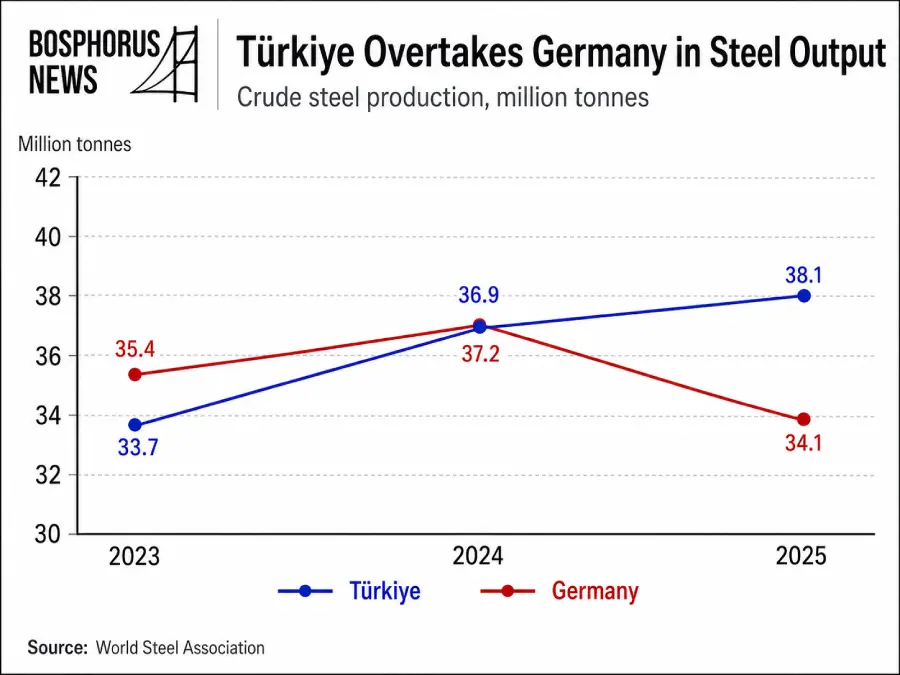
Türkiye became the world's seventh-largest crude steel producer in 2025 after output increased by 3.3 percent to 38.1 million tonnes.
The country moved ahead of Germany, whose production fell to 34.1 million tonnes, and ranked second in the wider European geography after Russia. Türkiye had produced 36.9 million tonnes in 2024.
Türkiye's rise from eighth to seventh place globally came as electric arc furnaces accounted for 72.2 percent of national output.
Turkish producers continue to face pressure from imported steel, excess global capacity and tighter trade barriers in the European Union and United States.
Strategic Take
Athens used the final weekend before Guterres' Cyprus visit to complete political coordination with the Greek Cypriot side. On the same day, Greek personnel intercepted missiles and unmanned aircraft over Saudi Arabia's Red Sea energy infrastructure.
The Cyprus meeting and the Yanbu interceptions belong to separate files, but each extends Greek activity beyond the country's immediate borders. One concerns the negotiating framework for Cyprus. The other places a Greek military unit inside the defense of an energy route that has gained importance as traffic through Hormuz declines.
The Caspian attack widened the security map eastward. Ships associated with Russian-Iranian logistics now face pressure beyond the Black Sea, bringing military risk closer to the trade corridors Türkiye and Azerbaijan are promoting between Central Asia and Europe.
Sources: Türkiye parliamentary reporting, Greek prime minister's office, United Nations reporting, Greek military sources, Reuters, Associated Press, ERT, ANA-MPA, Milli Majlis of the Republic of Azerbaijan, US House Foreign Affairs Committee documents, World Steel Association, Turkish Steel Producers Association, Bosphorus News review and reporting
Read yesterday's brief: Eastern Mediterranean Strategic Brief | July 24, 2026