

By Bosphorus News Geopolitics Desk
The United States and Iran are widening operations around Gulf shipping as oil prices climb. Russian strikes have killed seafarers aboard foreign vessels at Ukrainian ports, while Iraq is advancing export routes towards Türkiye and the Mediterranean that would reduce its reliance on the Strait of Hormuz.
US-Iran Campaign Moves Deeper into Gulf Shipping
The United States and Iran intensified military operations across the Gulf as commercial traffic through the Strait of Hormuz remained severely restricted and crude prices recorded their strongest weekly rise since the latest conflict began.
U.S. forces continued striking Iranian military, transport and surveillance infrastructure. Iran reported new attacks against American-linked facilities in Gulf states and said its forces had targeted a U.S. vessel in the northern Indian Ocean.
The operational claims have not been independently verified. The latest exchanges indicate that the campaign is moving from attacks on fixed military sites towards direct intervention in commercial shipping routes.
American forces have sought to intercept or redirect Iran-linked vessels as Washington enforces its renewed blockade of Iranian shipping. Iranian forces have also stopped vessels accused of violating Tehran's restrictions in the strait.
Only three commodity vessels crossed Hormuz on Thursday, with no very large crude carriers or liquefied natural gas tankers recorded for a second consecutive day. Several ships approaching the waterway stopped or reversed course.
Brent and West Texas Intermediate crude gained about 16 percent over the week as traders priced in continued restrictions on Gulf exports.
Iran has threatened to extend the disruption to Bab el-Mandeb if the United States attacks its electricity network. Military action at both waterways would place the Gulf and Red Sea approaches to Mediterranean trade under pressure at the same time.
Foreign Seafarers Killed in Black Sea Port Strikes
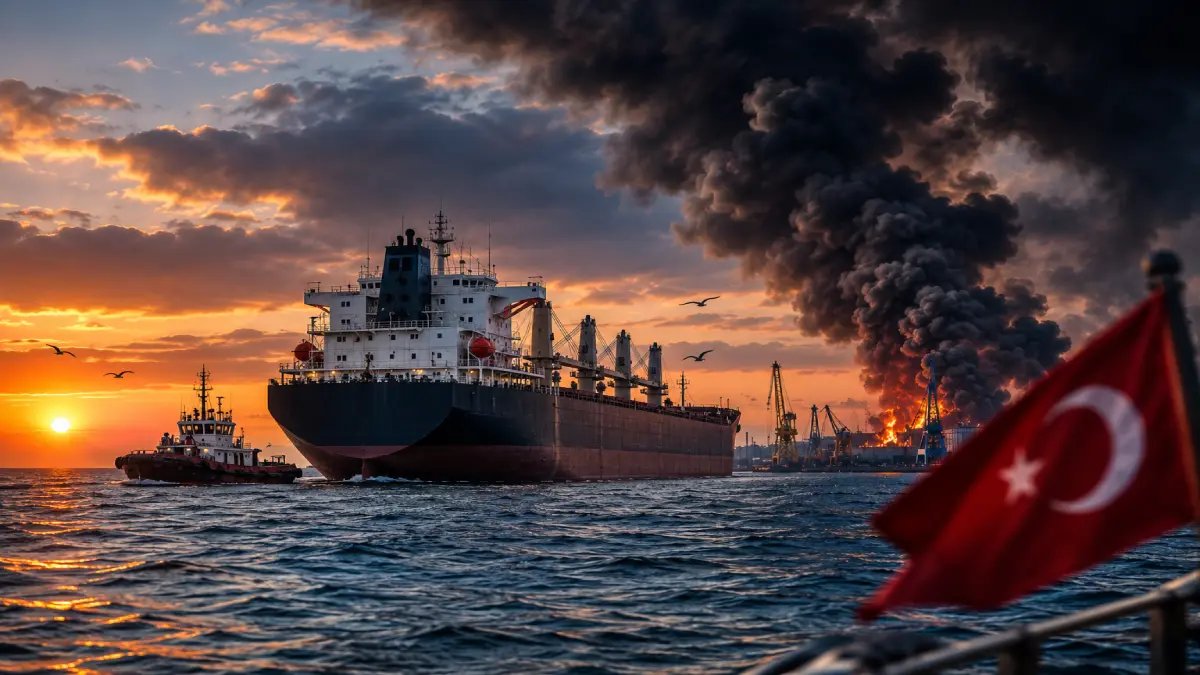
Russian attacks on Ukrainian ports killed three people and damaged several foreign-flagged commercial vessels, pushing the Black Sea campaign further onto ships carrying regional exports.
A drone strike against port infrastructure in Mykolaiv damaged three civilian foreign-flagged vessels. Two people aboard one of the ships were killed.
A separate Russian attack killed another person in Odesa. In the wider Odesa region, a Marshall Islands-flagged vessel was struck, injuring four members of its 17-person crew and causing a fire aboard the ship.
Russia's Defense Ministry said its forces targeted port infrastructure in Odesa and Chornomorsk. Ukrainian authorities said the attacks hit terminals and vessels supporting the country's agricultural exports.
Bosphorus News reported on Friday that attacks against vessels, ports and transport routes were already reducing Ukrainian grain-export capacity and pushing wheat prices higher. The latest strikes have now caused fatalities aboard foreign commercial ships.
Ukraine said it attacked 12 Russian vessels on Friday and claimed its forces had hit 159 vessels in the Black Sea and Sea of Azov during July. Russia said it had destroyed 24 Ukrainian military boats during the past week. Neither side's operational totals have been independently verified.
More than 90 percent of Ukraine's agricultural exports pass through ports in the Odesa region. Shipowners were already cancelling bookings or refusing voyages before the latest casualties, while several terminals had reduced purchases and rail deliveries.
Türkiye maintains direct contact with both governments, but the attacks are spreading across the commercial maritime network faster than diplomatic efforts to contain them.
Iraq Advances Oil Routes towards Türkiye and Mediterranean
Iraq is advancing plans for pipelines towards Türkiye and Syria as the disruption at Hormuz increases pressure on Baghdad to develop export routes outside the Gulf.
Western companies have signed preliminary agreements with the Iraqi government covering energy and infrastructure projects valued at more than $60 billion. Chevron's agreements include possible investment in higher production and a new pipeline intended to reduce Iraq's dependence on tanker exports through Hormuz.
The projects remain at different stages and do not represent completed pipelines or final investment decisions.
Iraq has authorised preliminary studies for two strategic routes. One would run from Basra through Haditha and Kirkuk to Türkiye's Ceyhan terminal. The second would connect Basra and Haditha with Syria's Mediterranean port of Baniyas.
The United States is also supporting efforts to revive an Iraq-Syria crude pipeline linking fields near Kirkuk with the Syrian coast. The proposals are intended to give Iraqi crude an alternative to southern export terminals exposed to disruption in the Gulf.
The Türkiye route has a more immediate operational basis. Bosphorus News previously reported that Baghdad, the Kurdistan Regional Government and international producers were trying to secure a durable export arrangement through Ceyhan before the existing Türkiye-Iraq pipeline agreement expires on July 27.
Türkiye and Iraq are preparing a 12-month arrangement to keep the pipeline legally operational while negotiations continue over a new bilateral framework. Energy Minister Alparslan Bayraktar said the temporary deal would prevent an interruption after the current agreement expires.
The line can carry about 1.5 million barrels per day but remains heavily underused. Most Iraqi crude continues to leave through southern terminals and the Strait of Hormuz.
New routes towards Ceyhan and Baniyas would shift part of Iraq's export system towards the Eastern Mediterranean. Financing, security conditions and transit agreements remain unresolved.
Türkiye Revives EOKA File before July 20 Anniversary
Türkiye's Defense Ministry released a video recalling attacks against Turkish Cypriots by the Greek Cypriot paramilitary organisation EOKA ahead of the anniversary of Türkiye's 1974 military intervention.
The ministry said Türkiye had not forgotten EOKA's "bloody legacy" and used Turkish Cypriot testimony and archival material in the video. It described EOKA as a terrorist organisation, reflecting Türkiye's official terminology.
The video was released two days after the 52nd anniversary of the Greek military junta-backed coup of July 15, 1974, and three days before the anniversary of Türkiye's intervention on July 20.
The statement returns attention to the violence preceding 1974 as the Greek Cypriot and Turkish Cypriot sides remain divided over the basis for any renewed settlement process.
Strategic Take
Commercial shipping is moving closer to the centre of the Gulf and Black Sea conflicts. The U.S.-Iran confrontation is restricting passage through Hormuz, while Russian strikes have killed crew members aboard foreign vessels serving Ukrainian ports.
Iraq is responding to the Gulf disruption through infrastructure planning. The proposed routes towards Türkiye and Syria would not provide immediate relief, but they could reduce Baghdad's dependence on Hormuz if the projects move beyond preliminary studies.
Türkiye is directly connected to both maritime files through the underused Ceyhan pipeline and its continuing diplomatic access to Russia and Ukraine.
Sources: Reuters, Associated Press, Türkiye's Defense Ministry, Ukrainian regional and military authorities, Cyprus Mail, Bosphorus News review and reporting.
Read Yesterday's brief: Eastern Mediterranean Strategic Brief | July 17, 2026.