
By Murat Yıldız
United Nations Secretary-General António Guterres ruled out an expanded meeting on Cyprus during the General Assembly high-level week, saying more preparatory work was needed before another gathering could produce a result.
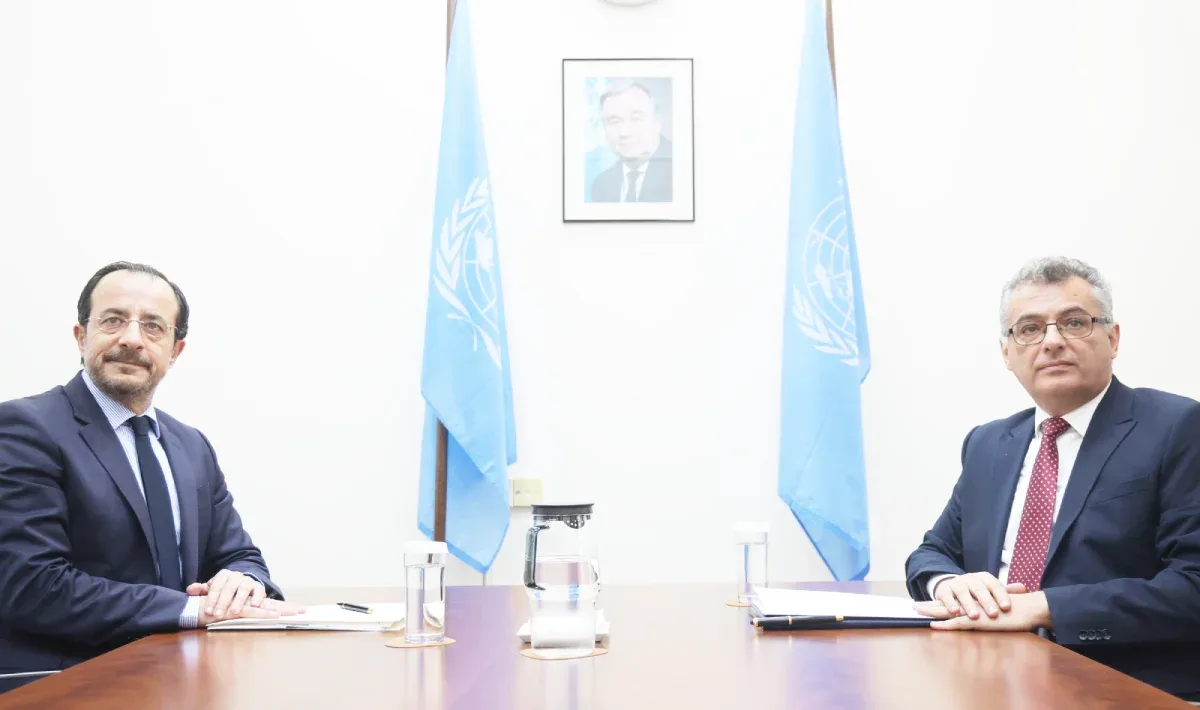
The following morning, Turkish Cypriot leader Tufan Erhürman and Greek Cypriot leader Nikos Christodoulides met in the United Nations Protected Area in Nicosia. The UN described their exchange only as a "good discussion" on confidence-building measures, methodology and substance, announcing no agreement, convergence or breakthrough.
That sequence can look like a conference that failed to make the calendar, although no expanded Cyprus meeting had been scheduled for General Assembly week in the first place.
When Guterres visited Cyprus in July, he said another 5+1 meeting would follow adequate preparation on confidence building, methodology and substance, with previous convergences taken into account. By September, the process had not reached that threshold.
The calendar is nevertheless tightening. Guterres' term ends on December 31, while parliamentary and local elections in the Turkish Republic of Northern Cyprus (TRNC) are scheduled for December 6. The local election calendar begins on October 7 and the parliamentary election calendar two days later.
That leaves less than three weeks from Thursday's leaders' meeting before the first formal election calendar begins, while only 25 days separate the December 6 vote from the end of Guterres' term. An expanded meeting could still be held during that period, but the political room around it is becoming narrower.
The immediate problem is therefore not finding another date, but deciding what needs to be in place before that date becomes useful.
Twenty-seven contacts, still before negotiations
Christodoulides supplied the arithmetic before Thursday's meeting, counting it as the eleventh leaders' meeting since October alongside sixteen meetings between the negotiators.
Twenty-seven contacts at leader or negotiator level in eleven months.
Erhürman offered a different measure afterwards. He said the latest meeting had been relatively better than earlier encounters, but the confidence-building files under discussion had not reached the point he would call resolved, methodology remained unsettled and substantive issues were still at the stage of the two sides listening to each other.
There is a useful comparison with where Erhürman placed the same methodology nine months earlier. After a December 2025 trilateral meeting with Christodoulides and UN envoy María Ángela Holguín, he said the process had reached only "one eighth" of his four-point proposal. In his account, only the first half of the first item, the definition of political equality drawn from UN Security Council resolutions, had entered the joint text, while the rotating presidency had not.
On Thursday, Erhürman said the sides had still not reached agreement "even on the first point."
The two statements use different benchmarks. The December assessment referred to language that had entered a joint text, while the latest one referred to agreement between the sides on the methodology itself. They should not be read as proof that the process has moved backwards. They do show that what Erhürman described as partial movement in December has still not matured into a shared procedural agreement.
That fits the architecture the UN has used since the beginning of the year. On January 28, Secretary-General's Personal Envoy María Ángela Holguín described the process explicitly as a "pre-negotiation phase," saying the leaders were trying to chart a way toward substantive negotiations while continuing work on confidence-building measures.
The meetings now taking place are therefore not another comprehensive settlement negotiation under newly agreed rules. They are part of the effort to establish those rules, a distinction Erhürman has also drawn by describing the present format as a meeting table rather than a negotiating table.
Christodoulides came away from Thursday's session with a more positive reading. He said he had introduced new ideas across confidence-building measures, methodology and substance, that Erhürman had asked for clarifications and reserved his position, and that the proposals had not been rejected.
The two accounts can coexist. Erhürman is measuring what has actually been settled, while Christodoulides is pointing to proposals that remain alive. The distance between those two measures says something about where the process stands.
The dispute before the dispute
In Greece and Türkiye Must First Name the Problem, I argued that Athens and Ankara often reach the dialogue table before agreeing on what the dialogue is meant to resolve.
Cyprus now has a more formal version of that problem. Here it is called methodology.
Erhürman's four-point proposal begins with political equality, including effective participation and the rotating presidency. The second point seeks to prevent convergences reached before Crans-Montana from being reopened, the third calls for a results-oriented and time-framed process, and the fourth seeks a procedural safeguard so that another failed negotiation does not simply return Turkish Cypriots to the existing status quo.
In Erhürman's approach, these are not procedural details to be left until after comprehensive negotiations have begun. They form part of the conditions that would make such negotiations meaningful in the first place.
Christodoulides also says previous convergences should not be discarded. His emphasis has been on having the UN establish a concrete record of them, circulate it to the sides and guarantor powers and use that work to identify what remains unresolved.
The disagreement is therefore no longer over whether earlier negotiations produced common ground. They did. The issue is how that record is authenticated and how it enters a new process.
That takes the discussion back to Crans-Montana, though not simply to the disagreements that ended there.
What survives from an unfinished settlement
The negotiating inheritance left behind in 2017 is much larger than the phrase "previous convergences" suggests.
According to the Secretary-General's report on the 2015-2017 negotiations, the leaders held 70 meetings, their negotiators more than 150 and expert groups another 369. More than 565 joint papers were exchanged, recording progress and convergences across the negotiating chapters.
The UN described the period as one of unprecedented substantive progress. Governance and power sharing had advanced considerably, citizenship questions were almost completely concluded and the economy was among the areas closest to agreement. Large parts of the European Union chapter had been resolved, property principles had been established, maps had been exchanged on territory and significant ground had been covered on political equality and effective participation.
The remaining gaps were substantial, with security and guarantees among the issues still unresolved when the Conference on Cyprus ended in July 2017.
Nor did the hundreds of papers amount to a settlement. The negotiations continued to operate under the principle that nothing was agreed until everything was agreed, meaning a convergence could survive politically and diplomatically without becoming part of a final treaty.
The six-point framework presented by Guterres at Crans-Montana belongs to that record, but it is not the same thing as the full body of convergences. Neither are the later Terms of Reference discussions. The negotiating acquis is broader.
That was visible again in November 2019, when the two leaders meeting Guterres in Berlin reaffirmed the February 11, 2014 Joint Declaration, previous convergences and the six-point Guterres Framework as the basis for renewed results-oriented negotiations.
The argument in 2026 is about how that accumulated work is carried forward. Christodoulides wants a concrete record established through the UN before the process advances, while Erhürman wants protection of previous convergences established as a methodological rule before substantive negotiations begin.
Both positions preserve the idea that earlier work should survive, but they do not yet produce the same procedure for making it survive.
Nine years after Crans-Montana, Cyprus is left with hundreds of pages recording areas where the sides once moved closer together and no common rule yet for deciding how those pages become the starting point of another negotiation.
Seven measures, seven different realities
Alongside methodology sits a shorter list that appears easier to manage.
Erhürman said the seven issues raised by Guterres cover new crossing points, demining, joint mechanisms for disasters and irregular migration, sport, European Union citizenship for children of mixed marriages and the civil society structure developed through the process.
He says the Turkish Cypriot side accepted six of the seven, with new crossing points the exception, while Greek Cypriot officials have said their side accepts the seven-point proposal.
Those statements describe political acceptance, not seven completed agreements.
New crossing points remain unresolved. Demining has produced agreement in principle and technical work but no completed new arrangement. Existing bicommunal structures provide a basis for cooperation on disasters and other practical issues, while the shape and implementation of new mechanisms remain open. Sport runs into the older institutional question of how Turkish Cypriot teams and organizations participate internationally.
The civil society track has moved further. On May 8, the UN announced that the leaders had agreed on a framework for establishing a consultative body for civil society engagement. The process moved into another stage in August, when the leaders agreed that the members of its Steering Committee would be announced.
Then there is citizenship.
In Invisible Europeans, I wrote about Turkish Cypriots who hold European Union citizenship while living in a territory where the EU acquis is suspended under Protocol 10, and about mixed-marriage families whose children have faced long-running disputes over citizenship applications.
That issue has now entered the current UN process.
Erhürman does not regard it as a conventional confidence-building measure and frames the unresolved cases as a rights issue. The Greek Cypriot side has described the matter in humanitarian and legal terms and does not treat it as an ordinary CBM.
Even the nature of the file is disputed.
The European dimension reaches beyond citizenship. After the 2004 referendums, the Council of the European Union declared its determination to help end the isolation of the Turkish Cypriot community and facilitate reunification. Financial assistance followed and continues today, while the proposed Direct Trade Regulation was never adopted.
EU citizenship, EU law, trade access and institutional representation have consequently developed on different tracks across the island. A contradiction that once sat mainly in the background of the Cyprus settlement has moved into the preparatory work for another negotiation.
When contact becomes a status question
The confidence problem does not end with the seven issues.
Erhürman used Thursday's meeting to raise episodes he says have damaged trust, including the EXIT and NEXUS festival disputes, the cancellation of FC Barcelona academy activities in the TRNC, contacts between his representative Mehmet Dânâ and foreign ambassadors and decisions in the European Parliament.
These cases do not carry the same legal or political weight, but they show how activities far removed from constitutional negotiations can become entangled with recognition, jurisdiction and the political meaning attached to international contact with Turkish Cypriot institutions.
The Barcelona case shows how quickly that can happen. Barça Academy camps advertised for September 7-11 and September 16-20 at Near East University did not take place. The camp page disappeared from the club's website, with the dates, location and programme removed, and the Lefkoşa entry also disappeared from its global camp map. Before that, the Cyprus Football Association (CFA), acting after consultations with UEFA, had written to the Spanish Football Federation seeking intervention over the planned camp.
A children's football programme had become a dispute extending from Nicosia to UEFA and the Spanish federation before the first scheduled session began.
The same dynamic appears in other forms. A festival becomes a diplomatic dispute, while a meeting with an ambassador raises questions of representation. Cooperation is expected to reduce the political dispute, yet the form of cooperation can itself become part of that dispute.
In my August analysis, I asked whether practical confidence-building measures would remain limited steps or develop into separate political arguments. By September, several of those episodes had reached the leaders' table.
Security policy was also being described in the same language of confidence during the days around the meeting. After Washington renewed the suspension of International Traffic in Arms Regulations restrictions for the Republic of Cyprus through September 30, 2027, Türkiye's Foreign Ministry said on September 12 that steps likely to further erode trust between the two sides should be avoided.
The Ministry of National Defence returned to the decision on September 17, the day the leaders met, saying the renewal could negatively affect the island's delicate balances and climate of confidence. The Republic of Cyprus, by contrast, welcomed the United States decision as another sign of its deepening strategic partnership with Washington.
The regional environment has also become more crowded. In an earlier analysis, I examined how the current process now operates amid a denser network of defence relationships, energy projects and competing alignments than the one surrounding Crans-Montana.
The difference now is that those pressures are entering a process that has yet to settle its own rules.
Brussels returns, with limits
The European Commission moved closer to the Cyprus file in July when it designated Raffaele Fitto as its Special Representative for Cyprus.
His mandate is framed as support for the settlement process within the United Nations framework and in cooperation with Holguín. Brussels has not presented Fitto as the head of a separate European negotiating track.
Türkiye has not rejected the appointment itself. The Foreign Ministry described it as an internal matter of the European Union while repeating Ankara's view that the EU lacks the impartiality required to act as a neutral player on Cyprus.
The Turkish Cypriot Ministry of Foreign Affairs has taken a harder position, challenging the legitimacy of the appointment and objecting to an EU role established without Turkish Cypriot consent.
Erhürman has drawn the boundary differently. He met Fitto and has said the EU cannot be a party at a future negotiating table, while still leaving room for a Commission role in areas directly connected to EU policy, including the Green Line, trade, citizenship, property and confidence-building measures.
He has also directed the confidence argument toward Brussels itself, saying Turkish Cypriots need confidence-building measures with the European Union after years of decisions they regard as one-sided.
Fitto's role therefore exposes another unresolved boundary around the process. The Commission sees itself supporting the UN effort, Ankara questions its neutrality, the Turkish Cypriot Ministry of Foreign Affairs challenges the legitimacy of the appointment more directly, and Erhürman engages with Fitto without accepting an EU place at the negotiating table.
Brussels is closer to the process than it was, but the limits of its role remain unsettled.
New York is a test, not a new round
The leaders now go to New York without an expanded Cyprus conference waiting for them.
Erhürman is due to meet Guterres and Holguín, while Christodoulides will also brief the UN leadership on the ideas he presented in Nicosia. The UN says those contacts will address the "way forward," language it has used throughout the pre-negotiation phase.
New York will therefore test whether the work in Nicosia has created enough common ground for the process to move further.
The outstanding questions are clear enough. The sides still need a workable methodology for formal negotiations and a common way to identify and carry forward previous convergences. Confidence-building proposals have to move beyond broad acceptance where implementation remains incomplete, while contact with the Turkish Cypriot community continues to run into disputes over recognition and status.
A future 5+1 would have to arrive with enough of that preparatory work completed that the meeting itself does not become another venue for restating the same disagreements.
Guterres has repeatedly set that standard. In July, he tied another expanded meeting to adequate preparation on confidence building, methodology and substance, taking previous convergences into account. In September, he said substantial work remained and warned against repeating past mistakes.
The calendar is narrowing, but time alone is not what is holding the process back.
The absence of a 5+1 during General Assembly week reflects a more basic problem. After 27 contacts at leader and negotiator level, the parties have still not established a sufficiently shared foundation for the next stage.
It is still negotiating the conditions for negotiation.
Sources: United Nations Secretary-General and Good Offices Mission in Cyprus, UNFICYP, United Nations report S/2017/814, Turkish Cypriot Presidency, TRNC Information Office, Republic of Cyprus Presidency, Republic of Cyprus Ministry of Foreign Affairs, Republic of Türkiye Ministry of Foreign Affairs, Republic of Türkiye Ministry of National Defence, Turkish Cypriot Ministry of Foreign Affairs, European Commission, United States Department of State, Federal Register, Cyprus Football Association, FC Barcelona, Cyprus Mail, Bosphorus News monitoring of Greek and Turkish Cypriot media, Bosphorus News archive, Bosphorus News review and reporting.