
By Bosphorus News Geopolitics Desk
On November 25, 2026, the Union for the Mediterranean (UfM) reported progress on a permanent aerial firefighting and training center at Paphos, Cyprus, one day after Greece and the Republic of Cyprus agreed to establish a joint technical working group on civil protection.
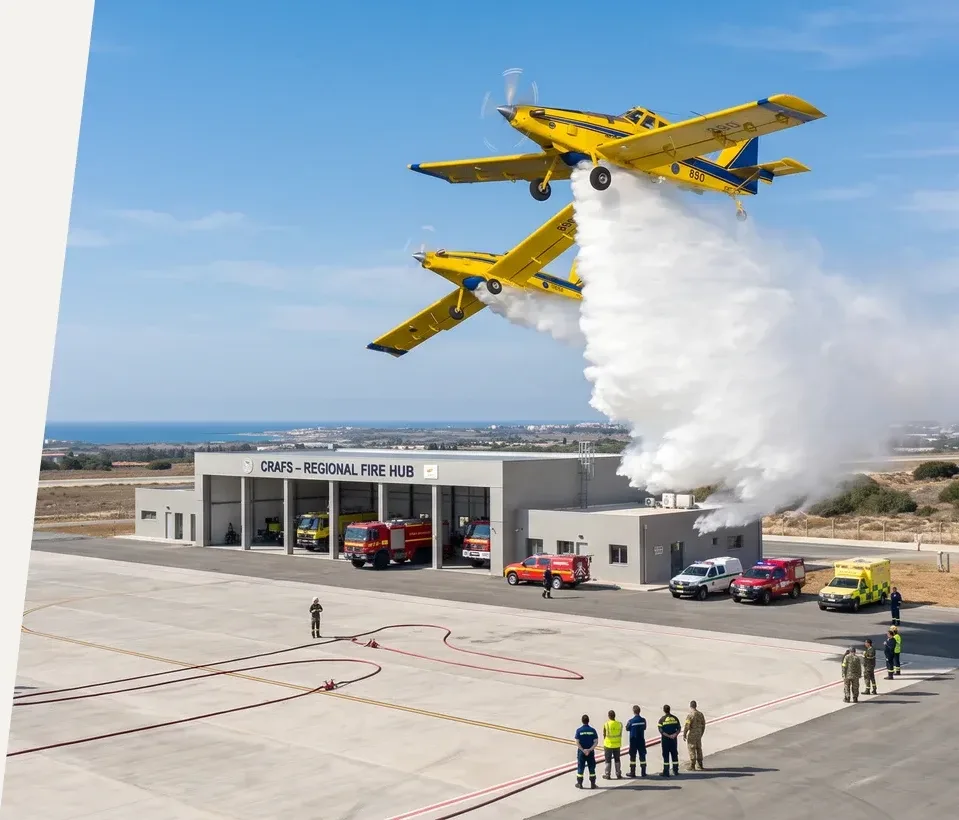
Based at the Andreas Papandreou military airbase, the Cyprus Regional Aerial Firefighting Station (CRAFS) is being developed with European Union (EU) support to coordinate firefighting aircraft and train emergency response personnel from Europe and the southern Mediterranean.
Since the April announcement of the hub under the Pact for the Mediterranean, work has moved toward training outside the wildfire season, the acquisition of dedicated aircraft and formal cooperation with regional institutions.
Greece Explores a Formal Role
At their fourth intergovernmental summit on November 18, Greece and the Republic of Cyprus discussed the possible participation of a Greek institution in the CRAFS consortium now being formed. Their joint communiqué envisaged closer cooperation with other Eastern Mediterranean countries through the initiative.
Six days later, Republic of Cyprus Interior Minister Constantinos Ioannou and Greek Climate Crisis and Civil Protection Minister Evangelos Tournas met in Athens and agreed to establish a bilateral technical working group. The talks covered the expansion of CRAFS's operational capabilities, common training programs and exercises, and the use of drones and artificial intelligence to improve risk assessment and early warning.
During the 2026 wildfire season, a 21-member Greek firefighting team was stationed in Cyprus under the EU's civil protection pre-positioning program. Greece's participation in the CRAFS consortium has yet to be formalized.
From Seasonal Deployments to Permanent Capacity
Republic of Cyprus Defense Minister Vasilis Palmas announced on September 14 that the CRAFS infrastructure had been completed on April 15 at a cost of €802,000. Palmas identified operational control of aircraft assigned to firefighting missions and technical assistance within the European civil protection system among the center's responsibilities. Under the transitional arrangements he described, the Defense Ministry is responsible for organizing, managing and operating CRAFS, and the Interior Ministry handles its finances. Work on establishing the center's permanent institutional footing was still underway in September.
The European Commission confirmed on November 10 that six aircraft had been pre-positioned at Paphos for the 2026 fire season. Palmas said in September that efforts to secure EU co-financing for two firefighting aircraft of the center's own were at an advanced stage. No completed acquisition has been confirmed.
CRAFS held its first regional cooperation and needs assessment workshop on September 15 and 16, attended by representatives of 11 countries and four international organizations, the Defense Ministry reported. At the European Civil Protection Forum in Brussels on November 3, its commander, Lieutenant Colonel Marios Giannaros, presented plans for joint training outside the wildfire season.
The Commission's autumn action plan schedules the development of a regional training program for late 2026 and early 2027, alongside exercises and work on drones and artificial intelligence. The wider Mediterranean disaster preparedness program has €3 million in EU funding and is to receive additional support under a regional security package worth €26.7 million overall. The plan does not specify how much will go directly to CRAFS.
A first working meeting of the prospective consortium for the second phase of the Prevention, Preparedness and Response to Natural and Man-made Disasters in the Mediterranean program (PPRD Med II) was scheduled for November 24 in Barcelona. The proposed consortium includes Expertise France as lead institution, Entente Valabre, Spain's Pau Costa Foundation, the Cyprus-based Center of Excellence in Risk and Decision Sciences (CERIDES), CRAFS and the UfM. Greek participation in the CRAFS consortium is a separate proposal. Spain's Directorate General for Civil Protection and Emergencies is already involved in implementing the station, the Commission's action plan records.
Türkiye's Place in the Regional Network
The Commission's action plan lists six EU members expressing general interest in the civil protection initiative: the Republic of Cyprus, Greece, France, Spain, Italy and Lithuania. Six southern Mediterranean partners are also listed: Egypt, Israel, Jordan, Lebanon, Palestine and Syria. These expressions of interest do not constitute formal CRAFS membership or commitments to deploy aircraft or personnel.
The training program has a wider remit, covering southern Mediterranean partners, EU members and countries participating in the Union Civil Protection Mechanism (UCPM).
Türkiye is a participating country in the mechanism and signed an updated participation agreement with the EU on July 9, 2024. In July 2026, the Commission mobilized firefighting aircraft from Türkiye, Greece and Italy to assist Spain.
As a UCPM participant, Türkiye falls within the categories of countries envisaged for training. The general-interest list covers EU members and southern Mediterranean partners; it is not a roster of countries eligible for CRAFS training.
Access to the facility presents a diplomatic and operational difficulty: Türkiye does not recognize the Republic of Cyprus. The public records reviewed contain no specific arrangements for Turkish aircraft or civil protection personnel to use the center.
Civil Protection and the EU's Mediterranean Presence
CRAFS has a civil protection mandate and operates from military premises under the administrative arrangements described by Palmas. The Republic of Cyprus now has permanent infrastructure to host foreign emergency personnel and coordinate aerial firefighting operations.
On October 9, the Council of the EU extended the mandate of its naval Operation IRINI until March 2029, adding responsibilities that include support for critical maritime infrastructure protection. The military operation and the firefighting station are separate instruments, with no announced operational link.
A permanent training program at Paphos would give the Republic of Cyprus regular institutional contact with emergency response authorities across the Eastern Mediterranean and the Middle East. Dedicated aircraft and Greek institutional participation could extend that role. Access arrangements for non-EU countries, particularly Türkiye, will help determine how far the center can serve as a regional facility.
Sources: Union for the Mediterranean, European Commission, Council of the European Union, Republic of Cyprus Presidency, Republic of Cyprus Interior Ministry, Republic of Cyprus Defense Ministry, Türkiye's Foreign Ministry, Cyprus News Agency, Cyprus Mail, Bosphorus News review and reporting.