

By Bosphorus News Defense Desk
On November 25, 2026, US Ambassador to Cyprus John Breslow confirmed that Washington was working toward extending its arms embargo waiver for the Republic of Cyprus, following discussions with President Nikos Christodoulides and Foreign Minister Konstantinos Kombos in Nicosia.
While declining to disclose whether American military equipment would arrive on the island in the coming weeks or months, Breslow acknowledged that the Republic of Cyprus periodically provides refueling assistance to US forces and welcomed the ongoing modernization of the country's military installations.
Kombos outlined a more ambitious objective, seeking either a permanent lifting of the restrictions or an extension of the waiver to three or five years. With the US midterm elections concluded, he pointed to the composition and leadership of congressional committees as factors that could influence the legislative process.
The discussions, covered in the November 25 Eastern Mediterranean Strategic Brief, come as the Republic of Cyprus is gaining access to American military procurement programs, developing infrastructure suitable for allied forces and expanding cooperation in military education and training.
Several of these initiatives are already advancing independently of the congressional debate over the arms embargo, giving the bilateral defense relationship a longer-term institutional foundation.
From Annual Waivers to a Five-Year Framework
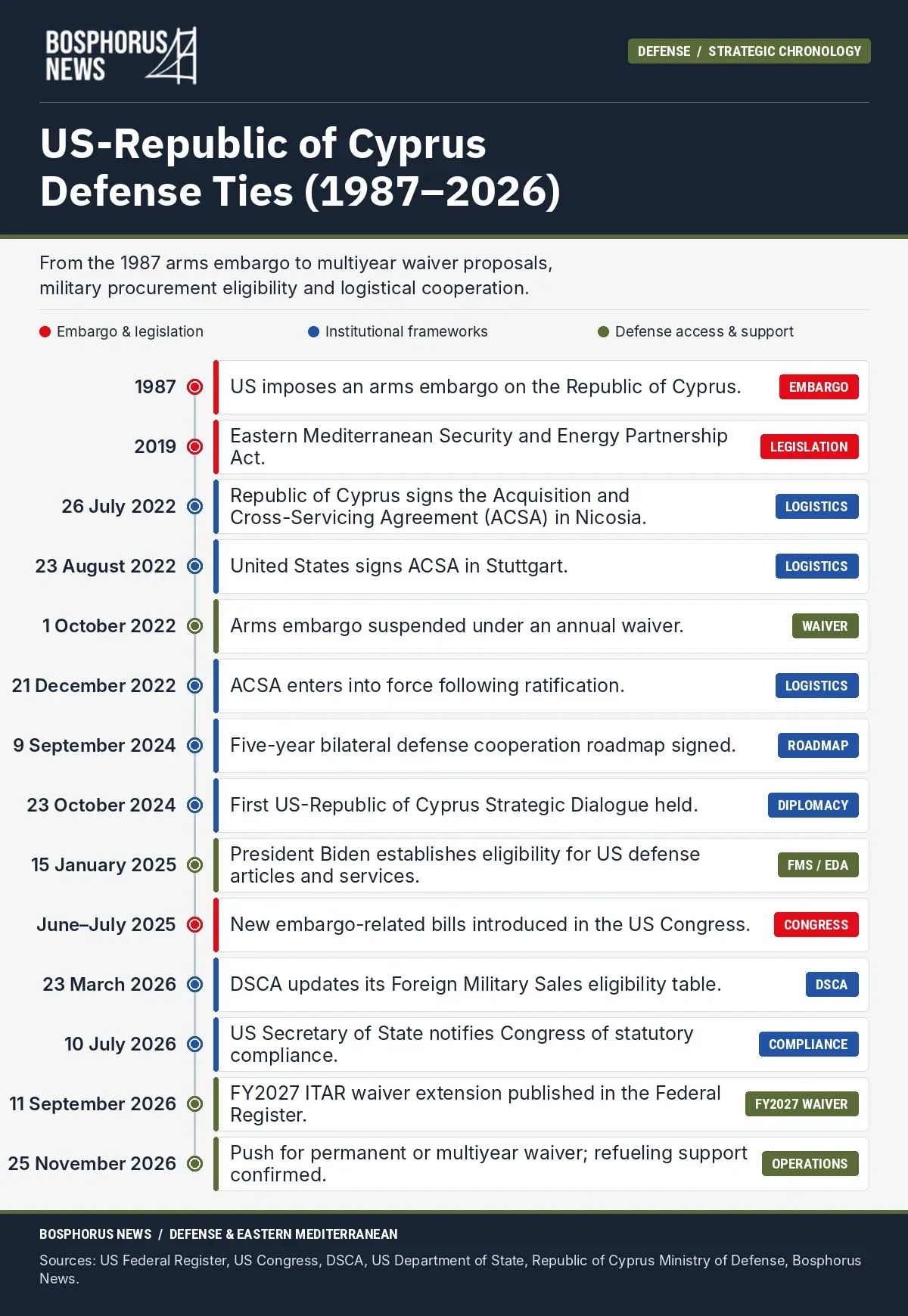
The restrictions imposed under the International Traffic in Arms Regulations (ITAR) have governed American defense exports to Cyprus since the introduction of the US arms embargo in 1987. Their suspension remains subject to conditions established by US legislation in 2019, including cooperation on anti-money laundering reforms and financial regulatory oversight, as well as the denial of port access to Russian military vessels seeking refueling and servicing.
On July 10, 2026, the US Secretary of State notified the relevant congressional committees that the Republic of Cyprus had met the applicable statutory conditions. The subsequent amendment to ITAR Section 126.1, published in the Federal Register on September 11, extends the suspension of relevant defense export, reexport and transfer restrictions from October 1, 2026, through September 30, 2027.
Annual renewal creates regulatory uncertainty for defense procurement programs that can require several years of planning, financing, contracting and implementation. Two legislative proposals introduced during the 119th Congress seek to address that problem.
The End the Cyprus Embargo Act, H.R. 4413, introduced on July 15, 2025, was ordered reported by the House Foreign Affairs Committee on December 3 by a vote of 47 to 2. A similar Senate proposal, S. 2018, advanced through the Senate Foreign Relations Committee on October 30, 2025.
The latter bill, sponsored by Senators Cory Booker and Jerry Moran, remained on the Senate's official legislative calendar as Order No. 234 on November 24, 2026, one day before Kombos publicly reiterated his government's objective of securing a longer-term arrangement.
According to the Congressional Budget Office's February 5, 2026 assessment, H.R. 4413 would lift the relevant restrictions for five years following enactment. At the end of that period, the administration could restore restrictions if the Republic of Cyprus ceased to cooperate on financial regulatory reforms, anti-money laundering measures or the denial of port services to Russian military vessels.
The proposal would also preserve Washington's authority to deny individual transfers over human rights concerns or reintroduce restrictions on national security grounds.
A five-year arrangement would give the Republic of Cyprus greater predictability when negotiating acquisitions from American suppliers and allocating resources for longer-term procurement programs, with individual transfers remaining subject to the applicable US authorization procedures.
Neither proposal has been confirmed as enacted. Kombos' remarks therefore concern an existing legislative initiative whose further progress will depend on the congressional agenda following the midterm elections.
Cyprus Enters the Pentagon's Procurement System
The Republic of Cyprus has already secured a significant change in its eligibility for American defense equipment.
On January 15, 2025, then-President Joe Biden issued Presidential Determination 2025-03, establishing the country's eligibility to receive defense articles and services under the Foreign Assistance Act of 1961 and the Arms Export Control Act, concluding that such assistance would contribute to US security interests and international peace.
On March 23, 2026, the Defense Security Cooperation Agency (DSCA) incorporated that determination into the Pentagon's security assistance administration through Policy Memorandum 26-51, updating the Republic of Cyprus' status in the Security Assistance Management Manual.
Identified by the security cooperation customer code CY, the country is formally listed as eligible under the Foreign Military Sales (FMS) framework and the Arms Export Control Act, enabling its government to pursue acquisitions through the system used by Washington to manage military sales to foreign partners.
The Republic of Cyprus can also seek equipment through the Excess Defense Articles (EDA) program, under which eligible countries may acquire material no longer required by the US military, subject to availability and authorization.
Presenting his ministry's annual assessment on March 23, Defense Minister Vasilis Palmas confirmed that it had examined opportunities under both programs and was working with American authorities to assess specific acquisitions in accordance with its operational requirements and strategic priorities. A DSCA delegation had provided further information on the programs during consultations earlier in the year.
Breslow declined to discuss possible equipment deliveries on November 25, citing the classified nature of the information. No new acquisition list or delivery schedule emerged from his remarks, although the institutional mechanisms through which such acquisitions could be pursued are already in place.
Extending the embargo waiver would provide a more stable regulatory environment for their use, particularly where procurement and delivery schedules extend across multiple fiscal years.
Paphos and Mari: Expanding Military Infrastructure
Alongside the changes to American defense export regulations and procurement eligibility, infrastructure projects at the Andreas Papandreou Air Base in Paphos and the Evangelos Florakis Naval Base in Mari are expanding the practical scope of bilateral cooperation.
The Republic of Cyprus has presented the development of these installations partly in the context of regional crisis response, humanitarian assistance and evacuation operations. Reported plans also indicate that the facilities could support a wider range of military activities.
In April 2026, Associated Press reported that the United States had provided €500,000 for a development plan to determine the scope and estimated cost of expanding the Paphos air base. The funding covers preparatory work, with the overall cost of modernization yet to be established.
On November 18, Kathimerini reported that the proposed infrastructure would accommodate at least seven C-17 Globemaster III heavy transport aircraft and provide support for American F-15 and F-16 fighter aircraft.
Infrastructure suitable for both heavy transport and combat aircraft would broaden the potential uses of Paphos considerably. The reported planning requirements indicate that the installation is being developed with the needs of foreign military operators in mind, although no permanent American aircraft deployment has been announced.
At Mari, US European Command (EUCOM) is financing a helicopter landing facility designed to accommodate heavy transport helicopters, while the Republic of Cyprus is pursuing a separate expansion of the naval base.
On October 6, the Defense Ministry announced the award of a year-long technical study to the Athens-based engineering consortium TRITON-MARNET. According to Janes, the project envisages harbor infrastructure suitable for larger warships and auxiliary vessels, with a reported capacity target of more than eight large ships.
The final configuration and technical specifications of the expanded harbor remain subject to the study, while access by foreign naval forces would continue to require authorization from the authorities of the Republic of Cyprus.
The American-funded helicopter facility and the Cypriot-funded naval expansion remain distinct projects, although both could improve the ability of the Republic of Cyprus to accommodate and support foreign military forces.
The development of Paphos and Mari would also expand the military infrastructure available to Western partners on an island where the British Sovereign Base Areas have historically occupied a central position in regional military activity, without altering the legal status of those bases.
American Logistics and the Russian Dimension
Breslow's acknowledgment that the Republic of Cyprus periodically provides refueling assistance to American forces brings renewed attention to a bilateral agreement concluded in 2022.
The Acquisition and Cross-Servicing Agreement (ACSA), signed in Nicosia on July 26 and in Stuttgart on August 23 of that year, establishes a framework for the reciprocal provision of military supplies, services and logistical support. It was ratified through Cypriot Law 15(III)/2022, published on December 12, and entered into force on December 21, according to the US Department of State's official treaty records.
Covering fuel, transportation, maintenance, storage and other logistical services, the agreement provides a mechanism for military cooperation without requiring the establishment of a permanent American military presence.
It was signed shortly before the full suspension of US arms export restrictions took effect in October 2022. Under the American legislation governing that suspension, denying Russian military vessels access to Cypriot ports for refueling and servicing remains one of the conditions for continued eligibility.
The restrictions on Russian military access and the establishment of reciprocal logistical support with the United States are legally separate arrangements. Their concurrent development nevertheless reflects a significant change in the Republic of Cyprus' external defense relationships, particularly in an Eastern Mediterranean where successive regional crises have increased demand for military logistics and evacuation infrastructure.
A February 2026 study published through the US Naval Postgraduate School examined the potential benefits of the bilateral agreement for American naval logistics. While identifying advantages in cost, flexibility and the provision of military supplies and services, the researchers found that its practical use remained limited, partly because of existing infrastructure constraints and the relatively recent implementation of the agreement.
Breslow's November 25 remarks establish that the wider bilateral logistical relationship has extended to practical refueling assistance, although he declined to disclose details of American military movements. Whether the assistance he described was provided specifically under the ACSA framework remains unconfirmed.
The modernization of Paphos and Mari could address some of the infrastructure limitations identified in the study and broaden the range of services available under the existing defense relationship, giving Washington additional options for regional crisis response and logistical support without necessarily establishing permanent bases.
The Next Generation of Cypriot Officers
The growing relationship with Washington also extends into the education of future military officers, an area in which the Republic of Cyprus recorded its first concrete development earlier this year.
On May 29, 2026, Palmas attended a swearing-in ceremony for the first Cypriot student to secure admission to the United States Naval Academy in Annapolis. The admission established a precedent for subsequent efforts to expand access to American military academies.
On October 21, the Council of Ministers of the Republic of Cyprus approved a Defense Ministry proposal to pursue three places for the 2027-2028 academic year, covering one prospective position at the United States Military Academy at West Point, one at the United States Naval Academy and one at the United States Air Force Academy.
The ministry issued its call for applications on October 30, beginning the domestic selection process for candidates seeking admission to four-year programs scheduled to start in June 2027.
Subject to the respective admission procedures, the initiative could allow additional future officers of the Cyprus National Guard to undertake their formative military education within the American system.
Military training cooperation has already acquired a broader institutional basis through the State Partnership Program (SPP), established between the Cyprus National Guard and the New Jersey National Guard in 2023.
Covering leadership development, communications, cyber defense, emergency response and military training, the partnership continued throughout 2026. Representatives met from July 21 to 23 to plan activities for the 2027 and 2028 fiscal years, according to the New Jersey Department of Military and Veterans Affairs.
These initiatives complement the 2024-2029 Bilateral Defense Cooperation Roadmap, signed on September 9, 2024, and the Strategic Dialogue launched the following month.
Officers educated in American institutions could bring professional relationships, operational practices and familiarity with US military procedures into the Cyprus National Guard throughout their careers. The institutional effects of this cooperation could therefore extend well beyond individual procurement cycles, reinforcing the interoperability sought through joint training and equipment acquisition.
Türkiye and the Island's Security Balance
The expanding defense relationship continues to face opposition from Türkiye and the Turkish Cypriot authorities, whose assessments are shaped by the unresolved Cyprus conflict and the island's existing security arrangements.
Following the publication of the latest American arms embargo waiver, the Turkish Foreign Ministry stated on September 12 that the decision would encourage further militarization on the island and undermine efforts to establish trust between its two communities.
The Foreign Ministry of the Turkish Republic of Northern Cyprus (TRNC) issued a similar objection on the same day. On September 17, Türkiye's Ministry of National Defense reiterated concerns over the military balance on the island and emphasized Türkiye's responsibilities as a guarantor state.
Ankara assesses the expansion of Greek Cypriot military capabilities within the context of the security arrangements established under the 1960 treaties, which remain a central element of its position on the Cyprus settlement.
Washington and the Republic of Cyprus describe their cooperation within a wider regional security framework, emphasizing defense modernization, crisis response, humanitarian operations and interoperability with international partners.
These divergent assessments become more consequential as bilateral cooperation extends beyond weapons procurement. Infrastructure developed to accommodate foreign military forces raises questions about the future use of installations on the island and the relationship between external military involvement and Cyprus' unresolved security arrangements.
None of the bilateral mechanisms examined here establishes a mutual defense obligation comparable to the collective defense commitments of the North Atlantic Treaty Organization (NATO). Nor has Washington announced the establishment of a permanent American military base in the Republic of Cyprus.
The political language surrounding the relationship has nevertheless become more ambitious, as examined in Bosphorus News' October 4 analysis of Breslow's security assurances.
Military Integration Ahead of a Political Settlement
A five-year arms embargo waiver would provide greater regulatory certainty to a defense relationship whose institutional and physical foundations are already being developed.
The Pentagon has incorporated the Republic of Cyprus into its military procurement system, reciprocal logistical arrangements are in force, American resources are supporting elements of military infrastructure development, and cooperation in military education is being extended to future generations of officers.
The Republic of Cyprus is pursuing the modernization of its national forces alongside a greater role in the regional military infrastructure available to its Western partners. Washington, in turn, is developing additional options for logistical support and crisis response in the Eastern Mediterranean.
These developments are advancing without an agreed revision of the island's security arrangements or a comprehensive settlement of the Cyprus conflict.
The prospect of replacing annual waivers with a five-year framework introduces a question of timing into the wider Cyprus security debate. Procurement programs, infrastructure investments and military education are being planned across successive years, while negotiations over the political division of the island have yet to produce an agreed security architecture.
By the time the parties reach substantive negotiations over future security arrangements, some of the military and institutional relationships now under development may already be firmly established.
The military environment in which a future Cyprus settlement would have to operate is changing before the parties have reached agreement on the security provisions of that settlement.
Sources: US Federal Register, September 11, 2026; H.R. 4413, End the Cyprus Embargo Act; Congressional Budget Office, February 5, 2026; S. 2018, US Senate; US Senate Legislative Calendar, November 24, 2026; US Presidential Determination, January 15, 2025; DSCA Policy Memorandum 26-51; Republic of Cyprus Defense Ministry, Palmas' Annual Assessment, March 23, 2026; US-Republic of Cyprus Defense Cooperation Roadmap, 2024-2029; First US-Republic of Cyprus Strategic Dialogue; Acquisition and Cross-Servicing Agreement, Cypriot Law 15(III)/2022; US Department of State, Treaties in Force Supplement; Naval Postgraduate School, NPS-LM-26-050, February 12, 2026; Associated Press, April 20, 2026; Kathimerini Cyprus, Paphos Air Base Modernization; Janes, Mari Naval Base Expansion; Cyprus News Agency, US Naval Academy Admission, May 29, 2026; Republic of Cyprus Defense Ministry, Cabinet Decision, October 21, 2026; Republic of Cyprus Defense Ministry, Military Academy Applications; New Jersey National Guard, State Partnership Program; New Jersey Department of Military and Veterans Affairs, July 29, 2026; AlphaNews, November 25, 2026; Türkiye Ministry of Foreign Affairs, Statement No. 177; Türkiye Ministry of National Defense, September 17, 2026; TRNC Ministry of Foreign Affairs, September 12, 2026.