
By Bosphorus News Geopolitics Desk
Turkish Cypriot leader Tufan Erhürman and Greek Cypriot leader Nikos Christodoulides are heading to New York with different accounts of seven issues Erhürman says United Nations (UN) Secretary-General António Guterres asked the sides to advance during his July visit. The Republic of Cyprus government says it accepted all seven. Erhürman says the Turkish Cypriot side accepted six, with new crossing points still unresolved.
Their Sept. 17 meeting in the United Nations Protected Area produced no announced agreement. The UN said the leaders had held a "good discussion" on confidence-building measures, methodology and substance. Ahead of the meeting, Christodoulides said he would bring some 19 specific points covering methodology and confidence-building measures. Afterwards, he said he had put forward new proposals and ideas across confidence building, methodology and substance. Erhürman said no confidence-building measure had been resolved and that the sides had not reached agreement even on the first point of the four-point methodology.
Seven points from July
Guterres did not publish a numbered seven-point list during his July visit. He said another expanded 5+1 meeting would follow adequate preparation on confidence building, methodology and substance, taking previous convergences into account. He also said he did not want another 5+1 without results.
Erhürman later identified seven issues he said Guterres had raised: new crossing points, demining, a joint mechanism for natural disasters, a joint mechanism for irregular migration, sport, European Union citizenship for children of mixed marriages, and a mechanism for civil society participation. At his Sept. 17 press conference, he said the Turkish Cypriot side had accepted six. Crossings remained open.
A day earlier, Republic of Cyprus government spokesman Konstantinos Letymbiotis told the Cyprus Broadcasting Corporation (CyBC) that the Greek Cypriot side had accepted Guterres' seven-point proposal and expected a constructive response from the Turkish Cypriot side.
Neither account amounts to seven completed agreements between the sides. The Cyprus process still has negotiating rules unsettled, and work on the seven issues varies considerably.
UN Secretary-General's personal envoy María Ángela Holguín addressed the argument in an August interview with ANKA. "I don't think it's useful, or accurate, to frame this as one side accepting and the other rejecting," she said. Holguín said several measures had broad conceptual agreement but encountered problems when implementation began.
The crossing package
At the Geneva meeting in March 2025, Guterres announced a group of confidence-building initiatives that included opening four crossing points. His public statement did not identify the four locations.
Four months later in New York, he said agreement had been reached "on the crossing points themselves," with an itinerary issue still outstanding. Turkish Cypriot diplomatic sources disputed that account, telling Cyprus Mail that no agreement on locations had been reached and that proposed transit corridors remained contested.
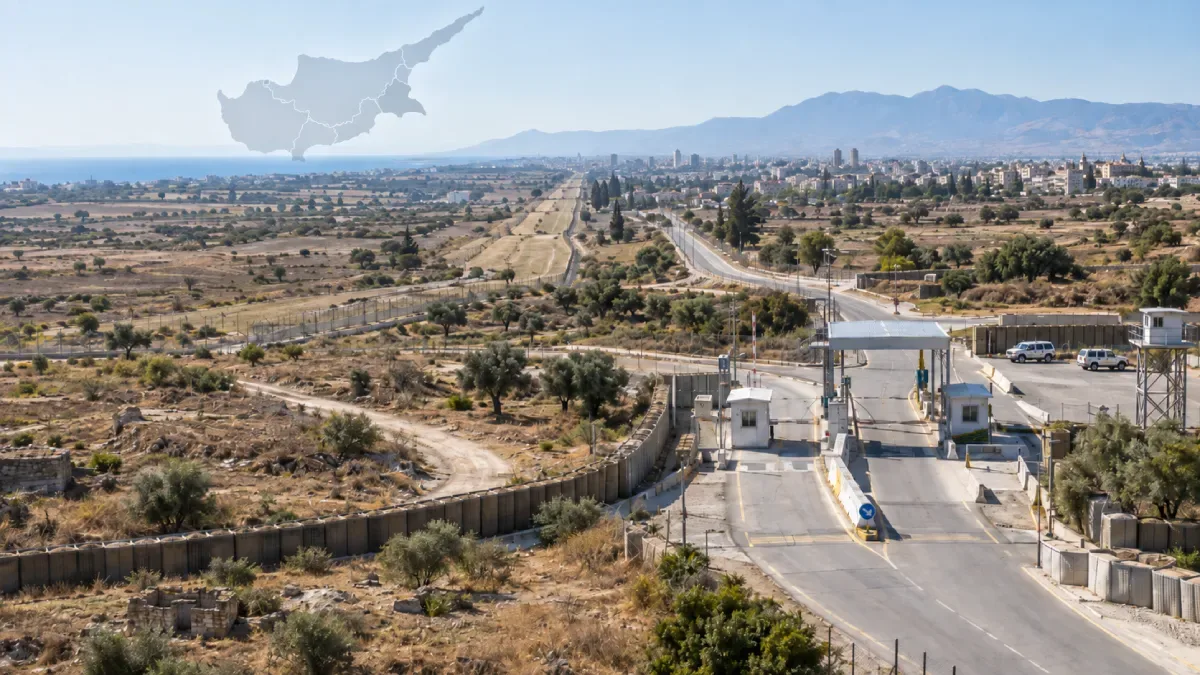
By February 2026, Erhürman was publicly keeping Mia Milia, known in Turkish as Haspolat, and Louroujina, known in Turkish as Akıncılar, on the table alongside what he calls the Kiracıköy-Eylence road connection. He said the Turkish Cypriot side had put forward four separate constructive proposals in response to Greek Cypriot concerns over the route, including construction of a new road on the Turkish Cypriot side.
During Guterres' July 2026 visit, Cyprus Mail reported that the Greek Cypriot side proposed moving first on Athienou-Aglandjia and Mia Milia while leaving Louroujina for a later stage. The Turkish Cypriot side rejected splitting the four-point package.
Christodoulides later said his side had accepted what Guterres presented during the visit as a "reasonable compromise." No agreement followed, and the UN has not published the detailed map or full terms of the proposal.
In an Aug. 5 television interview, Erhürman said a 3.3-kilometre section through the buffer zone sought by the Greek Cypriot side was the remaining blocked stretch on the route under discussion. He said the Turkish Cypriot side proposed in return 1.2 kilometres of buffer-zone access to ease travel for Turkish Cypriots living in Pyla, known in Turkish as Pile. That proposal, he said, was rejected.
The dispute also extends to how the four crossings are counted. Politis reported after an Aug. 20 meeting between chief negotiators Menelaos Menelaou and Mehmet Dana that the Greek Cypriot side treats Athienou-Pyroi-Aglandjia as one crossing. The Turkish Cypriot side counts Athienou-Pyroi and Pyroi-Aglandjia separately. The report cited a source familiar with the talks.
That count determines whether Louroujina stays in the four-crossing package. The same Politis source said the Turkish Cypriot side wants Louroujina-Lympia included, while the Greek Cypriot position is that Louroujina cannot return without Kokkina, known in Turkish as Erenköy.
The other six
Demining remains disputed. Erhürman said the Turkish Cypriot side accepted a Guterres proposal to begin clearance in the buffer zone and continue elsewhere, while Christodoulides rejected it on security grounds. Bosphorus News found no public statement from the Republic of Cyprus Presidency directly answering that account.
The citizenship issue is contested even over how it should be treated. It concerns applications by children of Turkish Cypriots married to people from Türkiye for Republic of Cyprus, and therefore European Union, citizenship. Letymbiotis has called it a humanitarian issue rather than a confidence-building measure. Erhürman also rejects its treatment as an ordinary CBM, saying it should be handled as a human rights matter.
Sport is also contested over implementation. Letymbiotis said the Turkish Cypriot side was not implementing an agreement involving the Cyprus Football Association and the Union of European Football Associations (UEFA). Erhürman has cited the cancellation of FC Barcelona academy activities in the north among actions he says have damaged confidence.
No specific Greek Cypriot objection has been made public to the proposed joint mechanisms for natural disasters and irregular migration. Christodoulides said on Aug. 30 that he had told Erhürman he would reject confidence-building measures that, in his view, "normalise the current illegal state of affairs." He said he would support measures that contributed to efforts to resolve the Cyprus problem.
On May 8, the leaders agreed on a framework for establishing a consultative body for civil society engagement. On Aug. 26, they agreed to announce the members of its Steering Committee the following day.
New York
No 3+1 or 5+1 Cyprus meeting is scheduled during General Assembly high-level week. Guterres said in July that another expanded meeting required more preparation before it could produce results.
Erhürman is due to leave for New York on Sept. 23 for separate meetings with Guterres and Holguín. The UN said the two leaders would brief the Secretary-General on their work and discuss the way forward.
Guterres' second term ends on Dec. 31, 2026.
Sources: United Nations, TRNC Presidency, Republic of Cyprus Presidency, ANKA, Cyprus News Agency, CyBC, Politis, Cyprus Mail, MyKıbrıs, Bosphorus News review and reporting.