
By Murat Yıldız
On September 7, the Turkish Cypriot Official Gazette published a decision removing Sinan Güneş from his post as head of the Meteorology Department, effective the following day. The same issue of the Gazette carried a change at the Postal Department. No reason was given for either decision. It came after a week in which the ferry disaster had already triggered the dismissal of Public Works and Transport Minister Erhan Arıklı and several senior transport officials.
Across the Turkish Cypriot outlets I reviewed on Tuesday morning, the personnel changes were among the leading domestic stories. Mağusa Haber Ajansı ran them as changes of duties at two departments. Other outlets carried Güneş's farewell message to his staff as a separate item. Prime Minister Ünal Üstel's figures on the disaster, 132 people admitted to public and university hospitals and four initially treated in intensive care, ran alongside them, as did a widening argument over whether the coast guard's initial response should also come under scrutiny.
Across the Greek Cypriot press that same morning, El Alamein dominated. President Nikos Christodoulides was in Egypt for a trilateral summit with Abdel Fattah al-Sisi and Greek Prime Minister Kyriakos Mitsotakis, and for the opening of an airshow as Sisi's guest of honour. Israeli President Isaac Herzog is due in Nicosia on Thursday. The ferry sat further down the page.
None of which means one press is covering the disaster and the other is looking away. That version is wrong, and it is worth killing before going any further.
What the southern press actually did
Greek Cypriot outlets have reported the sinking closely, and on several tracks ahead of the northern press.
Philenews reported the arrest of the captain and seven crew members on August 30. On September 1 it covered Tufan Erhürman's statement that an object found at about 550 metres was believed to be the ferry. On September 3 it reported court proceedings in which problems involving the vessel's engine and rudder were described.
Cyprus Mail has run the sequence in similar detail. The dismissal of Public Works and Transport Minister Erhan Arıklı. The appointment of Finance Minister Özdemir Berova as acting minister alongside the removal of three senior officials. The withdrawal of Arıklı's Rebirth Party (YDP) from the coalition, which it reported as leaving the government with an effective majority of three. Its coverage has included the allegation that crew locked the doors of a passenger cabin as the vessel took on water, and questions about the captain's licence.
By Tuesday, both presses were carrying the same death toll: 14 dead and 14 still missing, with 239 people rescued. Both reported the wreck at roughly the same depth. Both covered the same court appearances.
The facts are not what separate them. The vocabulary is.
The vocabulary
In Cyprus Mail's reporting, Üstel is the north's 'prime minister'. Arıklı was the north's 'transport minister'. The body that sent ambulances to Kyrenia's new port is the north's 'health ministry'. This is not peculiar to one story. It runs through the coverage, story after story.
The quotation marks matter. They are not marking direct speech. They let the title appear without the newspaper accepting it as an unqualified institutional fact. The reader is being told: this is what the office is called in the north, not necessarily what we accept it to be.
Philenews makes the device even more visible. Its September 2 report on Arıklı's dismissal was built around the occupied north's Üstel sacking a "minister". The punctuation does political work. The office has to be named, but the newspaper still keeps its distance from the title.
The Turkish Cypriot press runs the mirror image without needing quotation marks. Its own institutions appear as ordinary institutions, with their titles stated without qualification. The Republic of Cyprus, by contrast, appears as Güney Kıbrıs, South Cyprus, and its affairs are filed as coverage of somewhere else. Herzog's visit to Nicosia on Thursday is reported in the north, but as an event in the south rather than an event on the island.
So the same 267 people boarded the same vessel, and the same wreck now lies on the same seabed, but the institutions around them change name with the newspaper. The decision removing a meteorology director was signed by a government that exists plainly on one side of the buffer zone and in quotation marks on the other. The proceedings examining the captain's conduct are a court in one account and a body whose title has to be qualified in the other.
None of this is new. What the Filo Jet did was put it under load. A disaster with a death toll, a criminal investigation, a parliamentary crisis and a wreck at 550 metres demands precise institutional language every single day, and for more than a week neither press has managed to supply it without also making a statement about the island's status.
What each press puts first
The gap is not only in naming. It is in what gets chosen.
On Tuesday the Turkish Cypriot press carried, alongside the ferry, the postponement of the burial of the remains of 15 identified missing persons at Atlılar. That is a Committee on Missing Persons in Cyprus matter, unconnected to the sinking, concerning remains from the 1963 to 1974 period. It ran prominently in the north.
The same day, the Greek Cypriot press led with El Alamein, the strategic partnership language around Egypt, and preparations for Wednesday's meeting between Erhürman and Christodoulides.
Each press covers a Cyprus the other barely reports. The disaster changed none of that. It made the two presses describe the same disaster inside two different institutional worlds in the same week.
The cost
A reader following only the northern press this week gets an accountability story. Ministers and senior officials removed. A meteorology director dismissed amid the same week of institutional upheaval, although the decree gave no reason. An acting transport minister who, under the north's rules, can hold the portfolio only until September 12. A government left with 26 supporters in a 49-member legislature after the YDP walked out.
Follow only the southern press and the story looks different: arrests, court sessions, licence questions and a coalition crisis, all unfolding during a foreign policy week dominated by Egypt.
Both are accurate. Neither is whole. And because each press writes the other's institutions in a form the other will not adopt, the two accounts do not join. The people who most need the full picture are the families of the missing, the passengers who got off that vessel, and anyone on either side of the line still asking why it sailed.
International reporting has not escaped the same problem, shifting between "northern Cyprus", "de facto state" and simply "Cyprus" in describing the vessel's origin.
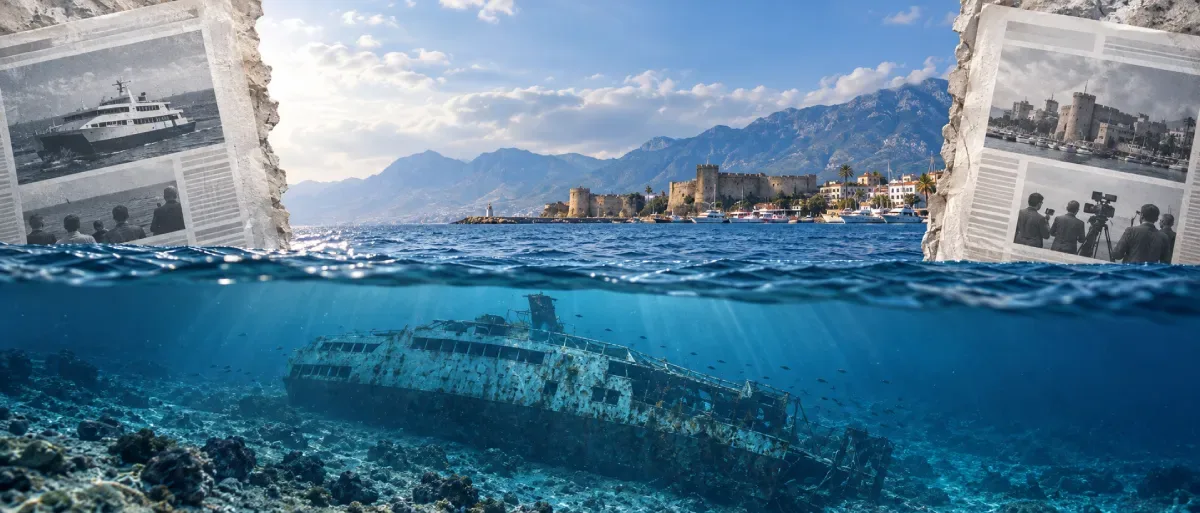
The wreck sits at about 550 metres, roughly four nautical miles offshore, in water that belongs to whichever description the reader was handed.
A note on Bosphorus News' language: The terminology quoted above is reproduced as evidence of how Greek and Turkish Cypriot outlets describe the island's institutions; it does not represent Bosphorus News' adoption of either convention.