

By Murat Yıldız
Crete has overtaken the eastern Aegean islands in Greece's principal irregular-arrival series. On the older sea route from Türkiye, the Turkish Coast Guard is recording far fewer migrants than a year ago, but more deaths.
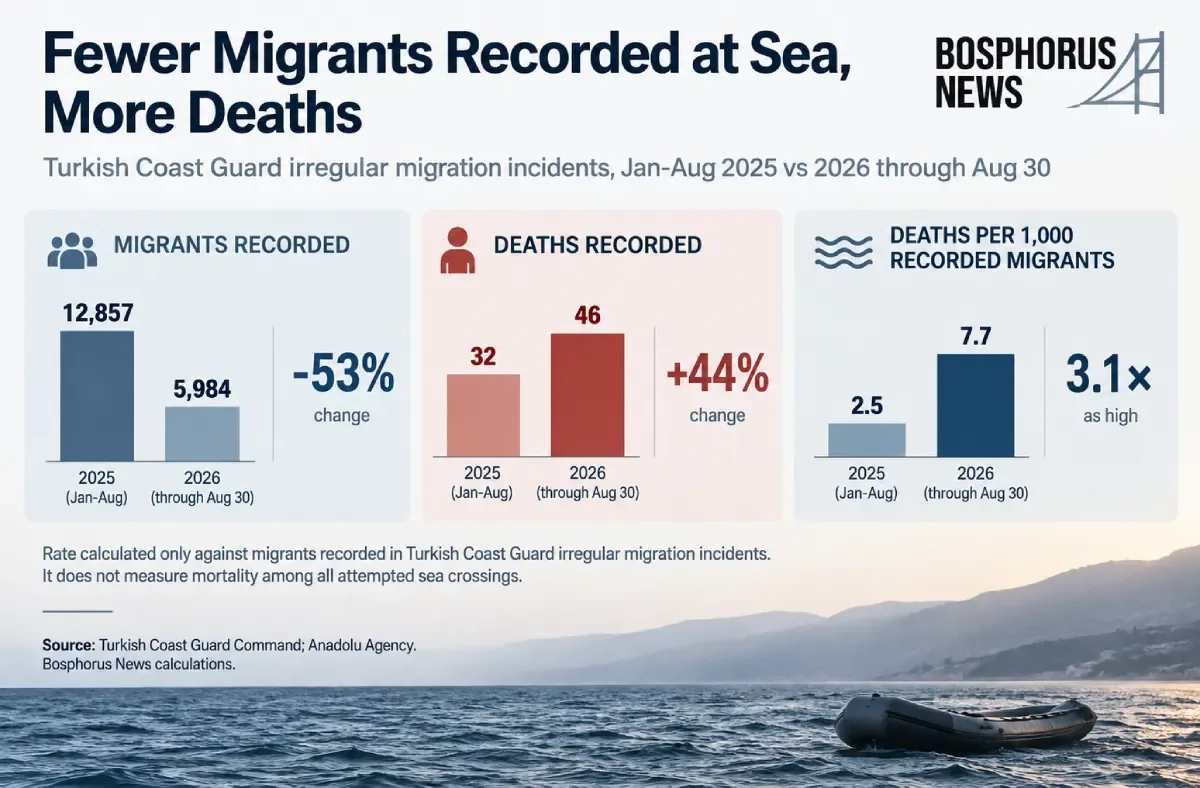
The Turkish Coast Guard Command recorded 46 migrant deaths in irregular migration incidents through August 30, 2026, up from 32 in the same period last year. The number of migrants in those incidents fell 53%, from 12,857 to 5,984, while incidents dropped from 494 to 256.
Within that series, deaths rose from about 2.5 per 1,000 recorded migrants in the first eight months of 2025 to 7.7 per 1,000 this year.
That calculation has a narrow denominator. It covers people who entered Turkish Coast Guard irregular migration records, not everyone who attempted a sea crossing. Migrants who reached Greece without appearing in the Turkish series, as well as departures never encountered by authorities, are not included.
On the Greek side, the center of arrivals has shifted south.
Greece's Ministry of Migration and Asylum recorded 19,456 arrivals across Crete, the eastern Aegean islands and the Evros land border from January through July. Crete accounted for 9,973, just over 51%. Fylakio on the Evros border recorded 4,843 and the eastern Aegean islands 4,640.
Crete alone received more people than Evros and the islands combined.
Crete's monthly arrivals rose from 294 in January to 1,646 in March, 2,563 in May and 3,157 in June, before falling to 1,296 in July. Evros rose from 351 arrivals in March to 945 in July.
Those figures come from the same Greek ministry series. Other authorities count additional arrival points under separate categories, so the datasets should not be mixed.
Frontex recorded 24,239 detections on the Eastern Mediterranean route during the first eight months of 2026, 25% fewer than a year earlier. The European Border and Coast Guard Agency said the Libya-Crete corridor was the busiest section over the period as a whole. By July, the land border with Türkiye had also moved ahead of the eastern Aegean islands.
Another 2,999 detections were recorded in August. Afghan, Sudanese and Bangladeshi nationals were the most frequently detected on the wider route.
The new route is also much longer. The traditional Aegean passage connects Türkiye's western coast with Greek islands across relatively short stretches of sea. Boats leaving Libya for Crete face a much longer journey across open water.
Fewer Encounters, More Deaths
The Coast Guard recorded 55,726 migrants in 2,011 irregular migration incidents in 2024. That fell to 20,078 migrants in 767 incidents in 2025. Through August 30 this year, the total stood at 5,984 migrants in 256 incidents.
Deaths did not fall with those numbers. The same series recorded 44 deaths in 2024 and 59 in 2025. The first eight months of 2026 produced 46.
Most of this year's deaths are concentrated in March and April. Fourteen were recorded in March and 19 in April, accounting for 33 of the 46 deaths through August. Five were recorded in February, two each in January and May, one in June and three in July. August recorded none.
The concentration limits what can be inferred from the per-capita comparison. One or more high-casualty incidents can move the ratio sharply when the number of migrants in the series has fallen so far, and the monthly table does not show how the March and April deaths were distributed across individual cases.
The year-on-year comparison itself is straightforward: the Coast Guard recorded 53% fewer migrants in maritime irregular migration incidents, while deaths rose from 32 to 46.
Aegean Boat Report, an independent monitoring group focused on departures from the Turkish coast, also records a steep fall in arrivals on the Greek islands. It counted 5,669 arrivals through August, down 60.2% from 2025. In August, 43 boats carrying 1,190 people reached the islands, while the group said another 71 boats carrying 1,842 people were picked up by the Turkish Coast Guard.
Its interception figures are substantially higher than the Coast Guard Command's official totals, so the two datasets cannot be combined. On arrivals, however, the direction is the same: the eastern Aegean is running far below previous levels.
Ankara Flagged the Southward Shift in 2024
Türkiye was talking about a southward shift before Crete became the leading Greek entry point.
Then-Interior Minister Ali Yerlikaya said in December 2024 that the number of irregular migrants prevented from entering Türkiye at its borders had fallen from 223,000 in 2023 to 104,000 in 2024. He put the reduction in migration pressure at 60% and said the route had moved farther south.
Yerlikaya also said Türkiye was no longer a transit and destination country for irregular migration. He left office on February 11, 2026, when Mustafa Çiftçi succeeded him as interior minister.
Subsequent Greek and Frontex figures support Yerlikaya's observation about the route more clearly than his broader claim about Türkiye's role.
Frontex recorded 5,704 detections on the Western Balkan route in the first eight months of 2026, with Turkish nationals the most frequently detected nationality. Turkish authorities also continue to record irregular migrants inside the country, at land borders and at sea.
Those figures are not one statistical series.
Türkiye's own data show the difference. Ramazan Seçilmiş, then director general for combating irregular migration and deportation affairs and now a deputy head of the Presidency of Migration Management, gave in-country apprehension totals of 454,000 in 2019, 122,000 in 2020, 162,000 in 2021 and 263,136 in 2022. After duplicate records were removed, the 2022 figure fell to 219,495.
A difference of roughly 44,000 people in a single year is enough to show why border preventions, in-country apprehensions, maritime encounters and deportations cannot be added together. Frontex gives a similar warning for its own detection figures because one person can be recorded more than once.
Pushbacks Remain Part of the Aegean Dispute
The decline in Aegean arrivals also sits inside the continuing dispute over what happens to boats before they appear in Greek arrival statistics.
Aegean Boat Report says it documented 48 alleged pushback cases involving 1,351 people during 2026, including eight cases involving 220 people in August. It says two of those August cases involved 50 people being placed in life rafts and left at sea.
Migration and Asylum Minister Thanos Plevris, appointed on June 28, 2025, rejected a separate BBC investigation into alleged pushbacks at the land border with Türkiye in April 2026 as "science fiction," according to AFP, and accused the broadcaster of accepting accounts associated with migrant-smuggling networks. His comments did not address Aegean Boat Report's August maritime allegations.
Two European Court of Human Rights cases add legal context.
In A.R.E. v. Greece, application no. 15783/21, the Court ruled on January 7, 2025 that a Turkish national had been unlawfully returned from the Evros region to Türkiye without an examination of the risks she faced. The Court also found strong indications that a systematic practice of pushbacks from Evros to Türkiye existed at the relevant time.
In G.R.J. v. Greece, application no. 15067/21, an Afghan national who was 15 and unaccompanied at the time alleged that he had been pushed back after reaching Samos. The Court found strong indications of a systematic practice of pushbacks from the Greek islands to Türkiye, but declared his application inadmissible because he had not provided sufficient prima facie evidence to establish his own presence in Greece and alleged return.
The formal EU-Türkiye return channel has also been inactive since July 2020. Greece's Migration and Asylum Ministry says returns under the EU-Türkiye Joint Declaration stopped during the Covid-19 period and did not resume after pandemic restrictions were lifted.
Greece has continued removals through other channels. During the first seven months of 2026 it recorded 1,811 forced deportations or returns, 486 Dublin transfers and 4,349 departures overall.
The reception system on the eastern Aegean islands has shrunk with arrivals. At the end of July, the ministry recorded 3,262 residents across Kos, Lesvos, Samos, Chios and Leros, down from 6,643 a year earlier. Hellenic Police separately recorded 264 sea arrivals elsewhere in Greece during the first seven months, including 182 in the Cyclades.
The map now looks markedly different from the one that shaped Europe's migration debate a decade ago. Crete leads Greece's principal arrival series, Evros has moved ahead of the eastern Aegean islands, and the number of migrants entering Türkiye's Coast Guard maritime records has fallen by more than half. The death count on that older sea route has not fallen with it.
Sources: Hellenic Ministry of Migration and Asylum, Frontex, Turkish Coast Guard Command, Presidency of Migration Management, European Court of Human Rights, AFP, Aegean Boat Report, Anadolu Agency, Bosphorus News review and reporting.