
By Murat Yıldız
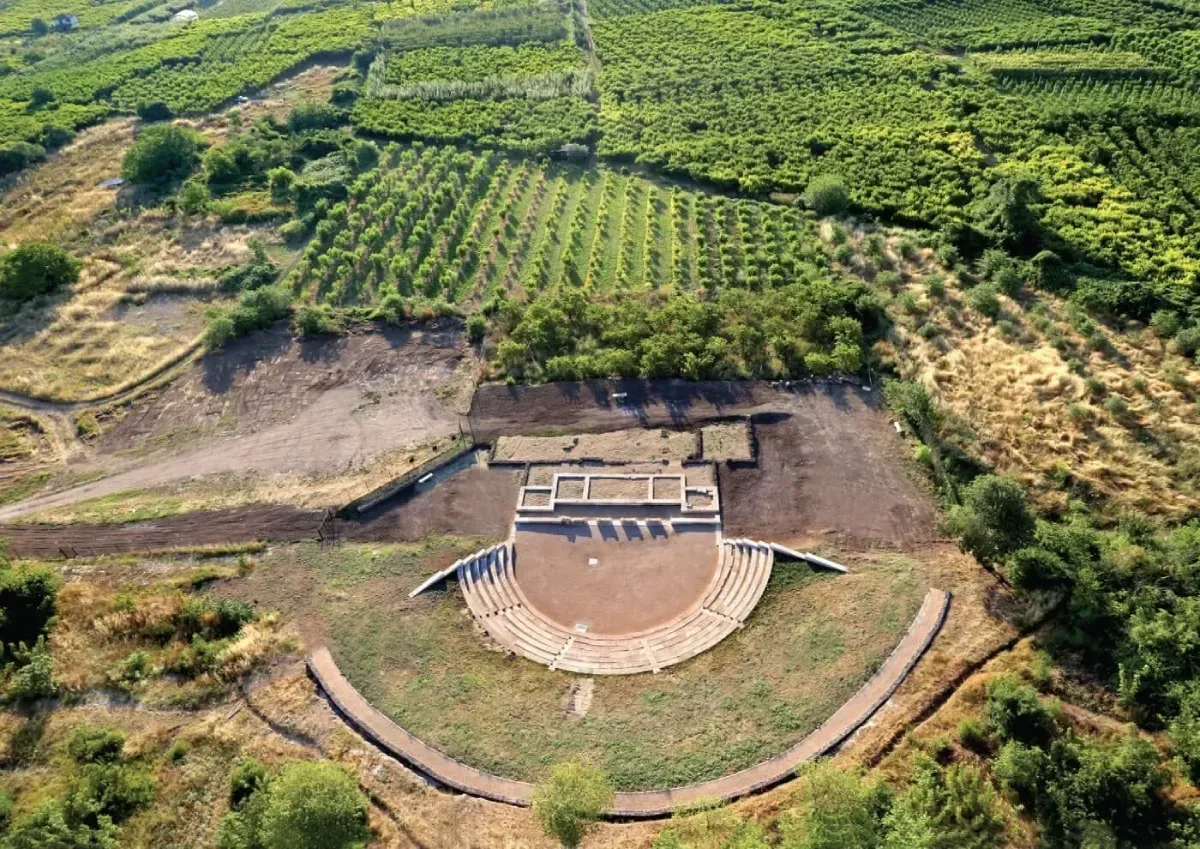
New excavations at ancient Mieza in northern Greece are strengthening the case that a fourth-century BC royal gymnasium was the educational complex where Aristotle taught the young Alexander the Great and other members of the Macedonian elite.
Work since 2024 has exposed more of the site's teaching, athletic and dining areas, clarifying the layout of a complex built during the reign of Philip II.
The 2026 season concentrated on the eastern side of the gymnasium, where the palaestra meets an area identified as the Didaskaleion, or teaching section. Archaeologists have identified lecture rooms with stone desks and a three-part suite covering more than 160 square meters. A central vestibule opens into two andrones, banquet halls with mosaic floors and raised platforms for reclining couches. Each could hold ten couches.
Earlier work established the scale of the site. The gymnasium covers roughly 3.5 hectares and includes a Doric xystos, a covered running portico nearly 200 meters long. Four writing styluses were recovered during the 2025 campaign, along with pottery, coins and fragments of Panathenaic amphorae.
Greece's Ministry of Culture dates the monumental complex to the middle of the fourth century BC, during Philip II's reign. Its construction and architectural details also show close parallels with the royal palace at Aigai.
Plutarch provides the clearest ancient textual link between Aristotle, Alexander and Mieza.
Plutarch (Bios Alexandrou / Life of Alexander, 7.3–4)
Philip II of Macedon invited Aristotle to educate Alexander and assigned Mieza to them:
"He gave them the Nymphaeum near Mieza as a place for study and recreation; there, even today, Aristotle's stone seats and shaded walks are shown."
For decades, a sanctuary and small portico at the nearby Nymphaeum of Isvoria were treated as Aristotle's school because they appeared to fit that description. More recent research has shifted attention to the much larger gymnasium. The Greek Ministry of Culture's archaeological portal now says the famous school should be sought within the monumental complex.
Ancient accounts of Macedonian elite education fit that setting. Arrian writes that, from Philip's reign, sons of senior Macedonians entered royal service around puberty, guarded the king and accompanied him on hunts. Curtius Rufus says they also received a liberal education and were prepared for future military and administrative roles.
No inscription found in the gymnasium names Aristotle or Alexander, and none of the writing tools can be tied to a known student. The identification rests on chronology, location, architecture, material finds and the literary tradition connecting Mieza with Aristotle's teaching.
The excavated plan points to a royal educational complex rather than a single classroom: teaching rooms beside athletic facilities, formal dining spaces beside the palaestra, all built on a scale consistent with Philip II's court.
Sources: Hellenic Ministry of Culture, Ephorate of Antiquities of Imathia, Plutarch, Arrian, Quintus Curtius Rufus, Bosphorus News review and reporting.