
By Bosphorus News Geopolitics Desk
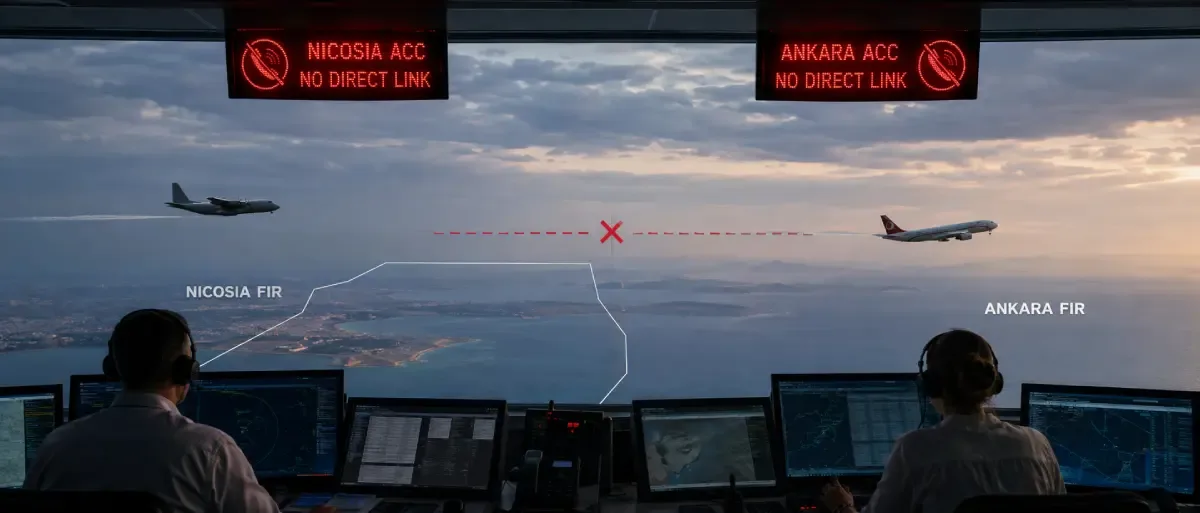
European air traffic controllers called on the Republic of Cyprus, Türkiye, the European Union and the International Civil Aviation Organization (ICAO) on August 28 to pursue high-level engagement over the lack of direct coordination between the Ankara and Nicosia area control centers after a reported near miss involving a Turkish military transport aircraft and a civilian Boeing 737.
The Air Traffic Controllers European Unions Coordination (ATCEUC) said the problem remains unresolved fourteen years after the European Commission's Directorate-General for Mobility and Transport described the situation in correspondence with the organization as unacceptable from a flight-safety perspective. The current Republic of Cyprus Aeronautical Information Publication (AIP) also states that direct communication and coordination between Ankara and Nicosia cannot be carried out.
ATCEUC represents 34 professional trade unions and more than 16,000 air traffic controllers and air traffic safety electronics personnel across Europe. It participates in the European Union's sectoral social dialogue for civil aviation.
The August 19 Incident
The Pan-Cypriot Air Traffic Controllers Union reported on August 19 that an aircraft using the call sign TUAF770 did not respond to calls from the Nicosia area control center, departed from its filed route and began climbing toward flight level 360.
A TUI Airways Boeing 737-800 operating as TOM56T was descending toward flight level 350 on a converging trajectory.
According to the union, Nicosia controllers detected the conflict and stopped the Boeing's descent. ATCEUC later identified TUAF770 as a Turkish Air Force Airbus A400M military transport aircraft and described the episode as a near miss.
The Republic of Cyprus Department of Civil Aviation responded the following day that Turkish aircraft operating in the Nicosia FIR are a longstanding and recurring operational reality that controllers manage on an almost daily basis. It also said aviation safety remained at a particularly high level and that controllers had identified the possible convergence in time to take the required action.
ATCEUC returned to the incident on August 28 in calling for renewed technical and diplomatic engagement.
Ankara and Nicosia Still Cannot Coordinate Directly
The current Republic of Cyprus AIP states that direct communication and coordination between the Ankara and Nicosia area control centers cannot be effected because Türkiye closed the direct communication line.
The absence of that channel changes how aircraft crossing between the two flight information regions are handled. Aircraft entering the Nicosia FIR from Ankara are instructed to establish radio contact with Nicosia before reaching the boundary and pass essential flight information themselves.
ATCEUC said the problem was already the subject of a 2012 letter from the European Commission's Directorate-General for Mobility and Transport to the organization's then chairman, Volker Dick. According to ATCEUC, the Commission described the situation as unsustainable and unacceptable from a flight-safety perspective.
Independent aviation guidance records the same operational divide.
An International Air Transport Association (IATA) safety notice on the Nicosia FIR identifies the lack of contact between Ankara and Nicosia area control centers and warns operators of possible conflicting air traffic instructions and uncoordinated transfers in the northern part of the FIR.
A joint briefing by the International Federation of Air Line Pilots' Associations and the International Federation of Air Traffic Controllers' Associations likewise states that the Ercan advisory airspace is not recognized by ICAO and that air traffic service responsibility remains with Ankara and Nicosia within their respective internationally recognized FIR boundaries.
A flight information region assigns responsibility for flight information and alerting services. Its boundaries do not by themselves establish sovereignty over the airspace concerned.
Competing Air Traffic Arrangements
Within the ICAO-recognized structure, the Republic of Cyprus Department of Civil Aviation provides air navigation services across the Nicosia FIR.
Turkish Cypriot authorities operate a separate control structure through Ercan and maintain that they provide air traffic services across the northern part of the Nicosia FIR and an adjoining area associated with the Ankara FIR under arrangements with Türkiye.
The Ercan advisory area extends into the northern part of the Nicosia FIR and part of the Ankara FIR. ICAO does not recognize Ercan as a separate controlling station within the Nicosia FIR.
Aircraft operators therefore face two air traffic structures in the northern part of the FIR that are not recognized in the same way. Nicosia remains the internationally recognized control authority within its FIR, while Ercan issues instructions in an area where the Turkish Cypriot side says it provides air traffic services.
The direct Ankara-Nicosia coordination channel remains absent across that divide.
The UN Correspondence
A separate record of the dispute has accumulated at the United Nations for years.
The Republic of Cyprus periodically sends the UN Secretary-General detailed lists of what it describes as violations of its national airspace, international air traffic regulations in the Nicosia FIR, territorial waters and restrictions involving ports and airports in the north. The letters circulate as General Assembly and Security Council documents under the agenda item "Question of Cyprus."
A June 30, 2025 letter, A/79/963-S/2025/438, covered July through December 2024 and contained twelve annexes. It recorded 989 alleged air violations and 45 naval violations, including 264 involving Turkish military unmanned aerial vehicles.
Türkiye's Permanent Mission to the United Nations responded on August 7 by formally transmitting a letter from the Turkish Cypriot representative rejecting the allegations.
That format recurs in the UN record: Türkiye's mission makes the formal submission while transmitting the substantive position of the Turkish Cypriot representative.
The correspondence continued in 2026.
A February filing covering September through December 2025 recorded 921 alleged air violations and 40 naval violations, part of a Republic of Cyprus complaint to the United Nations previously examined by Bosphorus News. The filing attributed 388 of the alleged air incidents to unmanned aerial vehicles and 151 to armed fighter aircraft.
A March 27 letter covering January and February listed another 305 alleged air violations and 33 naval violations, including 81 involving Turkish military unmanned aircraft and 44 involving armed fighter aircraft.
A June 22 letter from Permanent Representative Maria Michael covering March through May reported 520 alleged aerial violations and 23 naval violations. It said 103 of the air incidents involved unmanned aircraft and 196 involved Turkish military fighter aircraft.
Those figures are Republic of Cyprus allegations submitted to the United Nations. They are not independent UN findings.
The Turkish Cypriot Position
The operational dispute surfaced publicly again in June after the Republic of Cyprus accused Turkish Cypriot authorities of interfering with communications involving aircraft carrying European defense ministers to the island.
Kürşad Hüdaverdioğlu, president of the Turkish Cypriot Air Traffic Controllers Union, rejected the allegation and told the Cyprus Mail that the incident had nothing to do with harassment.
Türkiye's Directorate of Communications separately said that on June 7, four of six aircraft flying between Greece and the Republic of Cyprus entered airspace regarded by the Turkish side as belonging to the Turkish Republic of Northern Cyprus (TRNC). It said two Turkish F-16s stationed in northern Cyprus were scrambled as a precaution and denied that they harassed the aircraft or entered airspace controlled by the Republic of Cyprus.
The competing accounts return to the same operational problem: the two sides do not recognize the same air traffic structure in the northern part of the Nicosia FIR.
Nearly 100,000 Commercial Flights
Eurostat data published on August 28 recorded 97,096 commercial flights at Larnaca and Paphos airports during 2025. Larnaca accounted for 73,226 and Paphos for 23,870.
ATCEUC has asked ICAO to review the absence of two-way coordination between Ankara and Nicosia and engage directly with the relevant authorities. It also wants Eurocontrol to conduct a safety assessment of current operations in the Nicosia FIR and has called for renewed talks involving the European Commission, the Republic of Cyprus and Türkiye on a technical solution.
The current Cyprus AIP still instructs aircraft entering the Nicosia FIR from Ankara to contact Nicosia controllers before crossing the boundary and pass their own essential flight details because the two area control centers cannot coordinate directly.
Sources: Air Traffic Controllers European Unions Coordination, Republic of Cyprus Department of Civil Aviation, United Nations Digital Library, IATA, IFALPA/IFATCA, Pan-Cypriot Air Traffic Controllers Union, Turkish Cypriot Air Traffic Controllers Union, Türkiye's Directorate of Communications, Eurostat, Cyprus Mail, Bosphorus News review and reporting.