
By Murat Yıldız
My mentor, Professor Veysel Ulusoy, who now chairs this publication's editorial board, has often asked me with a smile whether I am Greek.
He is not the only one. People who know my attachment to ancient Greek philosophy, history and political thought eventually ask the same question, and it is an especially enjoyable question to put to someone who considers himself a Turkish nationalist. My instinctive answer has always been yes. The older I become, the less willing I am to give that answer before examining what the question means.
Not by ancestry, citizenship or national loyalty. I am Turkish, and I have never regarded that identity as uncertain or negotiable. My political loyalties, historical consciousness and sense of national belonging are Turkish. Yet much of the intellectual equipment with which I understand politics, journalism, power and public life came from ancient Greece.
Plato taught me to distrust the shadows presented as reality. Pyrrho taught me to distrust certainty, including my own. Thucydides taught me to look beneath the moral language of states and examine the power supporting it. The memory of Thermopylae gave me a language for discipline, endurance and holding one's position under pressure. These thinkers did not give me another passport. They gave me part of my mind.
The question becomes more difficult because I do not approach this civilisation as a culturally neutral outsider. I approach it as a Turk. In parts of the Greek public imagination, Turks are still sometimes dismissed as barbarians or Mongols, people supposedly arriving from outside civilisation rather than becoming participants in it. Such words reduce a complex people to an invading mass and treat culture as something permanently protected by ancestry.
I have no interest in answering one ethnic insult with another. The contradiction still deserves examination. What happens when the man described as a barbarian has spent years reading Plato, Isocrates and Thucydides, and enters those works more seriously than some who regard them as a birthright?
If education can create an intellectual ancestry, Professor Ulusoy's question is not absurd.
Education rather than blood
The idea has an ancient source.
In 380 BC, Isocrates wrote in his Panegyricus that Athens had advanced so far in thought and speech that its pupils had become the teachers of the rest of the world, and that the name Hellenes had come to signify education and intelligence rather than common descent. In George Norlin's translation:
The name Hellenes suggests no longer a race but an intelligence, and the title Hellenes is applied rather to those who share our culture than to those who share a common blood.
The popular claim that anyone educated in Athens becomes an Athenian is not what Isocrates wrote. His word was Hellene. His argument was that Athens had transformed Greekness from a condition received at birth into something that might also be acquired through education.
A shortened Greek version of the sentence is carved into the façade of the Gennadius Library in Athens.
Ἕλληνες καλοῦνται οἱ τῆς παιδεύσεως τῆς ἡμετέρας μετέχοντες
Those who participate in our education are called Hellenes. For someone who studied political science and international relations in Athens, those words carry unusual weight. They stand in stone in the city where I studied, among the streets, libraries and institutions through which Greek thought first became more than an academic subject for me.
Isocrates should not be turned into a modern prophet of borderless cultural identity. The Panegyricus was a political speech. He wanted the Greek cities to overcome their conflicts, unite against Persia and accept Athenian leadership, and his expansion of the Hellenic name served that purpose. He was strengthening Athens' claim to educate and lead the Greek world rather than abolishing the distinction between Greeks and non-Greeks.
The irony is difficult to miss. The sentence through which a Turkish nationalist might claim participation in Greek civilisation was written to mobilise the Greeks for a campaign against Asia. The person now called a barbarian finds his strongest argument for admission in a text produced by a civilisation that once defined itself against people to the east.
That irony sharpens the idea rather than destroying it. Can a person inherit the thought of a civilisation that once placed people like him beyond its political and cultural frontier? Can an argument escape the purpose for which it was first deployed?
Where the questions were first asked
There is a fact that complicates the geography of this argument, and both sides tend to leave it out.
Philosophy did not begin in Athens. It began on the Anatolian coast. Thales, Anaximander and Anaximenes were Milesians, from a city whose ruins now sit in the Turkish province of Aydın. Heraclitus was from Ephesus, near Selçuk. Herodotus was born in Halicarnassus, which is Bodrum. Pythagoras came from Samos, a few kilometres off the coast of what is now Kuşadası. The first attempt in the Western record to explain the world without recourse to gods was made within sight of a shoreline I can reach by car in a morning.
I am careful about what this proves, because the temptation to overclaim it is exactly the error I want to avoid. The Ionians were Greek-speakers in Greek cities. Turks arrived in Anatolia many centuries later. Republican Türkiye once experimented with a historical thesis that tried to fold Anatolian antiquity into a Turkish national lineage, and that thesis failed for the same reason the taxi driver's assumption fails. Soil does not transmit thought.
The geography cuts in both directions, and that is why it matters. It denies me the claim that Ionian philosophy is mine because it happened where I live. It denies the modern Greek the claim that it is his because he shares a language with the men who made it. What remains, once both inheritance claims collapse, is the only route either of us has: reading them.
Anaximenes is not my ancestor. He is my neighbour across twenty-six centuries, and the distance between us is measured in study rather than kilometres.
The route the inheritance actually travelled makes the point better than any argument about ownership. Much of Aristotle returned to western Europe through Arabic translation and commentary, by way of Baghdad, Córdoba and Toledo, before Latin Christendom could read him again. When Constantinople fell in 1453, the scholars who carried Greek manuscripts to Italy were largely men of that city, and the Renaissance recovery of Greek texts depended on them. At no point in that chain did the inheritance sit safely inside a single people. It survived because it kept passing through hands that were not its own.
The bridge I live on
I do not offer my answer as a political programme. I do not expect others to adopt my intellectual inheritance, and every person finds teachers in different traditions. I can only describe my own formation.
Ancient Greek thought has become part of the bridge on which I live. On one side stands my Turkish identity, my nationalism, my political loyalty and the historical community to which I belong. On the other stands a body of thought that shaped how I understand truth, power, doubt, citizenship and responsibility. It is not always a comfortable bridge.
Modern Turkish and Greek identities have often been narrated against one another. Each nation has appeared in the historical memory of the other as adversary, former ruler, former subject, neighbour and inherited comparison. The difficulty is conceptual as well as historical. From one side of the Aegean, the Turk has often been imagined as the opposite of the Greek, Asian rather than European, barbarian rather than civilised.
I do not deny the history separating us. I reject only the assumption that history grants one modern nation permanent ownership of thought. My national loyalty tells me where I belong. Ancient philosophy helps me decide how I should think while standing there. It has given me bearings rather than a closed ideology or a fixed list of answers.
There are moments in public life when language becomes manipulative, certainty becomes fashionable and repetition begins to pass for evidence. Institutions use noble words to conceal narrow interests. Political actors demand loyalty before examination. Journalism rewards speed, performance and confidence even when the facts remain incomplete. At such moments I return to ancient thought, because it helps me see where I am standing.
The Acropolis as inheritance
The distinction between national belonging and intellectual inheritance becomes visible in the most ordinary situations.
As a Turk in Athens, you may enter a taxi and discover that the driver wants to explain Greece and Greekness to you. He may tell you about history, national character, Europe, Türkiye and the ways foreigners misunderstand his country. You listen politely. Sometimes you smile inwardly.
I encountered this confidence more than once. It often carried an unspoken assumption that the intellectual inheritance of ancient Greece arrived naturally with Greek birth. Plato, Pericles, Leonidas and Thucydides were discussed with the familiarity of family possessions, as though their knowledge had passed intact through the generations. The same person who assumes that Plato belongs to him by birth may also assume that I stand outside Greek civilisation by birth. He is the natural heir. I am the barbarian at the gate.
Books complicate that division. Philosophy does not ask for a family certificate before it begins to educate its reader. Being born in Plato's country does not place the Allegory of the Cave inside the mind. Living beneath the Acropolis does not confer an understanding of Pericles' Funeral Oration. Belonging to the modern Greek nation does not transfer the political judgment of Thucydides. A driver may speak about these figures with confidence even when it is clear that he has never opened the books in which their arguments survive.
I do not say this with contempt. He possesses something I never can. He belongs naturally to the language, landscape and living memory of Greece. The Acropolis may have been part of the horizon of his childhood, and ancient names may have surrounded him long before he was old enough to understand their historical weight.
I came to them differently. I spent years reading them, returning to difficult passages, comparing interpretations and testing their arguments against journalism, politics and my own assumptions. I inherited Plato through pages. Whatever understanding I possess of Thucydides had to be pursued through study. Books transmit philosophy, and a birthplace provides access to a civilisation without providing understanding of it.
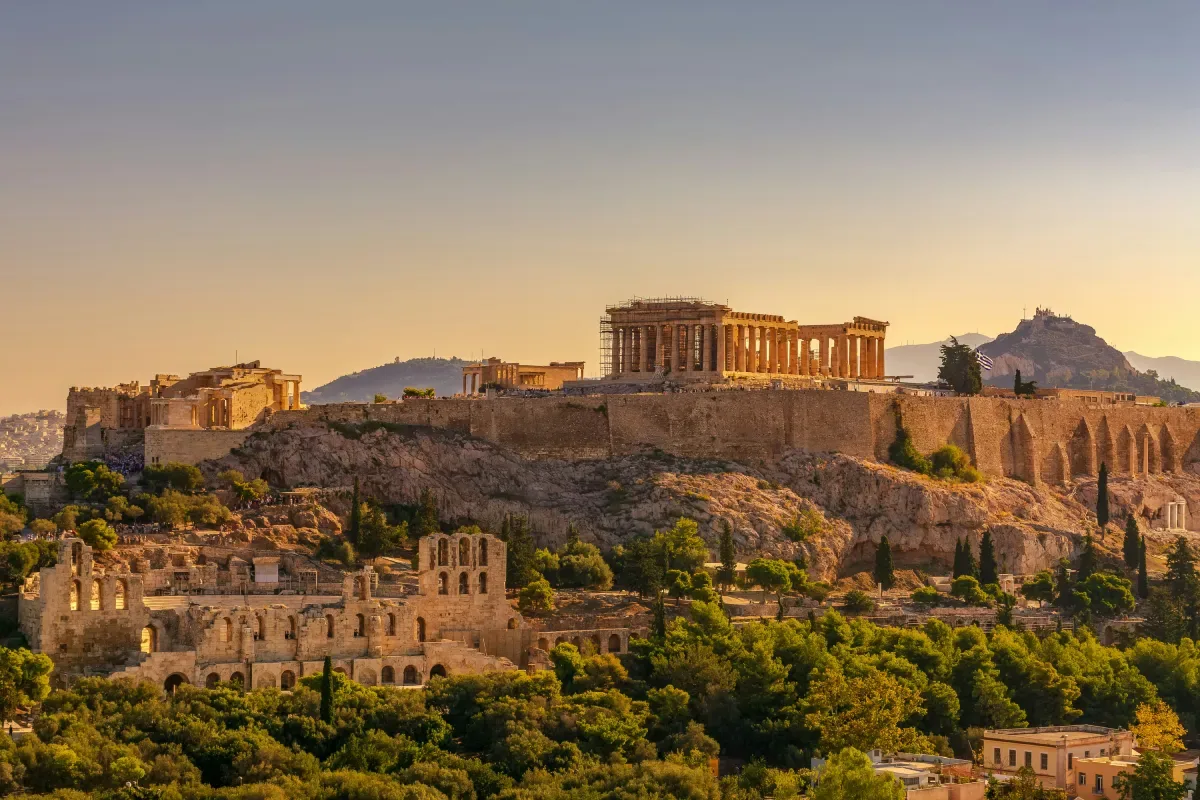
Eventually the driver leaves me beneath the Acropolis or among the streets of Plaka. He returns to the city he inherited. I enter the texts through which I have tried to inherit it. There, Pericles is no longer only a name in Thucydides. He becomes part of the landscape, carrying the ambition of Athens, the confidence of its public language and the contradiction between its democratic self-image and its imperial power.
The driver may pass the Acropolis every day. I arrive beneath it carrying Plato, Isocrates, Thucydides and the Milesians in my mind. His Greece is a homeland he inherited. Mine is a school I chose, and a school in which I remain a student.
He is Greek by belonging. I am Greek, if at all, by apprenticeship.
He may be Greek without reading Plato. I may read Plato for a lifetime without becoming Greek in the national sense. But if the inheritance under discussion is philosophy rather than citizenship, birth alone cannot settle the question. If Isocrates was serious that Hellenes were recognised through education, his sentence imposes a demand on native Greeks as much as it opens a door to outsiders. The native must also become a student.
The sharpest version of that demand comes from a Greek. In 1975 Nikos Dimou published On the Unhappiness of Being Greek, a sequence of aphorisms arguing that his countrymen were weighed down by a past they had inherited without earning. Any people believing itself descended from the ancient Greeks, he wrote, would be automatically unhappy, because the distance between the inheritance and the present is unbearable. He was labelled anti-Hellene for it, a gadfly at best and a traitor at worst. What he was doing was applying the Delphic instruction to know oneself to a nation that preferred not to. If a Greek can be called a traitor for saying that descent guarantees nothing, then the question of who may claim the inheritance was never only a question about foreigners.
The light by which I think
Ancient Greek thought is not a cabinet of quotations I open when I need intellectual decoration, nor an arsenal of famous names with which to defeat an opponent. It is one of the lights by which I navigate argument.
Plato's Allegory of the Cave has carried me through more sterile political disputes than almost any modern theory, and not because invoking Plato ends a debate. It changes the ground on which the debate takes place. It asks whether those involved are discussing reality or only the shadows that habit, ideology and social pressure have taught them to accept as real. Many political conflicts are not disagreements over facts. They are confrontations between rival caves, each with its own shadows, custodians and prisoners.
Pyrrho of Elis asks whether I have become too certain. His suspension of judgment is discipline rather than intellectual cowardice. In journalism, where speed rewards confidence and public debate punishes hesitation, that lesson is indispensable. Not knowing is not always a failure. Pretending to know usually is.
Empedocles prevents me from reducing political and social conflict to a single cause. His world is governed by attraction and separation, love and strife, combination and dissolution, and political orders also emerge from competing forces that hold together temporarily before separating again.
Anaximenes taught me to look for continuity beneath visible change. His cosmology belongs to antiquity, and the intellectual habit remains useful. Governments change, alliances shift and rhetoric hardens or softens while deeper structures remain intact. That he worked this out in Miletus, on a coast that is now Turkish, is a coincidence of geography I have learned not to make too much of, and not to forget either.
Socrates asks the question underneath all of this, and he asks it from the opposite direction. He was not an outsider seeking admission. He was Athenian by birth, by military service and by every criterion the city recognised, and the city put him to death for asking questions in public. At his trial he described himself as a gadfly fastened to a large and sluggish horse. Athens executed the man who best embodied what it claimed to prize. Membership did not protect him, and if the city could expel its most Athenian mind, the frontier it drew around itself was never about origin at all.
These thinkers do not tell me what conclusion to reach. They help me ask better questions before reaching one. Philosophy illuminates the terrain on which an argument is taking place, without ending the argument.
Intellectual descent must mean more than admiration. It begins with the thinkers to whom one repeatedly returns when the world becomes difficult to interpret.
Thucydides beneath modern politics
As a journalist and political scientist, I have read shelves of books about foreign policy, diplomacy, war and international order. When much of that literature is stripped to its foundations, the road leads back to a small Aegean island in the fifth century BC. It leads to Melos.
In Thucydides' account, representatives of imperial Athens confront the Melians, who wish to remain neutral during the Peloponnesian War. The Athenians refuse to conceal the dispute behind abstract claims of justice. Justice, they argue, has force only among parties with comparable power. The strong do what their power permits, while the weak endure what they must.
The passage is often treated as Thucydides' endorsement of ruthless power politics, and that reading is too simple. Thucydides places the argument in the mouths of the Athenians and allows imperial power to explain itself without moral disguise. He also places Melos within a wider history of Athenian brutality, overreach and eventual catastrophe. The Melians discover that moral conviction, historical friendship and appeals to justice cannot protect a community unsupported by power. The Athenians discover that superiority does not abolish judgment, consequence or the possibility of ruin. Melos is a warning to the strong as much as a lesson for the weak.
To read Thucydides seriously is to refuse innocence about power. Governments speak of law, principle, security, civilisation, historical rights and moral obligation. Such words may be sincere and legally important. Thucydides teaches me to ask what distribution of power stands behind them, who can enforce them and who will bear the cost when they fail. As a journalist, I listen to what states say, and he taught me to examine what their power allows them to do.
Plato taught me how people mistake shadows for truth. Thucydides taught me how states attempt to turn power into truth. Whenever political language becomes too clean, too moral or too convenient, Melos remains in the background.
Athens, Sparta and chosen virtues
There is another Greece in my imagination, found not in the schools of Athens but at the pass of Thermopylae.
Sparta, Leonidas and the Three Hundred have long represented discipline, endurance, loyalty and the refusal to abandon one's position. Many people with no Greek ancestry call themselves Spartans. They do not mean that they descend from Lacedaemon. They mean that when the line must be held, they know which virtues they hope to possess. I am proud to call myself Spartan in that symbolic sense.
That claim costs nothing, and the difference matters. A film can make a man a Spartan by the end of the evening. Nobody who adopts Leonidas as a personal emblem is required to read Herodotus, weigh the helot system or account for what Sparta did to Athens after the Peloponnesian War. Chosen symbols are cheap in a way that chosen study is not. If my claim on Athens rests on anything, it rests on the years, and I should hold it to the standard I applied to the taxi driver.
The Sparta inherited by the modern world is partly history and partly myth. Its courage existed alongside a restrictive social order sustained by the domination of the helots, and discipline cannot erase oppression. Athens carries comparable contradictions. It gave the world democracy while excluding women, slaves and resident foreigners from political participation. It celebrated education as the basis of Hellenic distinction while Pericles' citizenship law of 451 BC restricted Athenian citizenship to those with two Athenian parents, one of the most closed arrangements in the Greek world. It praised freedom while exercising imperial power over other Greek communities.
Athens preached cultural openness and practised legal closure. The sentence I have quoted from Isocrates was written in a city that would not have made me a citizen under any circumstances.
A civilisation cannot be inherited honestly by selecting only its noblest description of itself. I do not inherit Athens by pretending its democracy was complete, or Sparta by pretending courage cancelled oppression. Intellectual inheritance begins where admiration becomes capable of judgment. To inherit a tradition is to accept its questions, achievements, crimes and contradictions together. Athens teaches me to question. Sparta reminds me that standing by an answer may carry a cost.
A Turkish path to Athens
There is an objection from my own side, and it deserves an answer before the Greek one. Why Athens? Türkiye has inheritances of its own. Ibn Khaldun built a theory of how states rise and decay that no Greek wrote. Yusuf Has Hacib set out a political ethics in Turkish in the eleventh century. The Ottoman scholarly tradition ran for centuries without needing Athens as a reference point. A Turkish nationalist who reaches first for Thucydides can fairly be asked what he thinks he is doing.
These are not competing claims. The Muqaddimah sits alongside Thucydides rather than beneath him, and what I am describing is my own formation rather than a ranking of civilisations. A formation is a biography.
The objection also answers itself. Farabi, Ibn Sina and Ibn Rushd read the Greeks closely enough to argue with them and to produce work the Greeks had not produced, and it occurred to nobody to ask whether this had made them Greek. They were doing what serious readers do with a serious text. The tradition was never a Greek possession, even in the centuries when Greek was the language it was written in.
The distinction between national culture and participation in a wider civilisation is not foreign to Turkish thought.
Ziya Gökalp distinguished hars, the specific culture of a nation, from medeniyet, the broader civilisation in which different nations could participate. A society could preserve its national identity while adopting institutions, methods and ideas that did not originate within its ethnic community. One need not accept every part of Gökalp's system to recognise the usefulness of that distinction.
I do not become less Turkish by acknowledging Athens as one of the places where my mind was formed. Political loyalty and intellectual education are not identical categories. A Greek may be shaped by Roman law, Christian theology, French republicanism or German philosophy without ceasing to be Greek. A Turk may be formed by Socrates, Thucydides and the Milesians without surrendering his national identity. A civilisation proves its greatness when its ideas cease to be the private possession of its descendants.
That claim carries danger. Cultural universalism has often served imperial power. Isocrates used education to justify Athenian leadership, and later European powers used the language of civilisation to legitimise assimilation and domination. Education may invite participation, and it may also demand submission.
The question is not whether someone educated in a tradition becomes entitled to speak for the people from whom it emerged. He does not. The question is whether someone can become a genuine student of that civilisation without pretending to own it.
So, am I Greek?
I am not Greek by nationality, ancestry or citizenship. I am a Turk, and a Turkish nationalist. That answer is clear.
Some of us spent much of my their lives studying in schools founded by Greeks long dead, some of whom worked on ground that is now my country. Their questions accompany me in journalism, political analysis and public life. They do not think for me. They guide me while I think.
To anyone who sees me only as a Turk, an Asian or a barbarian, the answer will remain no. The frontier has already been drawn, and no amount of study can cross it. Isocrates offered another frontier, placed not in blood, geography or ancestry, but in education. By that measure the question cannot be dismissed so easily.
Perhaps this does not make me Greek. Perhaps it makes me only a serious student of Greece. Perhaps I remain the barbarian who entered the school. But once the barbarian has learned to question the shadows, who has the authority to order him out?
Professor Ulusoy's question therefore remains open. I know that I am Turkish. I also know whose questions I hear when politics becomes dark, language becomes deceptive and certainty becomes too easy. The answer lies somewhere between those two truths.