
By Bosphorus News Economy Desk
A recently published White House report on Chinese tariff evasion published this month places Türkiye among a group of countries it says combine significant trade volume with deep integration into China-linked supply chains, part of a broader network the report says has cost the United States tens of billions of dollars a year in lost tariff revenue.
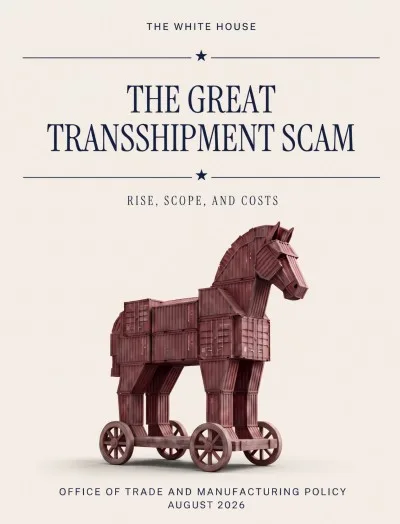
The report, titled "The Great Transshipment Scam" and issued by the White House Office of Trade and Manufacturing Policy, identifies more than 40 countries it says present elevated risk of illegal transshipment, the practice of routing Chinese-origin goods through third countries with relabeling, repackaging or minor processing to disguise their origin and avoid the higher tariffs the United States applies directly to China.
Türkiye Placed in the Network's Middle Tier
The report sorts the 40-plus countries into three tiers. Türkiye appears in Tier 2, described as "Scale Leaders with Significant Economic Integration with China," alongside Brazil, Indonesia, Malaysia, Thailand and Vietnam. The report says these countries combine substantial volumes of China-linked goods with deeper integration into Chinese supply chains, manufacturing platforms or regional rerouting channels, and it specifically describes Brazil and Türkiye as "larger regional production and logistics platforms capable of supporting rerouting or transformation claims across selected product categories."
A separate functional classification in the report places Türkiye among what it calls "Developed Logistics Platforms," alongside Belgium, Canada, the Netherlands, Singapore and Switzerland. The report describes this group as offering "advanced customs, ports, trading houses, bonded warehouses, and global re-export systems" that support the movement of goods under new documentation.
Türkiye does not appear among the specific product-line examples the report uses to illustrate the pattern, a set of nine "foreign-U.S. city pairings" tracing named product categories from countries including Mexico, South Korea, Vietnam, India, Malaysia, Indonesia, Thailand, the Dominican Republic and Costa Rica to corresponding American manufacturing regions. The report does not name a Turkish product corridor or estimate a country-specific dollar volume for Türkiye.
The Broader Numbers Behind the Report
The report draws on five independent estimates of total annual illegal transshipment into the United States, ranging from $40 billion, based on a Goldman Sachs econometric model, to $303 billion, based on a broader supply-chain exposure measure from the analytics firm Altana. Two government sources, the White House Council of Economic Advisers and the Commerce Department's Office of Trade and Economic Analysis, put the figure at $60 billion and $109 billion respectively, while the AI supply-chain firm Exiger estimated $75 billion.
Applying tariff differentials of 25 to 45 percent to those flows, the report calculates annual U.S. tariff revenue losses ranging from roughly $10 billion at the low end to more than $130 billion at the high end. Under its central case, built on the $75 billion Exiger estimate, the report projects roughly 450,000 American jobs displaced, $113 billion to $150 billion in lost annual GDP, and $19 billion to $26 billion in foregone federal revenue.
Enforcement Response
The report ties its findings to Executive Order 14411, signed by President Trump on June 3, 2026, which directs the Department of Homeland Security and Customs and Border Protection to tighten importer-of-record requirements, increase bonding and ownership-disclosure rules, and strengthen penalties for customs violations. It also describes an "AI-enabled Detective Border" under development at CBP, intended to fuse shipment data, routing histories and computer-vision analysis of cargo to flag anomalous trade patterns for enforcement.
The report does not describe any planned or existing punitive measures specific to Türkiye, and it stops short of directly accusing Turkish exporters or authorities of facilitating transshipment, framing the country's inclusion instead within its broader tier-and-function classification system covering the network as a whole.
Sources: The White House Office of Trade and Manufacturing Policy, Bosphorus News review and reporting.