
By Bosphorus News Economy Desk
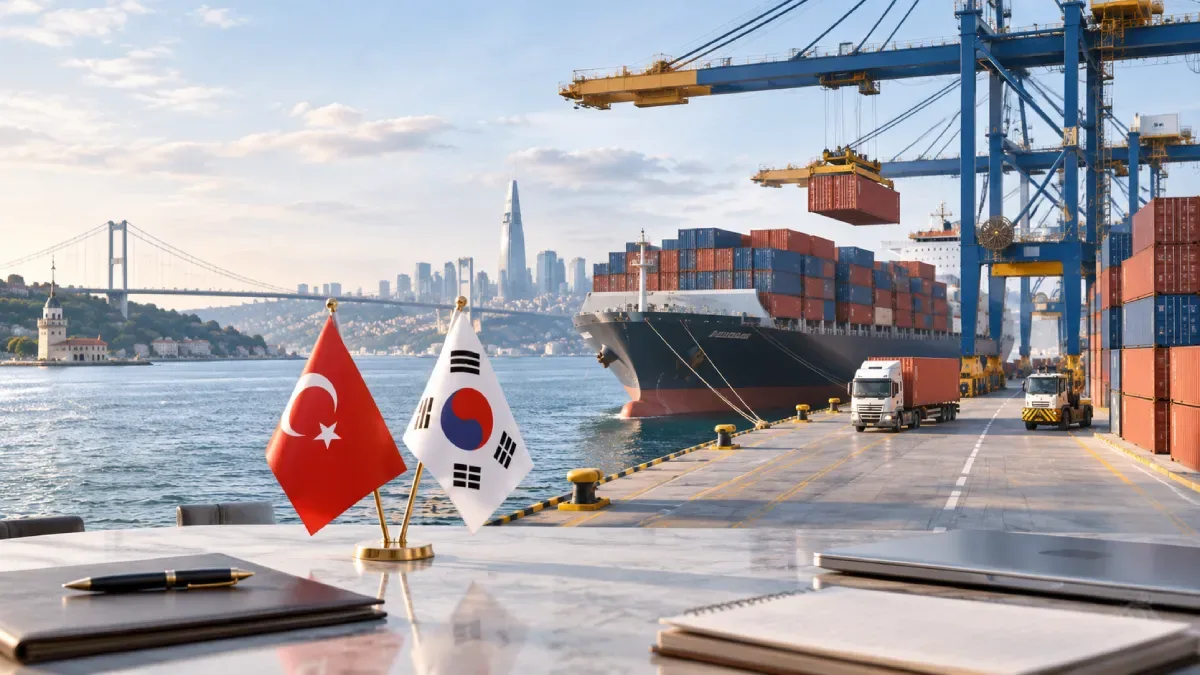
On November 1, 2026, President Recep Tayyip Erdoğan is due to begin a visit to South Korea as Ankara seeks to address a trade imbalance that has persisted throughout the 13-year life of the two countries' free trade agreement (FTA). The Turkish government has raised the possibility of revising tariff concessions, bringing an unresolved economic issue to Erdoğan's scheduled talks with President Lee Jae Myung in Seoul on November 3.
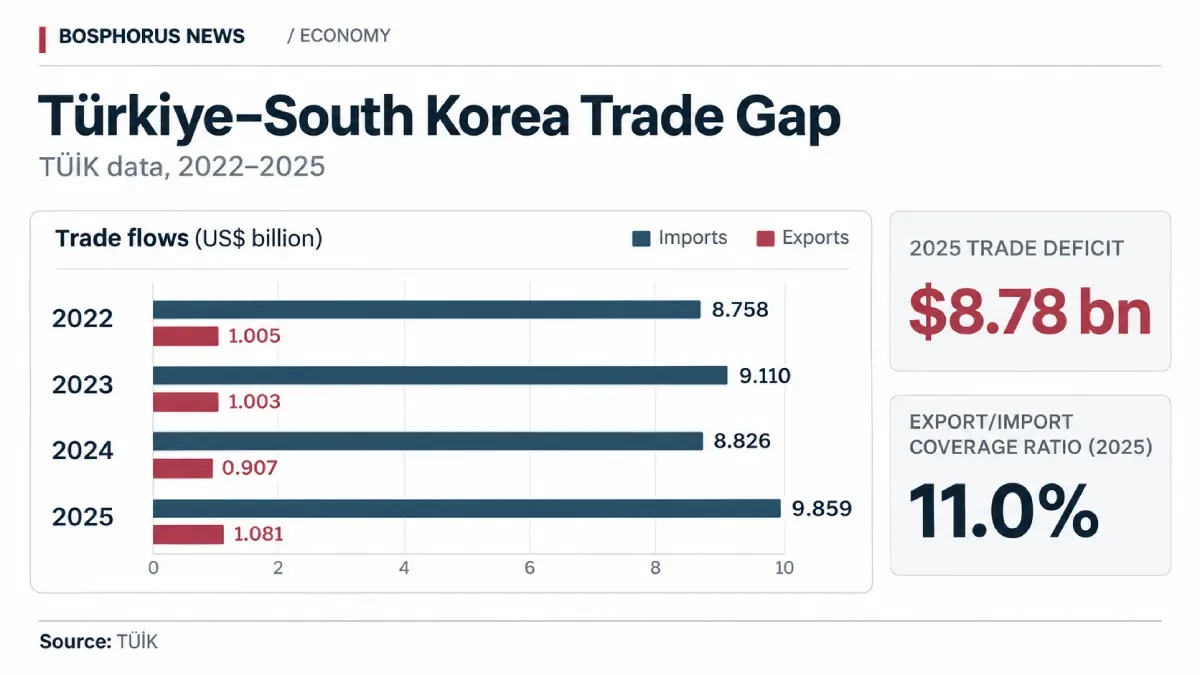
Türkiye exported $1.08 billion in goods to South Korea in 2025 while importing $9.86 billion, according to Turkish Statistical Institute (TÜİK) figures reviewed by Bosphorus News. The resulting $8.78 billion deficit persists despite extensive tariff reductions, while the two governments have yet to achieve their longstanding bilateral trade target of $15 billion.
South Korea is both a major supplier to Turkish industry and an investor in manufacturing operations serving domestic and international markets. Those ties complicate the economic picture, while Turkish companies have secured relatively little of the Korean market, even in sectors where they possess substantial export capacity.
Ankara Has Put the Agreement's Terms on the Table
Preparations for the sixth Türkiye-South Korea FTA Joint Committee meeting, scheduled for June 23-24, 2026, provide the clearest indication of Ankara's approach to the imbalance.
A draft annotated agenda circulated through the Southeast Anatolian Exporters' Associations, based on correspondence from Türkiye's Ministry of Trade, identified the trade deficit as a subject for formal discussion. Turkish officials planned to propose updating tariff-concession lists or exploring alternative measures to achieve a more balanced commercial relationship.
The agenda set aside two hours for the discussion and envisaged agreed minutes and a Joint Committee decision, indicating that Ankara intended to examine the agreement's implementation beyond the general concerns expressed in previous bilateral talks. The document was prepared before the meeting and cannot establish what was ultimately agreed. Bosphorus News has not verified a final committee decision authorizing amendments to the agreement.
South Korea's Ministry of Trade, Industry and Resources separately confirmed plans for the meeting and acknowledged Ankara's intention to propose measures addressing its trade deficit. Seoul had concerns of its own, particularly Turkish import restrictions and difficulties Korean companies encountered with customs procedures and certification.
Türkiye wants greater opportunities for its producers and a more balanced flow of goods, while South Korea is seeking fewer restrictions on products and businesses that already enjoy a strong position in the Turkish market.
Erdoğan had raised the issue at presidential level well before the June meeting. During President Lee's visit to Ankara in November 2025, he publicly called for the FTA to be reviewed to encourage more balanced trade, setting the political context for the subsequent technical discussions.
Thirteen Years of Liberalization, With Little Change in the Balance
The Türkiye-South Korea Trade in Goods Agreement entered into force on May 1, 2013, followed by agreements on services and investment in August 2018. The tariff-liberalization timetable called for the elimination of customs duties on approximately 90% of tariff lines by January 1, 2023, with certain sensitive agricultural products remaining subject to exceptions.
The removal of those barriers expanded preferential access for exporters on both sides, although Türkiye's trade with South Korea remains heavily weighted toward imports.
TÜİK data show that Turkish exports stood at $1.005 billion in 2022, against imports of $8.758 billion, producing a deficit of $7.753 billion. The gap widened to $8.107 billion in 2023, narrowed to $7.919 billion in 2024 and reached $8.777 billion in 2025.
Exports recovered from $907 million in 2024 to $1.081 billion the following year, but imports increased more sharply, from $8.826 billion to $9.859 billion. Türkiye's exports consequently covered only about 11% of its imports from South Korea in 2025, equivalent to more than nine dollars of imports for every dollar exported.
A TÜİK country-level report dated November 1 records $868.95 million in exports and $7.474 billion in imports for the reported portion of 2026, leaving a further deficit of approximately $6.605 billion. The available extract does not establish the precise reporting period or statistical coverage, and these figures cannot be directly compared with full-year totals or other partial-year releases.
Türkiye was already running a substantial deficit with South Korea when the agreement took effect. An earlier Ministry of Trade information note recorded a gap of approximately $5.63 billion in 2013, although differences between the historical and current statistical series prevent a straightforward comparison without further reconciliation.
The persistent deficit does not establish that the FTA has failed. Korean machinery and intermediate goods support production in Türkiye, while exchange rates, industrial investment and demand in both economies also influence trade flows. The figures nevertheless show that removing most tariff barriers has brought Turkish exports nowhere close to the value of Korean goods entering Türkiye.
The $15 Billion Target Has a Distribution Problem
The ambition to increase bilateral trade to $15 billion has appeared repeatedly in official statements. Foreign Minister Hakan Fidan referred to the target in July 2023, linking it to a more balanced relationship, while Erdoğan reiterated the objective during Lee's visit to Ankara in November 2025.
Based on TÜİK's 2025 figures, bilateral merchandise trade amounted to approximately $10.94 billion, with Turkish exports accounting for less than one-tenth of the total. Maintaining that distribution at a higher trade volume would produce a larger absolute deficit, making the composition of future growth particularly important for Ankara.
Turkish exports would have to grow substantially faster than imports to narrow the gap. Yet the FTA's original tariff-liberalization timetable has largely run its course, leaving Turkish businesses dependent on their ability to establish commercial relationships in a market dominated by sophisticated domestic manufacturers and established international suppliers.
The Ministry of Trade's own product assessments show how limited Turkish participation remains in several Korean import markets.
Tariff-Free Access Has Not Secured Market Share
Automotive components offer one of the clearest examples of the difficulties facing Turkish exporters.
South Korea imported approximately $5.117 billion in vehicle parts and accessories from international suppliers in 2025, according to the Ministry of Trade's assessment of potential Turkish industrial exports. Türkiye supplied just $43.94 million, accounting for approximately 0.86% of Korean imports in that product category, despite exporting roughly $8.28 billion in the same group worldwide.
The ministry's report lists an average Korean customs tariff of zero for the relevant Turkish products. Preferential access is already available, but Turkish manufacturers have secured only a small share of demand.
Other industrial categories reveal similar disparities. South Korea imported $4.821 billion in insulated wires and electrical cables during 2025, including just $1.88 million from Türkiye. Turkish shipments of transformers and static converters amounted to approximately $1.05 million in a Korean import market exceeding $4 billion.
The figures do not establish why Turkish suppliers have struggled to gain ground. Differences in product specifications, certification, logistics, pricing and established procurement relationships all warrant examination, particularly where Korean manufacturers have longstanding arrangements with domestic or regional component producers.
Türkiye has the manufacturing capacity to compete internationally in several of these categories, yet its presence in South Korea remains modest despite the tariff advantages available under the agreement.
Revising the FTA's concessions might address specific market-access issues, but improving Turkish export performance would also require closer attention to industrial standards, supplier networks and the commercial barriers that persist after customs duties have been removed.
Korean Investment Changes the Economic Calculation
South Korea's presence in Türkiye extends beyond merchandise exports. Korean companies have invested in manufacturing facilities, industrial partnerships and production networks connecting the Turkish economy to international markets.
According to South Korea's trade ministry, Korean companies had undertaken 1,176 investment projects in Türkiye by the end of 2025, representing approximately $4.59 billion in cumulative reported investment. Manufacturing accounted for 47% of that total.
Hyundai Motor and POSCO are among the Korean companies with industrial operations in Türkiye. Hyundai's vehicle production in İzmit illustrates how Korean investment can generate employment, domestic output and exports while creating demand for imported machinery, components and technology.
Some of Türkiye's imports from South Korea are therefore inputs into domestic production rather than finished goods purchased solely for local consumption. Measuring their economic contribution would require information on domestic value added, procurement from Turkish suppliers and the proportion of production exported to third countries.
The Korean investment figures also use a different methodology from Türkiye's foreign direct investment stock statistics and should not be treated as interchangeable.
Korean investment remains an important consideration in Ankara's review of the trade relationship, although its contribution to Turkish industry does not resolve the limited presence of Turkish exporters in South Korea, particularly in sectors where domestic manufacturers compete successfully elsewhere.
Seoul wants to protect market access and investment conditions for Korean businesses, while Ankara is seeking a stronger position for Turkish producers without disrupting industrial relationships established over more than a decade.
What Can Actually Be Changed?
The FTA's institutional framework allows the two governments to address implementation difficulties and consider amendments, but any changes to tariff concessions would require agreement between Ankara and Seoul.
The June committee agenda indicates that Türkiye was prepared to explore such changes, although no verified final decision establishing revised concessions has been made available for this analysis.
Technical certification, regulatory requirements and access to industrial procurement networks can influence trade even where customs duties have been eliminated. Closer cooperation between Turkish component manufacturers and Korean industrial buyers could support exports, provided the companies involved can meet commercial and technical requirements.
South Korea, meanwhile, has raised concerns about Turkish antidumping and safeguard measures affecting its products. Those complaints form part of the broader discussion over commercial access, alongside Ankara's efforts to improve its export position.
Changes to the agreement would also have to account for Korean manufacturers operating in Türkiye. Restrictions on imports could increase costs for local production where Korean components are difficult to replace, while expanded industrial cooperation would have limited effect on the bilateral deficit unless Turkish firms secured additional sales or production opportunities.
A review of the agreement would therefore have to consider its tariff provisions alongside the industrial relationships developed under them.
Seoul and the Unfinished Trade Agenda
Erdoğan's visit follows nearly a year of publicly stated concern over the FTA's balance and several months of technical engagement between the two governments. His talks with Lee are expected to cover a wider strategic partnership that includes defense industry, energy and technology, but the trade agreement carries an unresolved economic issue with measurable consequences.
The immediate test will be whether the June Joint Committee discussions produce a documented outcome, particularly on tariff concessions or measures intended to improve Turkish access to the Korean market. New industrial partnerships may also create opportunities, although their value for Türkiye's trade position will depend on the participation of Turkish suppliers and the business they generate.
The FTA provides the framework for a relationship that includes manufacturing investment, industrial imports and expanding commercial exchanges. Turkish exports have grown from their earlier levels, but the gap with Korean sales remains wide, while Turkish companies hold small shares in several major Korean import markets.
Reaching the $15 billion target would expand that relationship. Its effect on Türkiye's trade balance would depend on how much of the additional business Turkish exporters could secure.
With the original tariff-liberalization timetable largely implemented and Ankara seeking changes to the agreement's terms, the Seoul discussions will test whether the two governments can advance beyond the trade-volume target that has dominated their economic diplomacy for years.
Data note: Bilateral merchandise trade figures for 2022–2026 are based on the TÜİK country-level report dated November 1, 2026. The 2026 extract does not establish the precise reporting period or statistical coverage and is presented separately from the complete calendar-year figures. South Korea's trade ministry reports bilateral figures using its own statistical series, which differ from the TÜİK figures used here. Historical FTA figures, Korean investment statistics and product-level market data are drawn from separately identified official sources and are not merged into the TÜİK time series.
Sources: Turkish Statistical Institute (TÜİK), Türkiye Ministry of Trade, Republic of Korea Ministry of Trade, Industry and Resources, Southeast Anatolian Exporters' Associations, Presidency of the Republic of Türkiye, Turkish Ministry of Foreign Affairs, TRT Haber, Anadolu Agency, Bosphorus News review and reporting.