
By Bosphorus News Energy Desk
Türkiye will assess small modular reactor designs from four US companies under a roughly $2 million American-funded program tied to Ankara's target of 5 gigawatts of SMR capacity by 2050.
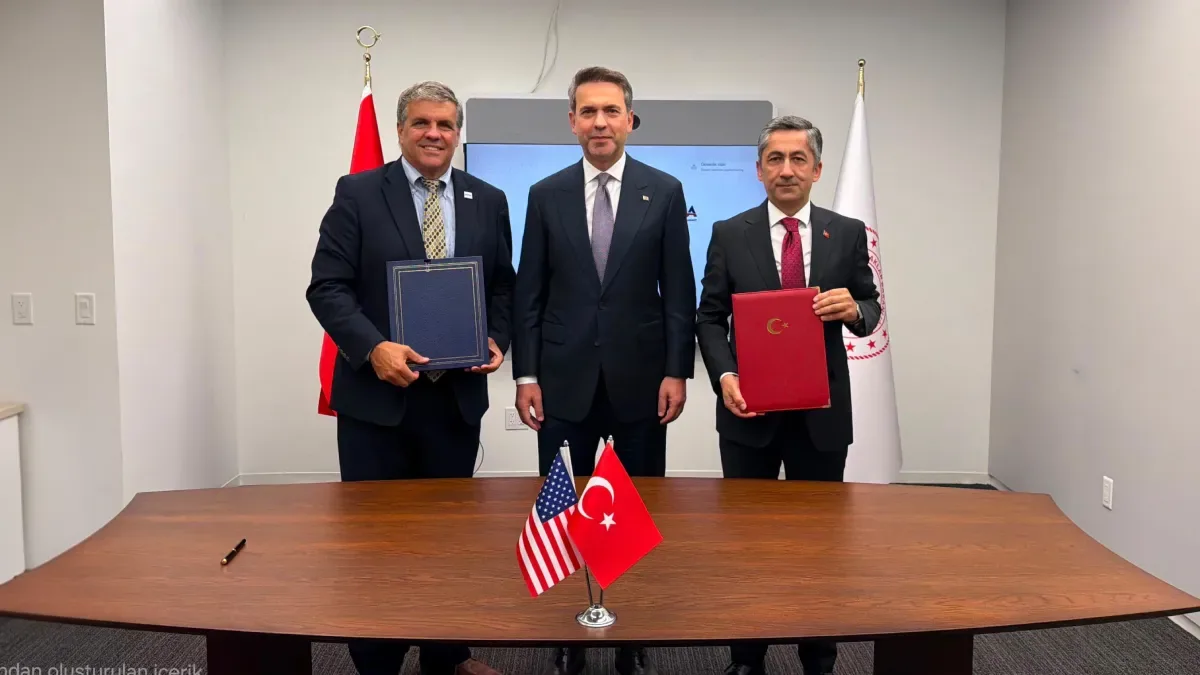
Türkiye Nükleer Enerji Anonim Şirketi (TÜNAŞ) and the U.S. Trade and Development Agency (USTDA) signed the agreement in New York on September 22. The study will run for at least one year and will also examine five US Generation IV reactor designs.
The agreement does not select a supplier or commit Türkiye to building a reactor. It covers work ahead of such a decision, including licensing, financing, site selection, regulation and technical comparison.
USTDA said the program would produce a regulatory, institutional and financial roadmap for SMR deployment by Turkish private companies. The agency also said the review would give US SMR companies an "early entry point" into Türkiye's civil nuclear sector.
Neither Türkiye's Energy Ministry nor USTDA identified the four companies.
Türkiye's Energy and Natural Resources Ministry said their SMR designs will be examined alongside five Generation IV reactor designs on technical, economic, regulatory and licensing grounds. The study will cover design characteristics, costs, supply chains, financing models, licensing status and the advantages and limitations of each option.
It will also examine authorization procedures, emergency planning, reactor safety, site selection and the legal rules needed for future projects.
USTDA said the findings will be submitted to TÜNAŞ and could be used by the Energy and Natural Resources Ministry and the Turkish Nuclear Regulatory Authority when updating nuclear regulations and procedures.
USTDA-funded programs are carried out by US companies. The agency said a request for proposals for the Türkiye technical assistance will be posted separately.
Four US Companies Enter Türkiye's SMR Review
Türkiye is already weighing several reactor technologies and suppliers across its nuclear expansion.
Ankara is targeting 5 GWe of SMR capacity by 2050 while preparing eight additional large reactors for Sinop and Thrace, four at each site.
Türkiye has held talks with companies and governments from South Korea, China, Russia and Canada over its next large nuclear plants. TÜNAŞ signed a memorandum of understanding with Canada's AtkinsRéalis in March to assess CANDU technology, including licensing, financing, ownership models, localization and workforce development.
Supplier and technology discussions remain open for Sinop and Thrace.
The USTDA program is focused specifically on the SMR track. It covers the rules and technical criteria that would govern future projects before Ankara chooses a technology.
The four unidentified US companies will be assessed while Türkiye is still setting the rules for SMR licensing, financing and siting.
USTDA linked the project directly to US commercial interests. The agency said the study would support Türkiye's energy goals while expanding opportunities for American nuclear technology companies.
USTDA Deputy Director Thomas R. Hardy said the program was intended to help create the conditions for SMR deployment and open opportunities for US companies.
Energy and Natural Resources Minister Alparslan Bayraktar said the work would strengthen Türkiye's technical and institutional capacity for SMRs and advanced reactors and support future investment and industrial cooperation decisions.
Akkuyu Sets the Existing Large-Reactor Model
Türkiye's first nuclear power plant was developed under a different model.
Russia's Rosatom is building the four-unit Akkuyu Nuclear Power Plant in Mersin under a build-own-operate structure. Each unit uses a Russian-designed VVER-1200 reactor, giving the plant a planned capacity of 4.8 GWe.
Work in 2026 has centered on bringing Akkuyu's first unit to electricity generation, with Russia also providing about $9 billion in additional financing for the project.
For Sinop, Thrace and future SMR projects, Türkiye has kept multiple technology and financing options open and has sought greater local industrial participation.
The USTDA study will compare US SMR technologies before Türkiye chooses a vendor or completes the rules under which such reactors would operate.
The September agreement follows the Strategic Civil Nuclear Cooperation Memorandum of Understanding signed by Türkiye and the United States on September 25, 2025. Türkiye's Energy Ministry said the TÜNAŞ-USTDA project was developed under that cooperation.
USTDA has also approved funding for Turkish nuclear energy decision-makers to visit the United States in 2027. The delegation is expected to examine US reactor design, manufacturing and operations as well as the American nuclear regulatory system.
The findings will feed into Türkiye's licensing, financing and site-selection rules before any commercial SMR project moves ahead.
Sources: Türkiye's Ministry of Energy and Natural Resources, U.S. Trade and Development Agency, World Nuclear News, Bosphorus News review and reporting.
Clarify the study's funding statusCut repeated study descriptions