
By Bosphorus News Defense Desk
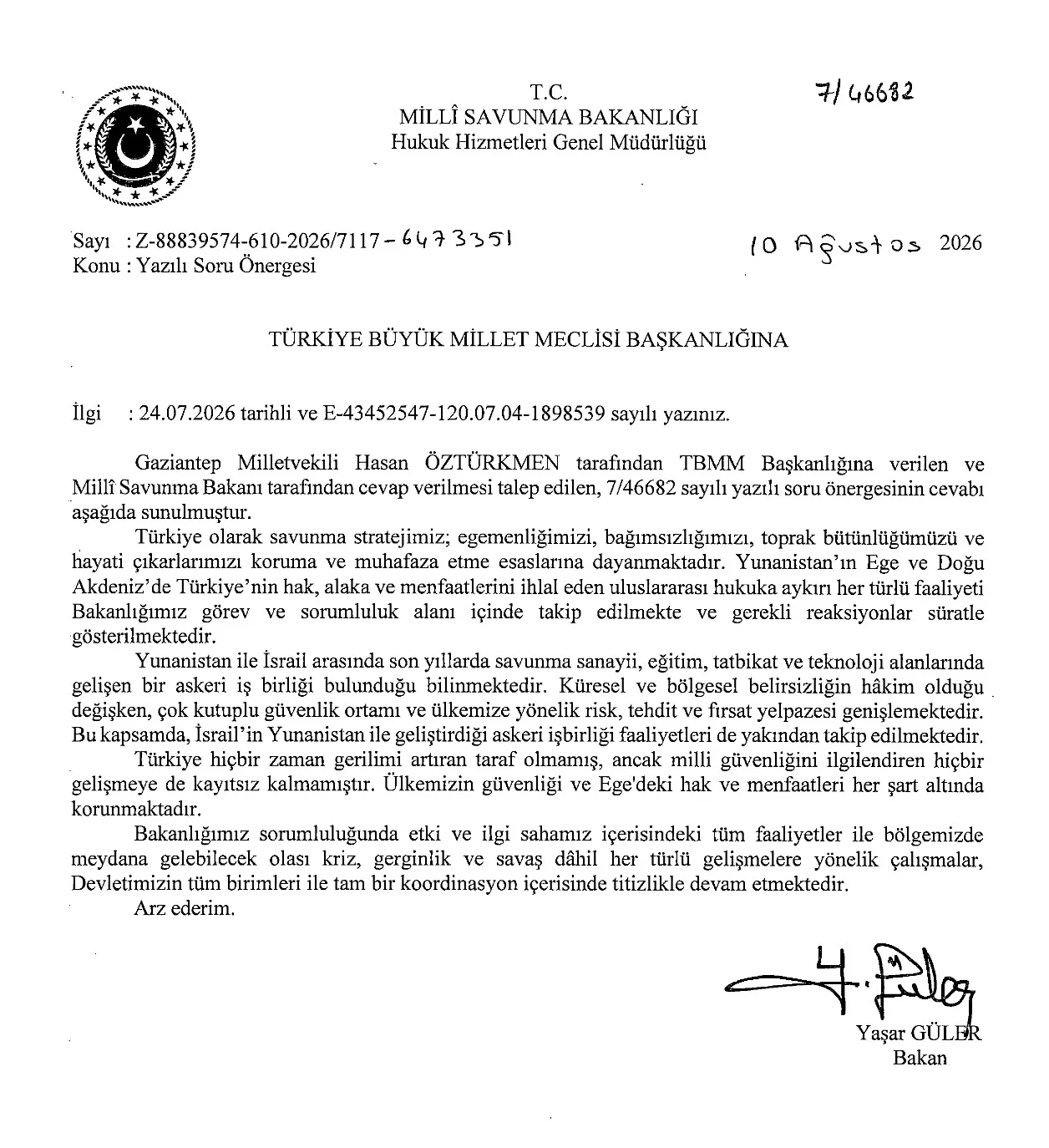
A written parliamentary reply signed by Turkish Defense Minister Yaşar Güler on August 10 lists Greece-Israel military cooperation in defense industry, training, exercises and technology while leaving unanswered a lawmaker's specific question on Greece's Achilles' Shield air-defense program.
The four-paragraph document has circulated in regional media with attention centered on its reference to preparations for possible crisis, tension and war. It contains no deployments, countermeasures or operational plans.
The reply answers written question 7/46682, submitted by Gaziantep MP Hasan Öztürkmen of the Republican People's Party (CHP). The question reached the Grand National Assembly of Türkiye on July 16 and concerned Greece's military activity on eastern Aegean islands that Türkiye argues are subject to demilitarization obligations.
The Ministry of National Defence's General Directorate of Legal Services answered under reference Z-88839574-610-2026/7117-6473351. Güler signed the response on August 10. Parliamentary records show it was received on August 13 and list the question as answered.
Four Areas Put in Writing
The most specific part of Güler's response is its second paragraph.
The ministry says military cooperation between Greece and Israel has developed in four fields: defense industry, training, exercises and technology. It adds that Israel's military cooperation with Greece is being closely followed as the range of risks, threats and opportunities facing Türkiye expands.
The opening paragraph sets out Türkiye's standing position on the Aegean and Eastern Mediterranean. It says the country's defense strategy is based on protecting sovereignty, independence, territorial integrity and vital interests, and that Greek activities which the ministry considers contrary to international law or harmful to Türkiye's rights and interests are monitored and answered when necessary.
The third paragraph says Türkiye has not been the party escalating tensions and will not remain indifferent to developments affecting national security.
The final paragraph says work continues, in coordination with other state institutions, on activities within the ministry's area of responsibility and on possible regional developments including crisis, tension and war.
That sentence generated much of the subsequent attention. It does not specify forces, locations, targets or military options.
Achilles' Shield Asked, Not Answered
Öztürkmen submitted six questions. One asked directly what measures Türkiye was developing against Greece's planned multilayered air and missile defense system, identified in the question as Achilles' Shield.
Güler's response does not mention the program by name.
It gives no assessment of Achilles' Shield, no reference to its components, cost or implementation schedule and no indication of a Turkish military response designed specifically against it. The answer instead addresses Greece-Israel military cooperation as a broader category.
Öztürkmen's question also cited reports that islands close to the Turkish coast could receive Israeli-made air-defense systems and alleged that underground military facilities were being prepared for command centers and ammunition storage.
Other questions covered possible Turkish deterrence measures, reports concerning fighter-aircraft runways and Patriot deployments on eastern Aegean islands, the scale of Greece-Israel military cooperation and legal steps connected to Türkiye's interpretation of the 1923 Treaty of Lausanne and the 1947 Treaty of Paris.
None receives an operational answer.
The contrast is sharper because Achilles' Shield is approaching its next procurement stage.
Greece and Israel are scheduled to sign agreements in Tel Aviv on August 31 for the integrated air and missile defense program. Greek officials have put its cost at just over €3 billion and say the system is expected to become fully operational within 35 months, with deliveries made in stages.
The agreements are expected to involve Greece's General Directorate for Defence Investments and Armaments and SIBAT, the Israeli Defense Ministry's Directorate of International Defense Cooperation, along with Israeli defense companies participating in the program.
Güler signed his parliamentary answer three weeks before the planned signing.
A Parliamentary Answer, Not a War Plan
The document records a Defense Ministry position under parliamentary oversight. Its language covers possible crisis and war, but it does not disclose how Turkish forces would operate in either scenario.
Several reports published after August 25 emphasized that final paragraph. The more concrete material appears one paragraph earlier, where the ministry identifies the four fields in which it says Greece-Israel military cooperation has expanded.
Achilles' Shield itself remains outside the answer despite being explicitly raised by the lawmaker.
That omission matters because Greece's air-defense modernization is one of the largest current procurement files involving Israeli defense companies. The program is designed as a multilayered system against aircraft, missiles, drones and other aerial threats and forms part of Greece's wider defense modernization program through 2036.
Güler's response does not say what Türkiye intends to deploy against it. What it does establish in the parliamentary record is narrower: the Turkish Defense Ministry is tracking Greece-Israel cooperation across defense industry, training, exercises and technology as Athens moves toward the next stage of Achilles' Shield.
Sources: Grand National Assembly of Türkiye written question records, Türkiye's Ministry of National Defence, Greece's Ministry of National Defence, ANA-MPA, Reuters, Kathimerini, Bosphorus News review and reporting.