
By Bosphorus News Geopolitics Desk
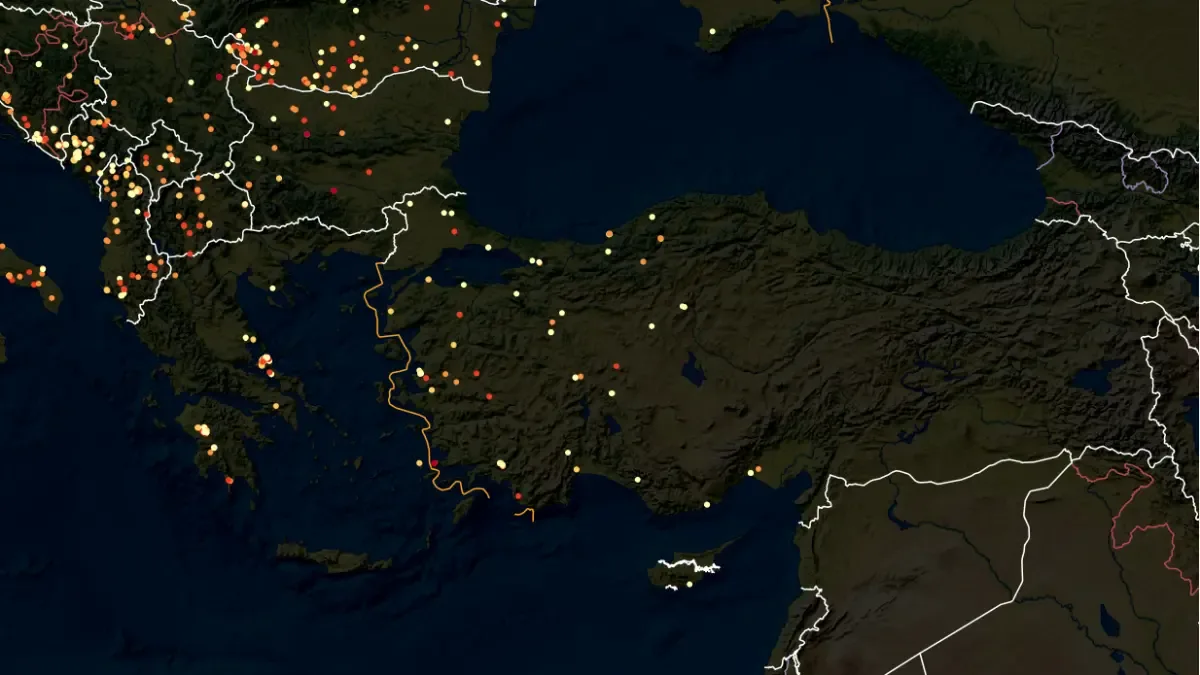
Greece placed Attica, Evia, Chios and Lesvos under a very high wildfire-risk warning for August 5, while Türkiye urged heightened caution across its western coastline as strong winds threatened to turn any new ignition into a fast-moving fire.
The Greek areas were classified at Category 4 under the country's five-level daily fire-risk system. The designation indicates very high danger but remains below Category 5, which represents extreme risk and the highest state of alert.
Greek authorities increased operational readiness under the National Civil Protection Mechanism, with additional patrols by the fire service, police and armed forces, continued aerial surveillance and personnel and vehicles placed on standby.
Local administrations were also expected to coordinate preventive measures. Access restrictions could be introduced in forests and other vulnerable areas, while residents and visitors were told to avoid activities capable of causing sparks or open flames and to report fires immediately.
Türkiye Warns of Critical Wind Conditions
Türkiye's Agriculture and Forestry Minister İbrahim Yumaklı issued a separate warning for August 4 and 5, saying meteorological forecasts pointed to strong winds capable of sharply increasing wildfire danger along the country's coastal regions.
He identified Çanakkale, Balıkesir, Bursa, İzmir and Manisa among the provinces requiring particular attention.
The warning focused on preventing new fires during a period in which dry vegetation and strong winds could narrow the time available for an effective response.
Yumaklı called on the public not to light fires in or near forests, throw combustible material into dry grass or burn stubble and garden waste. Smoke or suspicious activity should be reported to Türkiye's 112 Emergency Call Center.
"While all our teams are in the field, our greatest strength is the sensitivity of our citizens and preventing fires from starting," he said.
Türkiye did not declare a nationwide emergency or introduce a warning category equivalent to the Greek classification. The message was a preventive appeal tied to conditions expected across the western and coastal provinces.
High-Risk Areas Stretch Across the Aegean
The two warnings cover opposite sides of the same fire-prone geography.
Chios and Lesvos lie close to Türkiye's Aegean coast, while Çanakkale, Balıkesir, İzmir and Manisa include extensive forestland exposed to dry summer conditions. Bursa lies farther inland but was also included among the provinces where powerful winds were expected to raise the danger.
The principal threat is the speed with which a minor ignition can expand. Strong winds can carry embers beyond firebreaks, shift the direction of flames and create additional fronts before crews secure the original perimeter.
Such conditions may also limit aerial operations and make evacuations more difficult when fires approach settlements, roads or crowded summer destinations.
The warnings did not mean that fires were active throughout the areas named. Both countries were acting before an outbreak, placing the emphasis on reducing human-caused ignitions and shortening emergency response times.
Category 4 Signals Very High Danger
Greece's daily fire-risk map uses five categories, ranging from low danger at Category 1 to extreme danger at Category 5.
Category 4 requires increased readiness because a fire that starts under such conditions can spread quickly and become difficult to contain. The classification may lead local authorities to restrict access to forests, parks and other high-risk locations.
Some reports referred to the measures as a red alert, but the underlying official classification was Category 4 rather than the maximum Category 5 level.
This distinction matters because the warning signals serious operational risk without indicating that Greece had entered its highest nationwide emergency category.
Türkiye uses a different warning and response structure, but Yumaklı's message carried the same immediate priority: preventing avoidable ignitions while wind conditions remain dangerous.
Prevention Takes Priority
The alerts place much of the responsibility on public behavior during the most sensitive hours.
A discarded cigarette, agricultural burning, machinery producing sparks or an unattended flame can become far harder to contain when the ground is dry and winds are strong. Under those conditions, the first minutes of a fire often determine whether it remains a local incident or develops into a wider emergency.
Authorities in both countries urged the public to avoid open flames and activities that could ignite dry vegetation, particularly near forests and rural land.
Emergency services entered August 5 with greater readiness across several of the Aegean's most populated, forested and heavily visited areas, facing a threat shaped less by fires already burning than by how quickly the next one could spread.
Sources: Türkiye's Ministry of Agriculture and Forestry, Greece's General Secretariat for Civil Protection and Bosphorus News reporting and review.