
By Bosphorus News Energy Desk
An unmanned aerial vehicle assessed as potentially carrying explosive ordnance came ashore on Istanbul's Black Sea coast on Friday morning and was destroyed at sea hours later. It was the latest in a series of drone-related finds along a coastline that now sits behind almost all of Türkiye's domestically produced natural gas.
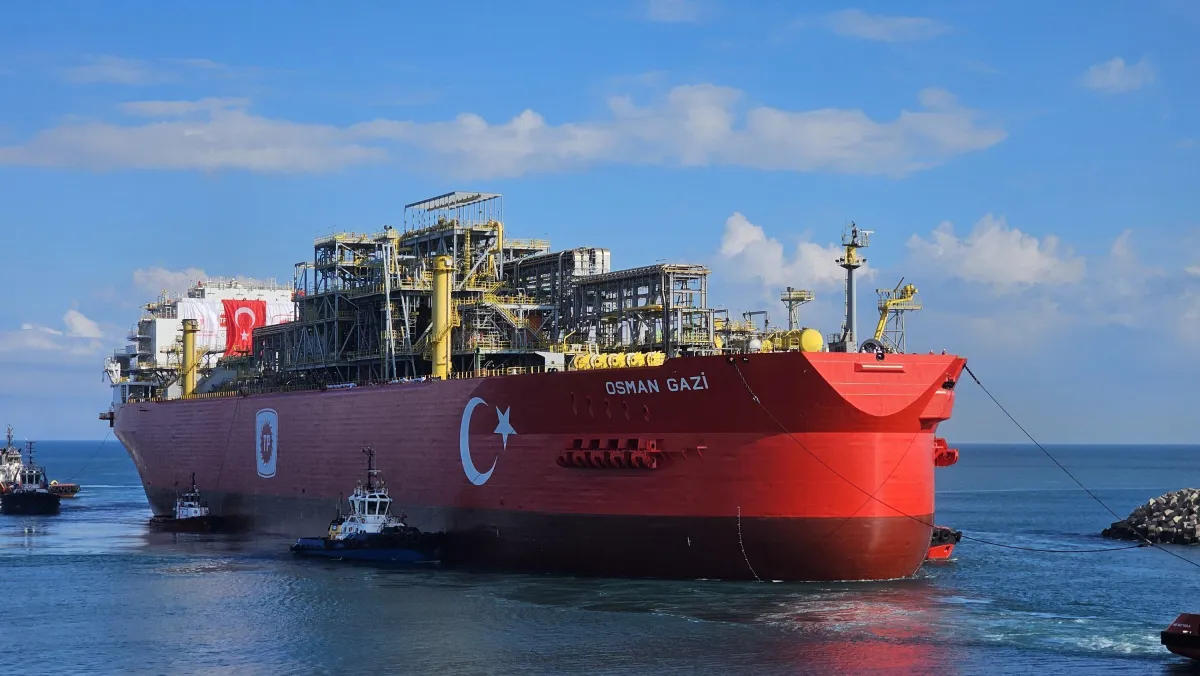
Türkiye's Black Sea gas production is entering a new phase. The Osman Gazi floating production platform is expected to begin operations in the fourth quarter of 2026, raising daily output capacity from the Sakarya Gas Field toward 20 million cubic metres.
Friday, Karaburun
People fishing from the shore at Karaburun, in Istanbul's Arnavutköy district, spotted an unfamiliar object in the water and alerted lifeguards working in the area. The lifeguards assessed it as an unmanned aerial vehicle and informed the Coast Guard.
After an initial examination indicated that the aircraft might be carrying explosives, SAS commandos were sent to the site. Security measures were established along the beach, the aircraft was towed offshore and destroyed in a controlled detonation.
Karaburun sits on the Black Sea about 29 kilometres west of the northern entrance to the Istanbul Strait.
Turkish agency reporting said the aircraft's origin, how it reached the area and the systems it carried would be determined through technical examination. No named Turkish official has publicly addressed those questions since, and Bosphorus News found no official statement providing an origin assessment.
The available reporting on the incident comes from Turkish news agencies and information attributed to security personnel at the scene.
Karaburun was not an isolated find. In mid-August, three suspected drone-related objects were found along the Turkish Black Sea coast within two days, following earlier cases involving Gerbera-type drones, unmanned aerial vehicles with suspected explosive payloads and an armed unmanned surface vessel.
None of these incidents has been officially described as a deliberate attack on Türkiye.
Sakarya's Next Production Phase
The Sakarya Gas Field has supplied Türkiye's grid since 2023, with production reaching around 9.5 million cubic metres per day in 2026. Energy and Natural Resources Minister Alparslan Bayraktar said the field accounted for 92 percent of Türkiye's domestic natural gas production in the first half of the year.
The Osman Gazi floating production platform is scheduled to leave Filyos and move to the field at the end of September before entering service in the fourth quarter. The platform is expected to raise daily production capacity toward 20 million cubic metres and increase the number of households supplied by domestic Black Sea gas.
A second floating production platform planned for 2028 is expected to lift output further, with Bayraktar setting a target of around 45 million cubic metres per day.
Türkiye's Black Sea gas reserves are estimated at approximately 785 billion cubic metres, with the Sakarya field representing the core of current production plans.
The field connects through subsea infrastructure to the Filyos processing complex on Türkiye's western Black Sea coast. The offshore system includes subsea wells, pipelines, drilling vessels and production infrastructure designed to support further expansion.
Nothing connects the Karaburun aircraft to Sakarya.
Karaburun lies near Istanbul, while the Sakarya field is located off the western Black Sea coast near Zonguldak. No authority has suggested that the aircraft was targeting energy infrastructure.
The issue is not a confirmed link between these events, but the growing exposure of infrastructure operating in the same maritime environment. Türkiye is adding production capacity to the Black Sea while unmanned systems and suspected explosive debris continue to appear in waters monitored by NATO states.
A Wider Offshore Push
The Sakarya expansion is part of a broader production strategy by Türkiye's national energy sector.
Türkiye's state energy company Turkish Petroleum Corporation (TPAO) has continued expanding domestic and international operations, with a target of significantly increasing total oil and gas output by 2028.
The Black Sea remains central to that effort. Five Turkish drillships: Fatih, Yavuz, Kanuni, Abdülhamid Han and Yıldırım — are involved in offshore exploration and production activities, while floating production infrastructure is being added to the system.
The growth of offshore capacity also increases the importance of protecting critical energy assets in a maritime environment affected by the wider Russia-Ukraine war.
Romania's Public Response
The contrast in disclosure is visible across the Black Sea.
On August 20, a commercial vessel reported a small maritime drone drifting in Romania's exclusive economic zone, roughly 80 nautical miles east of Constanța and near active facilities at the Neptun Deep gas project.
Romania's Ministry of National Defence established a command cell. Defence Minister Radu Miruță said Bucharest requested the transfer of NATO-level command authority to the Romanian military.
Two F-16s were scrambled, and one aircraft fired its onboard cannon at the target. The strike damaged the drone but did not fully destroy it, after which an explosive ordnance disposal team neutralized the remains.
Miruță said the drone was carrying explosives and that a direct communication channel with Ukraine produced official confirmation that it was not Ukrainian.
President Nicușor Dan attributed responsibility to Russia, while the European Commission and NATO issued public reactions. Russia did not comment publicly.
Romanian forces also destroyed two Gerbera-type drones in the same exclusive economic zone earlier in August.
Romania and Türkiye were not facing identical incidents. One intercepted an explosive device near an offshore industrial site; the other recovered an aircraft that had already reached a public beach.
What differed was the amount of information released afterward. Romania disclosed the detection, response chain, weapon used and communication with Kyiv. On the Turkish side, the immediate danger was removed, but the public record remains limited regarding the aircraft's origin and technical characteristics.
Security Without Attribution
The absence of a public origin assessment does not mean Türkiye has ignored the security challenge.
Romania, Bulgaria and Türkiye have expanded cooperation on Black Sea mine countermeasures, including efforts related to maritime safety and critical infrastructure protection. Bayraktar has also said Turkish teams were already working on protecting energy infrastructure and evaluating additional measures in response to drone activity in the region.
Ankara has spent the Russia-Ukraine war maintaining relations with both sides, enforcing the Montreux Convention and avoiding public attribution in incidents where available evidence did not establish a direct attack on Türkiye.
That approach has preserved diplomatic room with both Moscow and Kyiv, but it also means that no publicly available official tally currently brings together unmanned systems and suspected war debris reaching Türkiye's Black Sea coast during 2026.
Osman Gazi is scheduled to begin a new phase in Türkiye's Black Sea energy production at the same time that the security environment around those waters remains unsettled.
Sources: Türkiye Ministry of Energy and Natural Resources, Turkish Petroleum Corporation (TPAO), Romanian Ministry of National Defence, Reuters, Anadolu Agency, Demirören News Agency, İhlas News Agency, European Commission, NATO, Bosphorus News review and reporting.