
By Bosphorus News Economy Desk
Turkish visits to Greece reached nearly 1.5 million in 2025, up from about 1.2 million a year earlier, while a fast-track visa programme helped direct more travellers toward nearby Aegean islands.
The figures, cited by AFP on the basis of Bank of Greece data, represent an annual increase of about 25 percent. They cover all Turkish visits to Greece, not only passengers travelling under the special island visa programme.
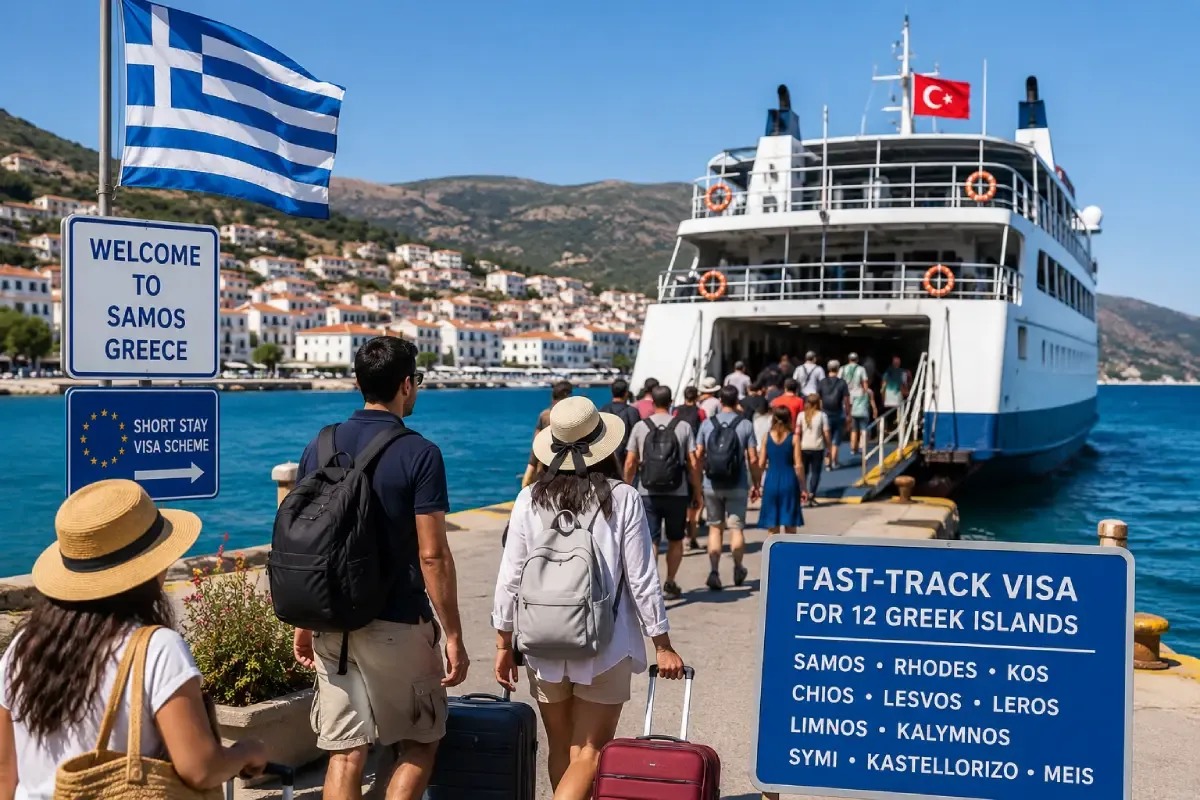
Introduced in April 2024, the scheme allows Turkish citizens and their families to obtain short-stay visas for 12 designated Greek islands, including Samos, Rhodes, Kos and Chios. Stays are limited to seven days, and the visa does not provide access to the wider Schengen area.
The arrangement is often described as a visa-on-arrival system, but it is not visa-free travel. Applications are processed through designated island ports under a limited programme agreed with European authorities.
Turkish demand becomes more important for island businesses
The economic impact is particularly visible on islands close to the Turkish coast.
On Samos, restaurants and tourism businesses have introduced Turkish-language menus and services as ferry traffic has grown. Local operators told AFP that visitors from Türkiye had become an important source of revenue.
Geography is a major part of the appeal. Ferry routes from Kuşadası, Çeşme and Bodrum make several Greek islands accessible for short breaks, public holidays and weekend trips without the planning required for a longer European holiday.
Rising holiday costs in Türkiye have also prompted some travellers to compare nearby Greek destinations more closely. Prices vary by island, season and accommodation type, and the trend does not mean Greek islands are uniformly cheaper. It has, however, made cross-Aegean price comparisons more relevant for Turkish travellers.
This demand differs from the conventional package-tour model. Travellers can book at shorter notice, stay for fewer days and return more frequently, giving hotels, restaurants, retailers and ferry operators access to customers living only a short distance away.
Greece seeks to keep the 12-island scheme in place
Greek Prime Minister Kyriakos Mitsotakis has presented the island scheme as one of the most tangible results of the recent improvement in relations between Türkiye and Greece.
Following talks with President Recep Tayyip Erdoğan in Ankara in February, Mitsotakis said hundreds of thousands of Turkish citizens had visited the islands over the previous year and that Athens would seek the programme's renewal through the European Union and the European Commission.
A joint declaration issued after the meeting also welcomed the continuation of the temporary short-stay arrangement for Turkish nationals visiting the 12 islands.
The programme does not resolve the wider disputes between Ankara and Athens. Its value lies in the travel it generates, the support it provides to local businesses and the immediate economic return it brings to one of the few functioning areas of bilateral cooperation.
Island visas remain separate from Schengen changes
The Greek island programme is distinct from the European Union's broader visa rules for Turkish citizens.
In July 2025, the European Commission introduced more favourable cascade rules for applicants with a record of lawful Schengen travel. Eligible travellers may receive progressively longer multiple-entry visas, but they must still apply through the standard Schengen system.
The island scheme is narrower. It applies only to designated destinations, is tied mainly to ferry connections from Türkiye and permits stays of no more than seven days.
That limited format has allowed Athens to ease access without extending wider Schengen rights, while giving eastern Aegean islands a larger share of Türkiye's outbound tourism market.
A nearby market with growing value
The rise in Turkish arrivals comes as Greece continues to expand its tourism industry and seeks to distribute demand beyond its best-known destinations.
For islands in the eastern Aegean, Turkish visitors offer a large nearby market that can respond quickly to ferry schedules, exchange rates, public holidays and seasonal prices.
The 1.5 million total cannot be attributed to the island scheme alone, since many Turkish citizens travel elsewhere in Greece on regular Schengen visas. Even so, the programme has become one of the clearest economic outcomes of the recent thaw between Ankara and Athens, particularly for islands that depend heavily on ferry traffic from Türkiye.
Sources: AFP via BGNES, Bank of Greece data cited by AFP, Greek Prime Minister's Office, European Commission and Bosphorus News review.