
By Bosphorus News Geopolitics Desk
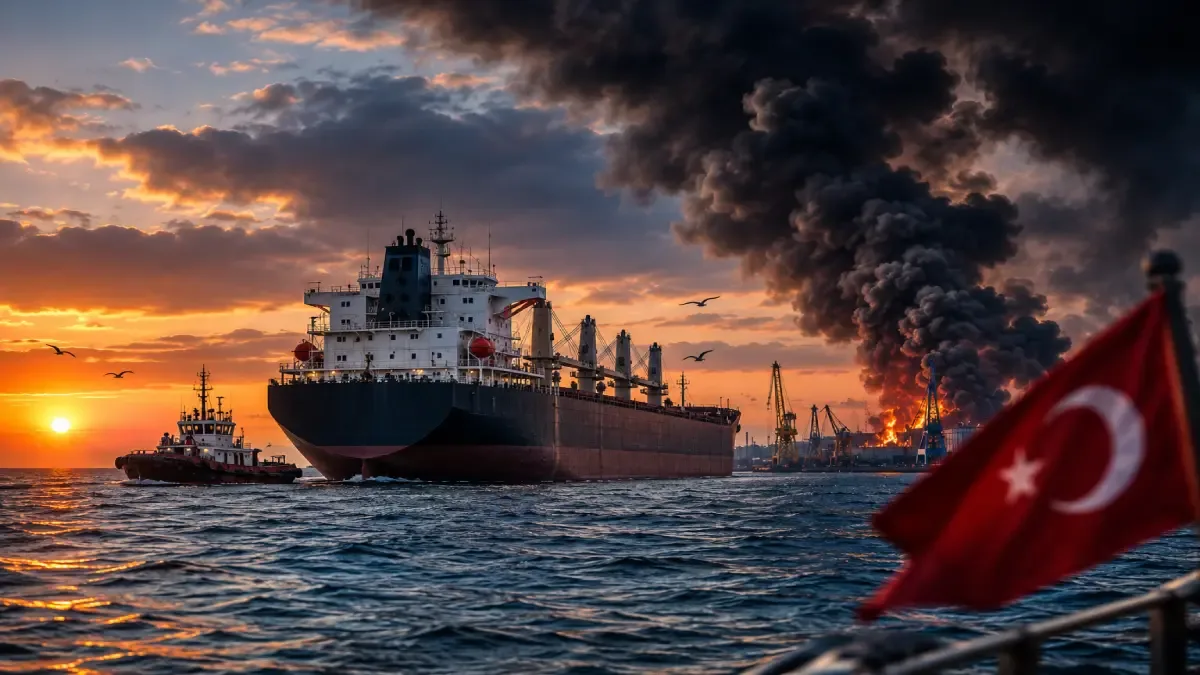
A Turkish-owned cargo ship carrying corn was severely damaged on July 30, 2026, after three drones struck it shortly after it left Ukraine's Port of Chornomorsk, adding to a series of attacks that have exposed merchant crews and commercial shipping along Black Sea trade routes.
The Panama-flagged ATA 2 was carrying 12 Azerbaijani nationals and one Turkish citizen when the drones hit its bridge and accommodation block. None of the 13 crew members was reported injured, although the vessel sustained extensive damage and continued under a backup manual steering system.
Built in 2006 and listed at about 6,555 deadweight tonnes, ATA 2 had departed Chornomorsk with a cargo of corn when the attack occurred. Subsequent reports placed the vessel in Romanian waters and said the crew remained in good condition.
The incident coincided with a wider Russian strike wave around Ukrainian Black Sea ports. Russia's Defense Ministry said its forces had hit one cargo vessel at Pivdennyi and two others near Odesa and Chornomorsk, claiming they were carrying military supplies, although Reuters said it could not independently verify the assertion.
Available reporting identified ATA 2 as a corn carrier, and no evidence has emerged that it was transporting military goods.
Crew steered damaged ATA 2 toward Romanian waters
The drones reportedly struck areas where officers and crew members normally work and live, badly damaging the bridge and accommodation spaces without causing reported casualties.
A relative of the vessel's second captain told Azerbaijani maritime media that the crew switched to a backup system and continued under manual control, initially heading toward Bulgaria before the ship was reported near Romania. It was expected to proceed to Istanbul and later enter a shipyard for major repairs.
The full extent of the damage has not yet been detailed in a statement from the owner, a port-state inspection or a formal casualty investigation.
Türkiye's Foreign Ministry had not issued a statement naming ATA 2 at the time of publication, although Ankara has repeatedly raised concerns following attacks on Turkish-owned commercial vessels.
On May 28, a Turkish-owned, Vanuatu-flagged dry cargo ship travelling from Odesa to Türkiye was struck by an unmanned aerial vehicle, leaving two Turkish crew members with minor injuries. Another Turkish-owned, Panama-flagged vessel was attacked off Chornomorsk on June 22, again injuring two Turkish citizens.
The ATA 2 strike adds to a pattern previously examined by Bosphorus News, in which Türkiye's exposure to the war has expanded through ship ownership, foreign-flagged fleets, Turkish crews and commercial routes serving ports on both sides of the conflict.
Azerbaijani union questions safeguards for crews
The most direct public reaction came from Azerbaijan's maritime labour community rather than through a formal diplomatic protest.
Ilham Nasirov, head of Azerbaijan's maritime transport workers' union, said seafarers should receive complete information about their routes and the dangers involved before entering a war zone. Higher pay, he argued, could not replace an employer's duty to protect crews or justify sending sailors into risks they had not properly assessed.
His remarks followed several attacks involving Azerbaijani seafarers. Maritime Executive reported that the captain of the Atlas Bey was killed on July 14, while 10 other Azerbaijani crew members were rescued.
The debate extends beyond identifying who carried out individual strikes and reaches the decisions made before a vessel enters high-risk waters, including the quality of route assessments, the information provided to crews and whether seafarers can realistically refuse dangerous assignments.
Golden Leo attack showed the human cost
ATA 2 was hit less than two weeks after the Turkish-managed Golden Leo came under attack while carrying corn from Chornomorsk through a Ukrainian-monitored corridor toward Romania.
The Guinea-Bissau-flagged vessel sustained major damage in the July 19 strike, which killed nine crew members. Eight others were evacuated before the ship sank off Odesa on July 26. Russia did not publicly comment on that particular attack.
As Bosphorus News reported, Golden Leo was managed by a Türkiye-based company but was not Turkish-owned, reflecting a shipping structure in which ownership, management, flag and crew nationality often belong to different countries.
That distinction matters when attacks are described as involving "Turkish ships." Some vessels are Turkish-owned but sail under foreign flags, others are managed by Turkish companies, while some carry Turkish crew or operate under the Turkish flag. Together, these connections leave Türkiye's maritime sector increasingly exposed to the war.
Black Sea attacks reshape commercial shipping
The International Maritime Organization warned on July 13 that attacks on merchant vessels in the Black Sea and the Sea of Azov were endangering seafarers, disrupting supply chains and threatening freedom of navigation. Secretary-General Arsenio Dominguez called on all parties to protect civilian shipping and comply with international law.
Commercial operators have already begun adjusting their routes. Maersk suspended services through Chornomorsk Fishing Port in July and redirected affected cargo through Romania's Constanta, while other carriers and grain companies reduced activity as attacks intensified around Ukraine's export infrastructure.
Repeated strikes raise war-risk premiums, narrow available insurance cover, complicate crew recruitment and force operators to decide whether the income from a route justifies entering waters where civilian traffic is increasingly exposed to military action.
ATA 2 survived without reported loss of life, but the damage to its bridge and accommodation areas showed how little distance now separates Black Sea grain shipping from the battlefield.
Sources: The Maritime Executive, Reuters, International Maritime Organization, Republic of Türkiye Ministry of Foreign Affairs and Bosphorus News reporting and review.