
By Bosphorus News Economy Desk
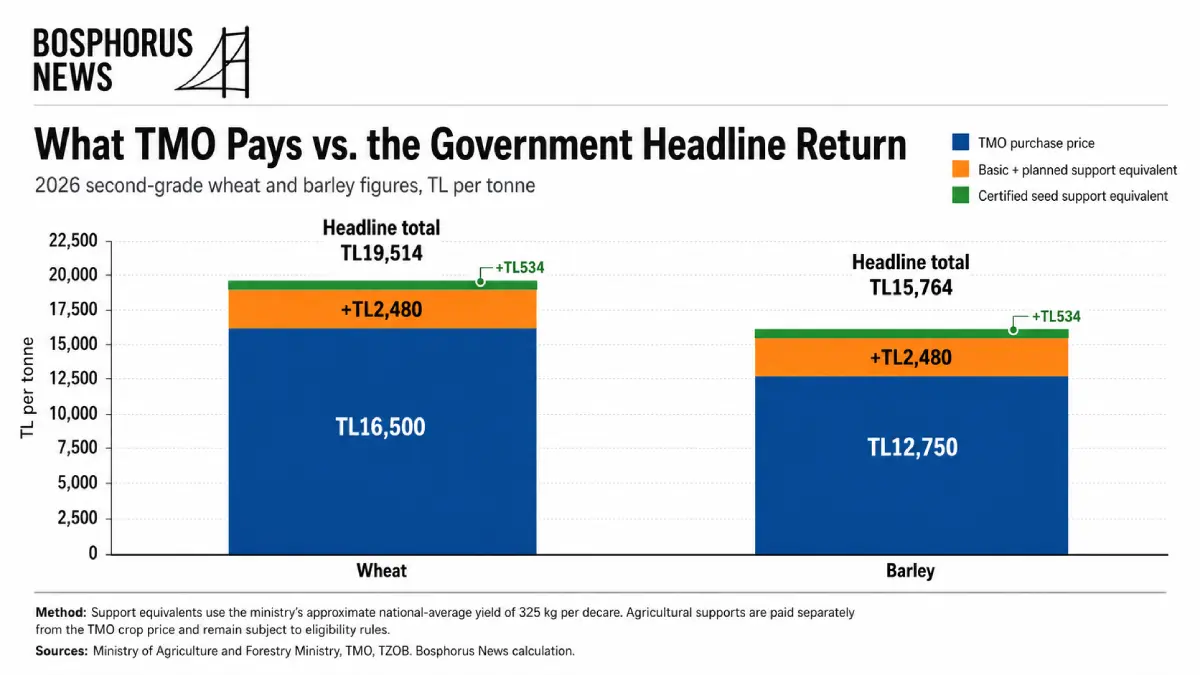
Türkiye's government says wheat growers can receive TL19,514 per tonne once agricultural support is included. But the Turkish Grain Board, known by its Turkish acronym TMO, will pay TL16,500 per tonne for second-grade bread and durum wheat.
The remaining TL3,014 comes from three land-based support payments converted into a per-tonne figure using an assumed national average yield. Those payments are administered separately from the TMO purchase, and one of them is conditional.
The distinction is central to the dispute over Türkiye's 2026 grain programme.
How the TL19,514 figure was built
The Agriculture and Forestry Ministry listed three support components for wheat and barley:
- TL403 per decare in basic support
- TL403 per decare in planned-production support
- TL173.60 per decare for certified seed use
The ministry combined the TL979.60 per-decare total and divided it by an assumed yield of roughly 325 kilograms per decare. That produced a support value of around TL3,014 per tonne.
It then added that amount to the TMO purchase prices, producing headline totals of TL19,514 per tonne for wheat and TL15,764 for barley.
The arithmetic combines a crop price with three separate agricultural payments. The TL16,500 wheat price is tied directly to grain delivered to TMO. The support components depend on registered land, production planning and eligibility requirements.
They are also not part of the same payment timetable. The ministry said TMO would transfer crop payments within 45 days of delivery, but did not place the separate agricultural supports inside that deadline.
Certified seed payment is not automatic
The Turkish Union of Chambers of Agriculture, known by its Turkish acronym TZOB, challenged the use of the full TL979.60 support figure.
TZOB President Şemsi Bayraktar said the basic and planned-production components total TL806 per decare. The additional TL173.60 depends on certified seed use and the producer meeting the relevant documentation and eligibility conditions.
Growers who qualify can receive the full amount. But the certified seed component cannot be treated as an automatic payment to every wheat and barley producer each year.
Using the ministry's average-yield assumption, the basic and planned-production payments alone correspond to about TL2,480 per tonne. That would put the combined return at approximately TL18,980 for wheat and TL15,230 for barley for a producer who does not receive the certified seed payment.
The difference from the government's headline calculation is roughly TL534 per tonne.
These are Bosphorus News calculations based on the ministry's stated support levels and average-yield method. They are not alternative TMO purchase prices.
The calculation also changes with actual farm productivity. Since support is paid per decare rather than per tonne, the same land payment produces a lower per-tonne value on higher-yielding farms and a higher value where yields are lower.
The TL3,014 figure is therefore a national conversion estimate, not a fixed support payment attached to every tonne.
The 45-day payment dispute
TZOB also rejected TMO's plan to pay growers within 45 days of delivery.
Bayraktar said farmers face fuel, fertiliser, seed, spraying, labour and credit obligations as soon as harvesting begins. The union asked for at least 50 percent of the crop value to be paid at delivery and the remainder within 15 days.
"Product payments should be made at least 50 percent upon delivery, with the remaining amount paid within no more than 15 days," Bayraktar said.
The timetable matters because farmers with immediate debts may be unable to wait for TMO and could instead sell to private traders. A producer who waits also carries the financing and inflation cost during the payment period.
TZOB formally asked the Agriculture and Forestry Ministry to revise the intervention prices and add a premium of TL3 per kilogram.
Purchase prices trail agricultural costs
TMO raised the wheat purchase price by 22.22 percent, from TL13,500 to TL16,500 per tonne. The barley price increased by 15.9 percent, from TL11,000 to TL12,750.
Both increases were below Türkiye's annual consumer inflation rate of 32.37 percent in April, the comparison used by TZOB in its objection.
Agricultural cost data released later provided a more direct benchmark. Türkiye's Agricultural Input Price Index rose 38.97 percent year on year in April, while fertiliser and soil improver costs increased 62.77 percent.
A separate April report by the U.S. Department of Agriculture said conflict in the Middle East had pushed fertiliser and fuel prices in Türkiye up by about 25 percent in March from the previous month.
The effect was not uniform across the production cycle. Some growers had purchased fertiliser earlier, while harvesting, transport, spraying and fuel expenses remained exposed to current prices.
A larger crop strengthens TMO's role
The price dispute comes as Türkiye prepares for a strong recovery from the drought-hit 2025 season.
The Turkish Statistical Institute forecast wheat production at approximately 22.8 million tonnes in 2026, up 26.7 percent from the previous year. It projected barley output at 9 million tonnes.
The National Grain Council placed wheat production at around 23 million tonnes and barley at approximately 8.7 million tonnes.
Heavy rainfall supported the recovery, particularly across Central Anatolia, which accounts for a large share of Türkiye's wheat acreage. Final production will still depend on harvest conditions and regional yields.
A larger crop can increase downward pressure on open-market prices, making TMO's intervention price, purchasing capacity and payment timetable more influential.
Agriculture and Forestry Minister İbrahim Yumaklı said in May that TMO would enter the harvest period with 20 million tonnes of storage capacity.
TMO plans to begin grain sales on October 1 at TL18,500 per tonne for wheat and TL14,000 for barley. Those prices are separate from both the purchase price paid to growers and the agricultural support calculation.
The published programme retains the TL16,500 wheat purchase price and the 45-day payment deadline. It does not include TZOB's requested TL3-per-kilogram premium.
Sources: Türkiye's Agriculture and Forestry Ministry, Turkish Grain Board, Turkish Statistical Institute, Turkish Union of Chambers of Agriculture, National Grain Council, U.S. Department of Agriculture, Bosphorus News review and reporting.