
By Bosphorus News Defense Desk
Foreign Minister Hakan Fidan said Türkiye and the United States are working to remove sanctions imposed under the Countering America's Adversaries Through Sanctions Act (CAATSA), reopening one of the hardest defence disputes between the two NATO allies before next week's Ankara summit.
Speaking on CNN Türk on July 3, Fidan said President Recep Tayyip Erdoğan and U.S. President Donald Trump share the will to lift the sanctions imposed after Türkiye acquired Russia's S-400 air defence system. He said both leaders had instructed officials to work through the file, while adding that the process still involves the U.S. Congress.
Fidan tied the current work to Erdoğan and Trump's September 2025 meeting in Washington, saying the leaders had already given the political direction. He described the issue as active, but did not present sanctions relief as a completed legal decision.
Washington imposed CAATSA sanctions on Türkiye in December 2020 after Ankara purchased the S-400 system from Russia. The measures targeted Türkiye's Presidency of Defence Industries, known as SSB, and senior procurement officials, restricting U.S. export licences, financing and defence-related authorisations.
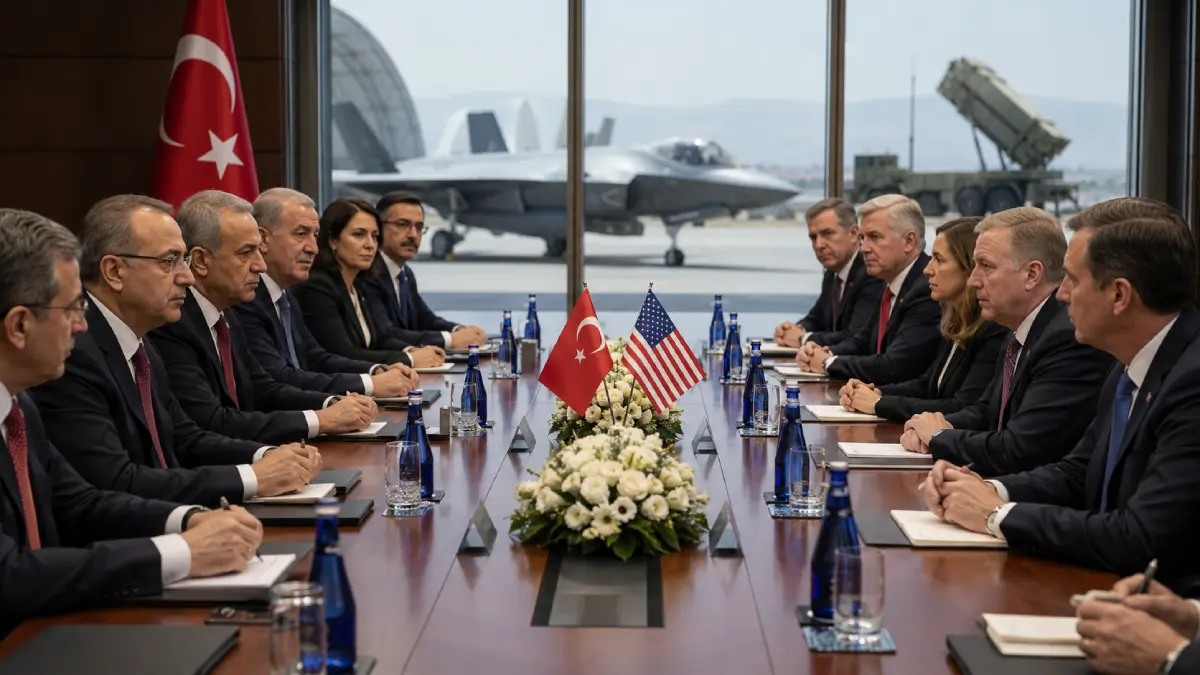
The United States also removed Türkiye from the F-35 Joint Strike Fighter program, saying the Russian system posed a risk to the aircraft and to NATO defence architecture. Türkiye rejects that position and says the S-400s are not integrated into NATO systems.
The Russia factor remains the centre of the dispute. Washington's objection is not limited to Türkiye's purchase of the S-400 from Moscow; it also concerns the presence of a Russian-built air defence system in the inventory of a NATO ally seeking access to the F-35 ecosystem. The United States still has to show Congress that any formula protects F-35 technology and NATO systems from Russian exposure.
Fidan separated the sanctions file from Türkiye's possible return to the F-35 production partnership. He said lifting the F-35 sales restriction would be easier in practical terms after the CAATSA file is resolved, while rejoining the production program would require a separate consortium decision.
That distinction matters because Washington can move some sales and export questions through executive and congressional channels, but Türkiye's industrial return to the F-35 program would require agreement among program partners. Turkish companies were removed from the F-35 supply chain after the S-400 dispute escalated.
The KAAN engine file gives the sanctions discussion a second defence-industrial layer. Reuters reported in June that the Trump administration had formally notified Congress of a more than $700 million sale of General Electric F110 engines for Türkiye's KAAN fighter program. Fidan did not name the engine package directly, but his remarks placed defence restrictions, sanctions relief and a more rational bilateral relationship inside the same normalization track.
Fidan also pointed to the resolution of the Halkbank case as part of the changing atmosphere in U.S.-Türkiye relations. A U.S. federal judge dismissed the long-running prosecution of the Turkish state lender in June, with no criminal penalties and no admission of wrongdoing.
U.S. Ambassador to Türkiye Tom Barrack said in April that he expected Washington and Ankara to solve the S-400 sanctions issue soon, according to Reuters. U.S. Secretary of State Marco Rubio told lawmakers in June that Türkiye's F-35 status remained governed by statute because of the S-400 file.
Fidan's remarks came days before Türkiye hosts NATO leaders in Ankara on July 7-8. The sanctions file now sits inside the same summit week as alliance spending, procurement and European security planning.
Türkiye wants CAATSA sanctions removed, F-35 restrictions eased and its defence industry treated as part of NATO's capability base. U.S. officials and members of Congress remain focused on the S-400 formula, the legal path for sanctions relief and protection of sensitive F-35 technology.
Fidan welcomed Trump's expected attendance at the Ankara summit, calling it positive for the NATO community. He said Erdoğan's direct outreach helped bring Trump to Ankara, adding a bilateral defence track to the summit's formal alliance agenda.
The political opening described by Fidan still runs through the same hard file that blocked the relationship in 2020: whether Ankara and Washington can produce an S-400 arrangement that Congress, the Pentagon and the F-35 program can accept.
Sources: Anadolu Agency, CNN Türk, Reuters, Associated Press, U.S. congressional remarks, Bosphorus News review and reporting.