
By Bosphorus News Geopolitics Desk
The Ultimatum
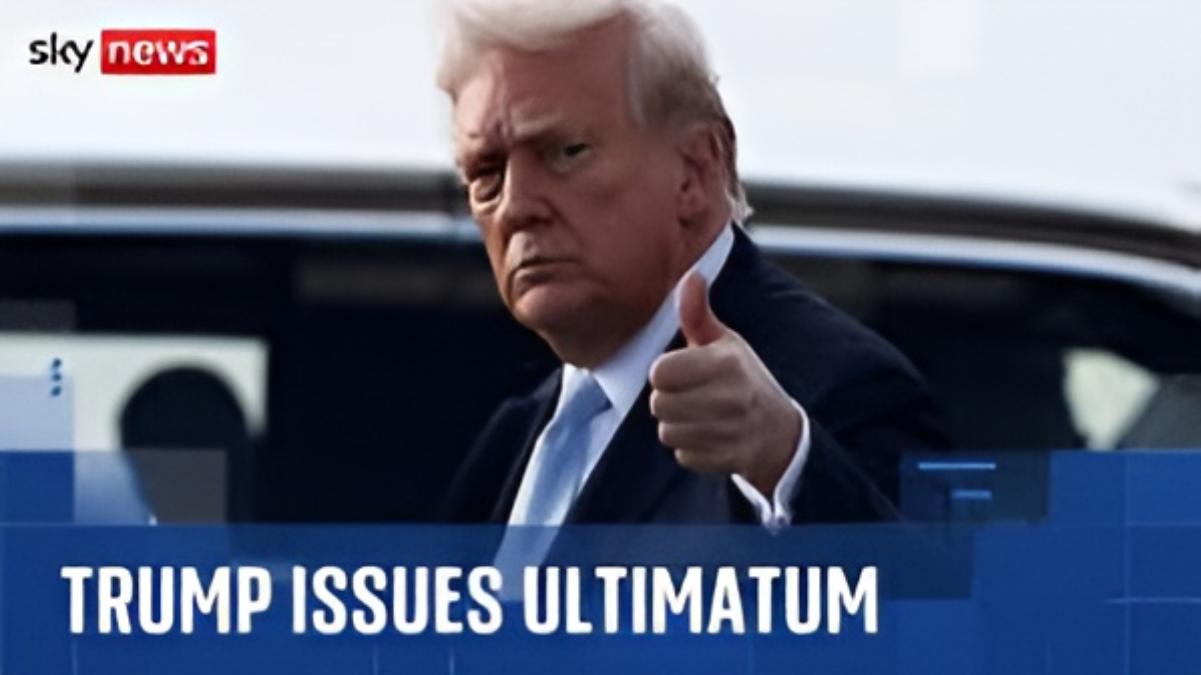
US President Donald Trump threatened late on Saturday to destroy Iran's power plants if the Strait of Hormuz is not fully reopened within 48 hours. "If Iran doesn't FULLY OPEN, WITHOUT THREAT, the Strait of Hormuz, within 48 HOURS from this exact point in time, the United States of America will hit and obliterate their various POWER PLANTS, STARTING WITH THE BIGGEST ONE FIRST," Trump wrote on Truth Social. The deadline expires late Monday, early Tuesday Tehran time.
Iran's parliament speaker Mohammad Baqer Qalibaf responded, in a statement posted on X, that all regional energy infrastructure would become "legitimate targets" if Iranian power plants are hit. The Iranian military warned that all US-linked energy infrastructure in the region would be targeted.
Trump had said less than 24 hours earlier that the US was considering "winding down" military operations. Hours later, Iranian missiles struck the southern Israeli cities of Dimona and Arad, wounding more than 100 people. Israel said its defences failed to intercept the incoming missiles at both sites.
14 Turkish Ships Still Waiting
Türkiye has 14 Turkish-owned vessels stranded near the strait with 171 crew members on board. Transport Minister Abdulkadir Uraloglu said on Saturday that authorities are coordinating to secure their safe passage.
One vessel, the Rozana, was allowed through on 13 March after Türkiye obtained permission from Iranian authorities. Uraloglu said it had been granted passage because it had used an Iranian port. Iran has classified Türkiye among countries permitted selective transit, alongside China, India, and Pakistan. That places Türkiye among a limited group whose vessels have in some cases continued to receive passage.
Ankara has declined to join a US-led naval escort mission in the strait, part of its effort to keep diplomatic access to Tehran open. Bosphorus News reported on 21 March that Türkiye's refusal reflects a broader pattern across the alliance, with no common NATO response emerging to Trump's demand.
Any escalation following the ultimatum could freeze that channel.
Three Missiles Over Turkish Airspace
Since the war began on 28 February, three Iranian ballistic missiles have been intercepted over or near Turkish airspace by NATO air and missile defence systems. The first was downed on 4 March over the eastern Mediterranean. Debris fell in Dörtyol, Hatay. The second entered Turkish airspace on 9 March over Gaziantep. The third was neutralized on 13 March.
Iran has denied deliberately targeting Türkiye. The Turkish Defence Ministry has protested to Tehran after each incident. A 7 March presidential decree established emergency and defence planning units under all cabinet ministries. Türkiye deployed a Patriot battery to Malatya on 10 March and reportedly sent F-16 fighters to Northern Cyprus after the second interception, according to Turkish media reports. NATO announced on 18 March that it would deploy an additional Patriot system to southern Türkiye. Ankara has not invoked Article 4 or Article 5.
Ceyhan Reopens as Iraq Restarts Northern Exports
The Hormuz blockade pushed Iraq back to a route that had been idle for more than a decade. On 18 March, Iraq resumed crude exports through the Kirkuk-Ceyhan pipeline at 250,000 barrels per day. Bosphorus News reported on 19 March that the Baghdad-Erbil deal unlocked Ceyhan as Iraq's only functioning crude export route.
Iraqi output dropped to 1.4 million bpd from roughly 4.5 million bpd after Basra terminals were forced offline. Iraq's oil minister said a parallel pipeline revamp could raise northern corridor capacity to 450,000 bpd.
The Hormuz closure has also put more weight on Türkiye's position in Europe's gas supply. The Southern Gas Corridor is now the only major overland route carrying non-Russian, non-Gulf gas into the EU, as Bosphorus News analyzed on 16 March.
The Cost Pressure
The Economic Policy Research Foundation of Türkiye (TEPAV), an independent Ankara-based think tank, warned on 16 March that the primary risk is not a supply cutoff but rising costs. Oil prices have surged from around $65 before the war to above $108, invalidating Türkiye's 2026 budget assumption. Petrochemical and aluminum imports from Gulf producers face delays and higher shipping costs as Persian Gulf routes remain disrupted.
The Ministry of Trade halted urea exports on 7 March. The Ministry of Agriculture removed import duties on urea and began sourcing alternatives, but higher fertilizer costs are raising pressure on wheat, corn, and sunflower production. The agricultural sector contracted roughly 8.8 percent in 2025.
A US strike on Iranian power infrastructure would directly affect the transit channel Ankara has been negotiating with Tehran and raise the exposure of 14 Turkish-owned vessels and 171 crew members still waiting near the strait.
***Trump's statements were posted on Truth Social. Iranian responses were carried by Mehr News Agency and Fars News Agency. Qalibaf's statement was posted on X. Casualty figures are from Israel's Magen David Adom. TEPAV's analysis was published on 16 March 2026. Ship data are drawn from Reuters, Xinhua and the Turkish Ministry of Transport.