
By Bosphorus News Geopolitics Desk
One year after Azerbaijani President Ilham Aliyev and Armenian Prime Minister Nikol Pashinyan met at the White House, the transport project unveiled alongside their joint declaration is beginning to move beyond agreements and institutional design.
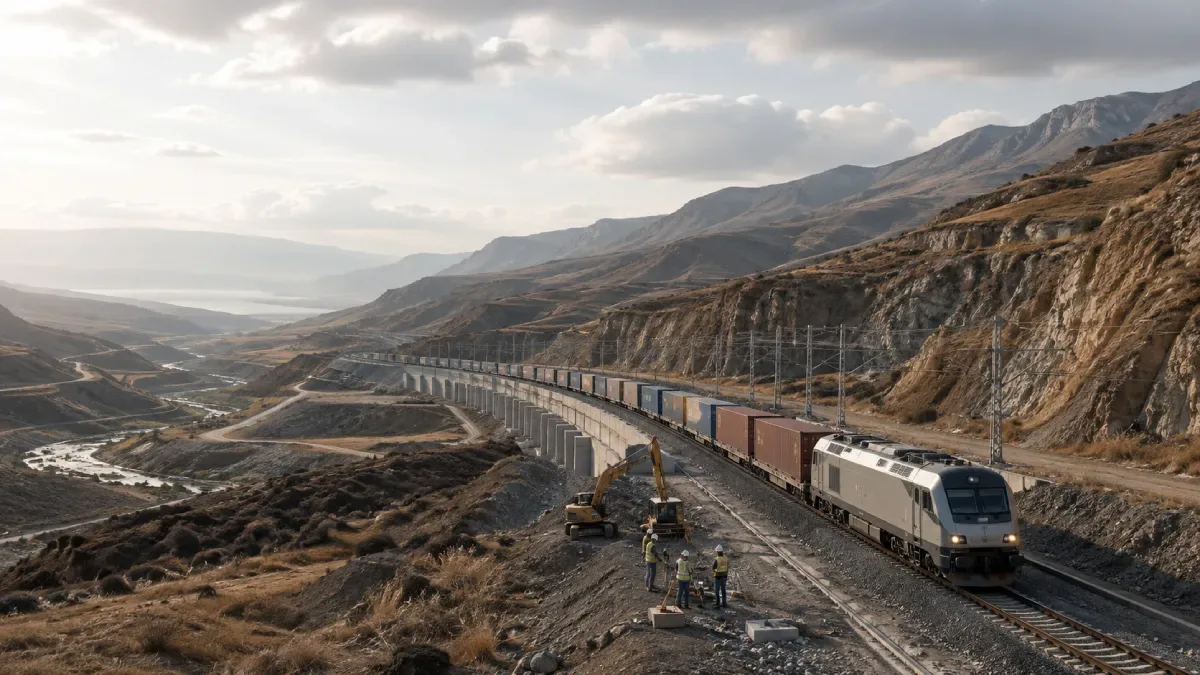
U.S. Secretary of State Marco Rubio said engineering work has started on the Armenian railway section of the Trump Route for International Peace and Prosperity, or TRIPP. The State Department said Azerbaijan is also nearing completion of road and rail infrastructure intended to connect with the Armenian section.
Washington has meanwhile activated the Trans-Caspian Enterprise Fund with $201 million in U.S. government capital. Its mandate extends beyond Armenia, with the fund designed to attract private investment along the Trans-Caspian Trade Route, widely known as the Middle Corridor, linking Central Asia and the Caspian through the South Caucasus toward Türkiye and Europe.
The work now underway would create an overland connection from mainland Azerbaijan through southern Armenia to the Nakhchivan Autonomous Republic, which shares a border with Türkiye.
Railway engineering starts on Armenian section
TRIPP is planned as a multimodal connection across Armenian territory between mainland Azerbaijan and Nakhchivan.
Rail and road form the backbone of the project, although the U.S.-Armenia framework also allows separate investments in oil and gas pipelines, electricity transmission and fiberoptic infrastructure.
Rubio said on August 8 that engineering work on the railway inside Armenia had begun. Washington also reported that Azerbaijan was close to completing the infrastructure needed to reach the Armenian connection from the east.
The project grew out of the August 8, 2025 White House meeting involving Aliyev, Pashinyan and U.S. President Donald Trump. Armenia and Azerbaijan signed a joint declaration there, while their foreign ministers initialed the text of a peace agreement.
That agreement has still not been formally signed. The transport project is consequently moving ahead while the broader political settlement remains unfinished.
The implementation work had already become visible before Rubio's anniversary statement. Armenian Foreign Minister Ararat Mirzoyan met U.S. envoy adviser Aryeh Lightstone in Yerevan on August 5, joined by Trans-Caspian Enterprise Fund President Konstantin Sokolov. Armenia's Foreign Ministry said the discussions covered putting TRIPP into operation on the ground and expanding the country's access to international transport networks.
U.S. entity to hold 74% of development company
Washington will have a large commercial stake in the company developing the Armenian section, but Armenia will retain state authority over the territory.
The U.S.-Armenia framework provides for the TRIPP Development Company to be incorporated in Armenia. A company owned by the U.S. International Development Finance Corporation is expected to hold an initial 74% stake, with Armenia owning the remaining 26%.
Individual TRIPP projects would receive exclusive development and land-use rights for an initial 49 years. The arrangement can be extended by another 50 years with mutual consent, after which Armenia's ownership share is due to rise to 49%.
Separate companies may be created for railway, road, pipeline, electricity and digital infrastructure projects.
Border control, customs, immigration, law enforcement and legal jurisdiction remain Armenian responsibilities. The U.S. majority share applies to the development company, not to sovereignty over the corridor or Armenian territory.
Türkiye sits at the western end of the route
The project would add another east-west land connection into Türkiye through Nakhchivan and could eventually link more directly with the Turkish railway network.
The U.S.-Armenia framework explicitly cites progress in Türkiye-Armenia normalization as one of the conditions that would help TRIPP succeed.
Ankara and Yerevan are separately examining what would be required to rehabilitate and return the Kars-Gyumri railway to service. A bilateral working group has been dealing with the technical and operational issues surrounding the line.
There is no reopening date, and the current technical work does not mean cross-border railway services are about to resume.
If the line eventually returns to operation, Kars-Gyumri could connect Armenia more directly with Türkiye as TRIPP opens another route between Azerbaijan and Nakhchivan farther south. Türkiye would then have an additional land link toward Azerbaijan, the Caspian and Central Asia alongside the established corridor through Georgia.
$201 million fund extends beyond the Armenian route
The Trans-Caspian Enterprise Fund is separate from the company that will develop TRIPP inside Armenia.
The TRIPP Development Company is designed for infrastructure projects on Armenian territory. The $201 million fund announced by Washington has a wider remit, covering investment opportunities across the South Caucasus and Central Asia along the broader Trans-Caspian route.
The U.S. capital should therefore not be described as a $201 million financing package for the Armenian railway.
Washington intends to use the fund to draw private capital into the wider transport network connecting Central Asia and the Caspian with Türkiye and European markets. TRIPP would form one section of that system rather than its entire scope.
The arrangement also departs from earlier post-war proposals that gave Russia a larger place in reopening transport links between Armenia and Azerbaijan. The Armenian section is instead being developed through a U.S.-Armenian corporate structure.
A year after the Washington summit, the project has reached a more concrete stage. Engineering work is underway in Armenia, Washington says Azerbaijan is close to completing the infrastructure approaching the route, and the United States has placed $201 million behind a fund aimed at the wider Trans-Caspian network.
Türkiye could gain another land connection from Azerbaijan and the Caspian through Nakhchivan, while rehabilitation of Kars-Gyumri could bring Armenia into the same east-west transport system.
Washington, however, will hold the majority stake in the company developing the Armenian section. Türkiye's role at the western end will be determined less by that company than by what Ankara and Yerevan do next with their own border and railway links.
Sources: U.S. Department of State, Ministry of Foreign Affairs of Armenia, Türkiye's Ministry of Foreign Affairs, Presidency of Azerbaijan, Bosphorus News review and reporting.