
By Bosphorus News Energy Desk
Türkiye added a thorium research track to its nuclear program on September 7, three days after the International Energy Agency (IEA) urged the government to reduce dependencies when negotiating its next two large nuclear plants.
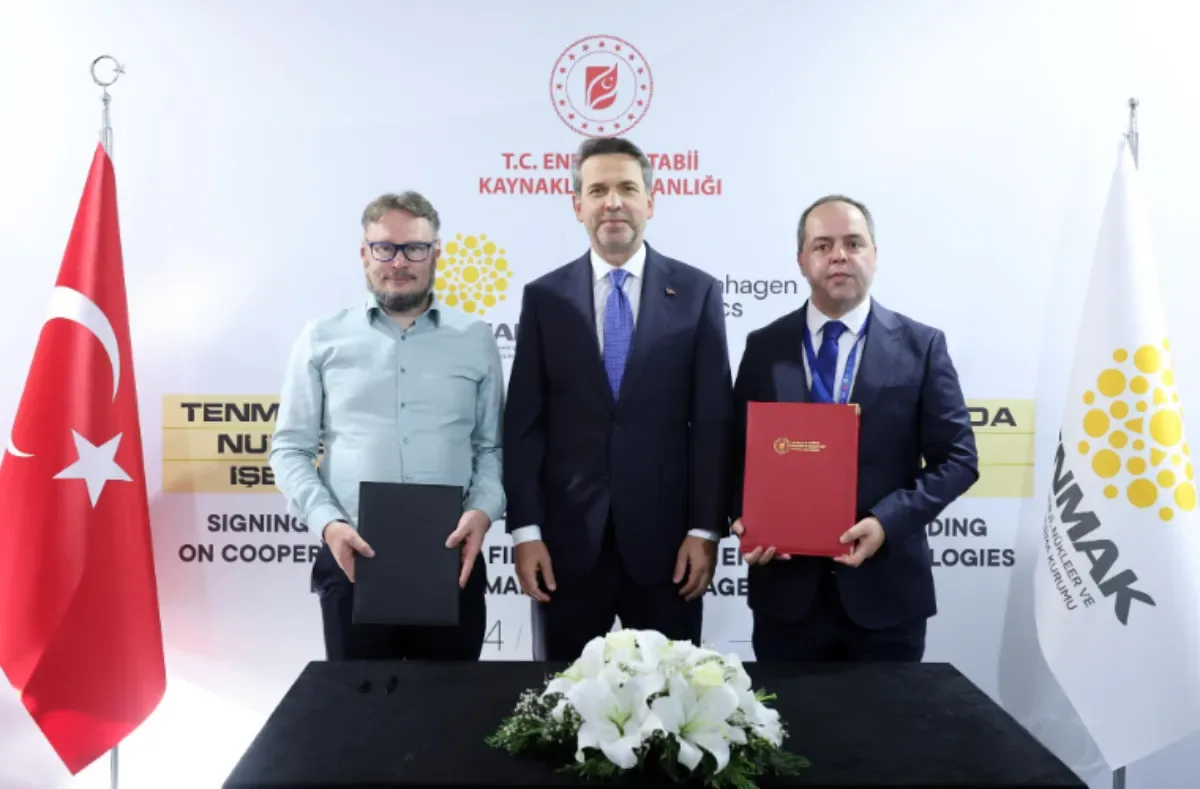
The Turkish Energy, Nuclear and Mineral Research Agency (TENMAK) signed a memorandum of understanding with Denmark-based Copenhagen Atomics covering the production of nuclear-grade thorium compounds in Türkiye and research into their use in molten salt reactors. The company will also assess its Onion Core reactor concept against Türkiye's research infrastructure, engineering base and industrial capabilities.
The memorandum covers research and technology evaluation, not reactor procurement. Energy and Natural Resources Minister Alparslan Bayraktar said Türkiye's domestic thorium resources could eventually reduce dependence on imported nuclear fuel. Copenhagen Atomics' current roadmap, however, still includes uranium: its initial reactor design uses 5% enriched uranium in the fuel salt and thorium in the blanket salt. The company targets a first nuclear test reactor in 2028 and commercial units in the early 2030s.
Thorium Enters the Nuclear Program
The TENMAK agreement brings the fuel question into Türkiye's work on advanced reactors.
The ministry says research will focus on producing thorium compounds in Türkiye that meet nuclear fuel standards, with Turkish researchers, engineers and industrial companies participating in the development process. It also sets an ambition for Türkiye eventually to become an international supplier in this field.
Copenhagen Atomics is developing a modular molten salt reactor based on its Onion Core design. The company has built non-fission prototypes but has not yet operated a nuclear reactor. Its commercial timetable therefore sits years beyond the supplier decisions Türkiye is considering for Sinop and Thrace.
Domestic thorium could supply part of a future fuel cycle, but the company's first reactor configuration still requires low-enriched uranium. The agreement gives Türkiye a route to work on domestic nuclear material and advanced reactor technology without replacing the fuel requirements of the large reactors now under negotiation.
IEA Ties New Plants to Lower Dependence
The IEA's Türkiye 2026 Energy Policy Review, published on September 4 in partnership with the Turkish government, places dependence directly inside the procurement debate for the next generation of plants.
The agency says security of supply, reduced dependencies, localization of technology transfer and viable financing should be central to negotiations for the two planned large nuclear power plants. It also urges Türkiye to complete a clear legal and administrative framework for small modular reactors, including a transparent process for selecting technologies and projects.
Sinop and Thrace require decisions on large foreign reactor suppliers. The TENMAK agreement starts work on a technology whose attraction, in Bayraktar's description, includes the possibility of using a fuel resource found inside Türkiye.
The Türkiye National Energy Plan set nuclear capacity at 7.2 gigawatts by 2035. The IEA says the proposed Sinop plant could help Türkiye reach that level, with further capacity depending on the reactor design and number of units selected.
Akkuyu Defines the Existing Model
The dependency issue is clearest at Akkuyu, Türkiye's first commercial nuclear power plant.
The IEA estimates the four-reactor plant will cost about $20 billion. Its four VVER-1200 pressurized-water reactors will provide 4.8 gigawatts of capacity. The first unit, once expected in 2025, is now due to be commissioned in 2026, with the remaining units following annually. Their planned operating life is 60 years, extendable to 80.
Russia's Rosatom leads and finances Akkuyu under a build-own-operate model. Akkuyu Nuclear Joint Stock Company is currently fully owned by Rosatom, which the IEA says will remain majority owner and provide fuel throughout the plant's operating life.
Türkiye did not finance construction directly from the state budget, but the agreement includes a 15-year electricity purchase commitment now held by the state-owned Electricity Generation Corporation (EÜAŞ). It covers 70% of output from Units 1 and 2 and 30% from Units 3 and 4 at a weighted average price of $0.1235 per kilowatt-hour, excluding value-added tax. The IEA says the dollar-denominated contract leaves EÜAŞ exposed to exchange-rate risk.
Akkuyu also includes localization commitments. Turkish engineers are expected to make up 20% of technical staff at start-up, at least 40% of construction work is expected to be performed by Turkish companies, and the IEA estimates that 57% of the project budget has so far been spent in Türkiye.
For the plants that follow, the Turkish government wants greater localization, more Turkish industrial participation and more control over the plant than under the Akkuyu structure, while retaining a financing model that does not place excessive pressure on the public budget.
Sinop and Thrace Remain Open
Türkiye has yet to choose the suppliers for either of its next large plants.
Sinop has received an environmental impact assessment decision and site approval. A third plant is planned on the Black Sea coast of Thrace, northwest of Istanbul. Vendor and investor talks remain under way for both sites.
Bayraktar said in March that Türkiye was talking with South Korea, Canada, China and Russia over eight reactors, four planned for Sinop and four for Thrace. He said the government would compare commercial terms and localization offers before choosing a partner. No contractor had been selected.
Ownership, fuel supply, technology transfer and financing will sit beside reactor price when those offers are compared. Akkuyu places all four inside a single Russian-led structure. The IEA wants Türkiye to account for the dependencies created by the next contracts before they are signed.
Russia Remains in the Race
Russia remains part of those negotiations.
President Recep Tayyip Erdoğan met Russian President Vladimir Putin in Bishkek on September 1 and said Akkuyu was approaching completion. Erdoğan added that Türkiye and Russia would discuss further nuclear steps after the plant enters service. No agreement on another reactor project was announced.
A new Russian project would extend a nuclear relationship in which Rosatom is already tied to ownership, financing, operation and fuel at Akkuyu. The IEA does not argue for or against a Russian bid. Its recommendation is about the structure of the next deal and the dependencies attached to it.
The TENMAK-Copenhagen Atomics agreement follows a different timetable and serves a different purpose. It centers on research, local materials and an advanced reactor concept that remains years from commercial deployment.
China and Russia Dominate New Builds
The supplier pool for large reactors is already concentrated.
The IEA's Global Energy Review 2026 says ten nuclear reactors began construction worldwide in 2025. Nine were in China and one in Russia. Over the previous decade, 94% of reactors that entered construction used Chinese or Russian designs.
Nuclear contracts also continue long after construction. Fuel qualification, enrichment, servicing, replacement components and ownership arrangements can keep the supplier involved for decades.
The European Commission's REPowerEU roadmap calls for the gradual removal of Russian nuclear energy imports from European Union (EU) markets. It includes possible trade measures on Russian enriched uranium and restrictions on new Russian nuclear supply contracts. Utilities in all five EU countries operating Russian-designed VVER reactors have signed contracts for non-Russian fuel, although testing and national licensing are still required before replacement fuel can be used.
Türkiye is making its next supplier decisions before Akkuyu has entered commercial operation. Sinop and Thrace remain open, Russia is still competing, and the thorium program is years from commercial deployment.
The next contracts will determine whether Akkuyu's concentration of ownership, fuel and technology is repeated, divided among several suppliers or replaced with a different model. The September 7 thorium agreement opens a separate effort to build some of that capability inside Türkiye.
Sources: International Energy Agency, Türkiye's Ministry of Energy and Natural Resources, Turkish Energy, Nuclear and Mineral Research Agency, Copenhagen Atomics, Reuters, Presidency Directorate of Communications, European Commission, Bosphorus News review and reporting.
IEA Türkiye 2026 Energy Policy Review | Original PDF