By Bosphorus News Geopolitics Desk
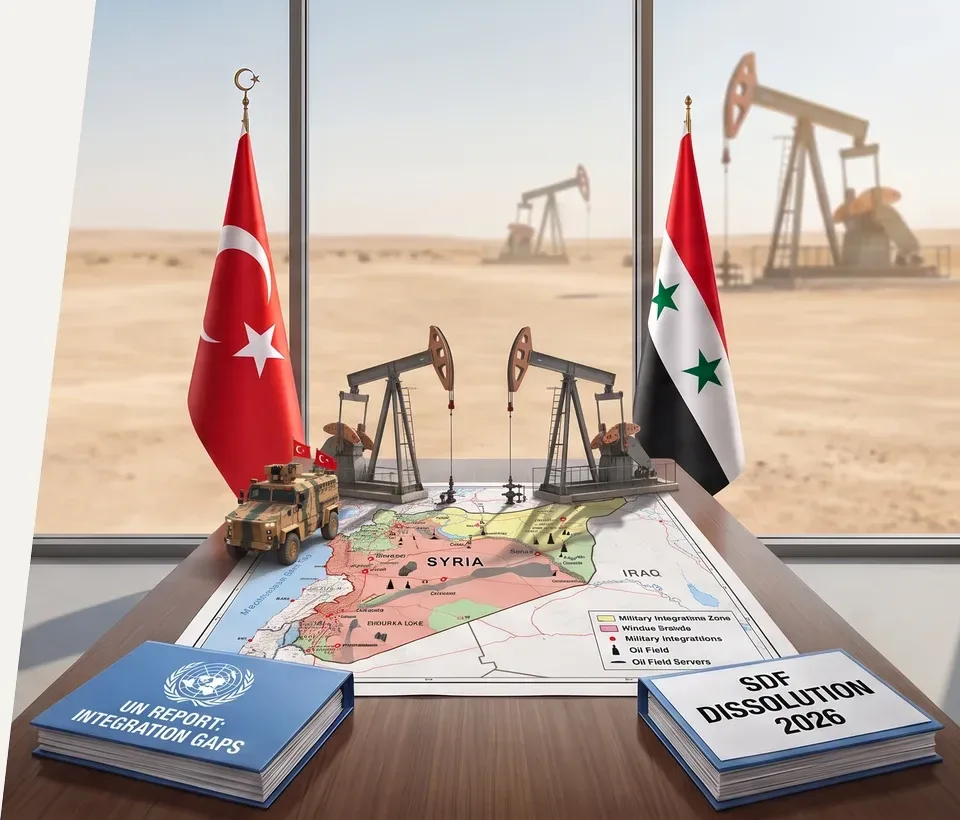
On November 16, 2026, Türkiye told the United Nations Security Council that Syria's integration of the former Syrian Democratic Forces (SDF) was falling short of expectations, nearly three months after the Kurdish-led group announced its dissolution as an independent military organization. The UN acknowledged progress but identified unresolved questions over Kurdish representation, education and the transfer of responsibilities to state institutions, highlighting the difficulties Damascus still faces in establishing authority across the northeast.
Ankara's principal concern is the military chain of command. Türkiye's UN Ambassador Ahmet Yıldız told the Security Council that integration must go beyond changing names and uniforms, a position Foreign Minister Hakan Fidan reinforced during talks with Syrian officials the following day. Fidan reiterated the principle of one state and one army. UN Deputy Special Envoy Claudio Cordone, meanwhile, described the continuing absorption of former SDF personnel into state institutions and negotiations over the administration of areas previously governed by the autonomous authorities.
The transfer extends to northeastern Syria's oil and gas resources. Under the January agreements with the SDF, Damascus assumed authority over energy fields, border crossings and civilian institutions. Syrian officials have since announced the resumption of production at several facilities brought under government control. The arrangements governing those assets are now part of the wider effort to restore state administration across the region.
Military integration and the command question
The SDF's August 25 announcement followed agreements negotiated over the previous year and a half. The first major framework was signed in March 2025 by Syrian President Ahmad al-Sharaa and SDF commander Mazloum Abdi. Further negotiations in January 2026 produced more detailed provisions covering military personnel, security responsibilities and civilian administration.
The January 18 agreement required SDF military and security personnel to enter the Ministries of Defense and Interior individually, following security screening. It also provided for the transfer of civilian institutions in Hasakah and government control over border crossings and northeastern energy facilities.
A second arrangement, reached on January 29 and announced the following day, outlined the structure through which former SDF units would join the Syrian army. It envisaged a division of three brigades drawn from the former force, with a separate Kobani-based brigade affiliated with a formation in Aleppo province. Personnel would be incorporated individually, and the resulting units would operate under the Syrian military establishment.
The command structure has remained a sensitive issue for Ankara. Türkiye wants the former SDF formations fully absorbed into the Syrian military hierarchy, with effective control exercised through the national chain of command. The January arrangements established the organizational framework, but the November discussions indicate that its operation has not satisfied Ankara's expectations.
Abdi declared the SDF's integration into Syrian army brigades complete when he announced its dissolution in Damascus on August 25. At the Security Council meeting in November, Ambassador Yıldız welcomed the dissolution while questioning the extent of the changes carried out on the ground. His remarks focused on the persistence of organizational relationships that Türkiye believes must be brought fully under state authority.
Fidan addressed the same issue on November 17, when he and Defense Minister Yaşar Güler met Syrian Foreign Minister Asaad Hassan al-Shaibani and Defense Minister Murhaf Abu Kasra in Ankara. Their discussions covered counterterrorism and the restructuring of Syria's armed forces, alongside work on border infrastructure and economic connections.
The four-minister meeting also covered border crossings and transport links. Neither government announced a new agreement on military integration. The public statements concentrated on implementing arrangements already reached and strengthening cooperation between the two states.
Local administration and Kurdish rights
The agreements also require Damascus to absorb public institutions that operated for years under the former autonomous administration. In Hasakah, the transfer affects government employment, schools and local security arrangements, with different institutions moving into the national system at different speeds.
Cordone told the Security Council that former SDF personnel continued to enter state security positions. Salary payments had also begun shifting to Damascus, providing a practical indication of the administrative changes taking place.
The January agreements provided for the retention of civilian employees during the transfer to government ministries and envisaged Kurdish participation in official appointments, including the Hasakah governorship. Arrangements for local security in predominantly Kurdish areas were also included.
Education remains particularly complicated. Schools operating under the former administration used curricula and issued qualifications that are now being brought into a different national system. Negotiations have covered the status of teachers, recognition of certificates and the place of Kurdish-language instruction.
Syria issued Presidential Decree No. 13 on January 16, recognizing Kurdish cultural and linguistic identity and introducing provisions concerning citizenship and education. The Education Ministry subsequently prepared measures for the 2026–2027 academic year, including two Kurdish-language classes a week.
The decree and subsequent ministry measures provide a formal basis for Kurdish-language teaching, although the treatment of existing curricula and certificates remains under discussion. These decisions will affect students seeking recognition of their qualifications and teachers moving into the state education system.
The Women's Protection Units (YPJ) present another challenge for the military arrangements. During the November 16 Security Council meeting, British representative Sarah MacIntosh welcomed progress on integration but called for further work on incorporating the women's units into the new structures.
Returning displaced families face a different set of difficulties. Cordone reported that more than 100 Kurdish families attempting to return to Tell Abyad in late October had reportedly encountered violence and intimidation and sought safety elsewhere. Organized voluntary returns to Ras al-Ayn and nearby areas were also continuing.
Disputes over property and housing have complicated the return process. Families seeking to resettle need access to their homes and the public services now being transferred to government administration. The outcome depends heavily on decisions taken by local officials and the institutions assuming responsibility for those areas.
Oil and gas return to state control
Northeastern Syria's energy fields were among the most important assets covered by the January agreements. The former SDF administration had controlled substantial oil and gas infrastructure, making the transfer a major step in restoring Damascus's authority over national production.
The January 18 agreement placed those facilities under Syrian state control. Within days, the Syrian Petroleum Company announced that extraction and transportation had resumed at fields taken over in Raqqa and Deir ez-Zor.
On January 25, the company reported that crude from the al-Omar and al-Tanak fields had reached the Baniyas refinery. Syrian authorities subsequently announced rehabilitation work at additional sites, including the resumption of natural gas supplies from the Jbessa fields in Hasakah to the Furqlus processing plant.
The recovery of these facilities gives Damascus greater control over domestic fuel supplies and electricity generation. Oil production also provides revenue for a government facing extensive reconstruction costs and the expense of integrating public institutions across territories that had operated under separate administrations.
The publicly available agreements establish state ownership and administration of the energy infrastructure, but they contain no detailed formula for distributing production revenues between Damascus and local authorities in the northeast.
That gap is relevant to government spending in Hasakah and surrounding areas. Civilian employees are being transferred into national institutions, infrastructure requires repair, and public services must operate under the new administrative arrangements. How the government allocates revenues will affect its ability to finance those responsibilities.
Türkiye's energy cooperation with Syria is developing through separate agreements.
During the November 17 talks, al-Shaibani said rehabilitation of the Aleppo–Birecik electricity interconnection had been completed and that work was continuing to increase capacity to 500 megawatts. Electricity and gas networks were discussed alongside transport projects and cooperation concerning Euphrates River water flows.
The discussions build on the energy and mining cooperation announced by Türkiye and Syria in August, which included plans to expand electricity supplies, develop mineral resources and explore opportunities in oil and gas.
These cross-border projects are distinct from the January transfer of northeastern oil fields. Their progress will nevertheless affect energy availability as Syria restores infrastructure and reconnects its national networks.
Ankara, Damascus and Washington
The November meetings showed broad agreement between Türkiye and Syria on the need for a unified Syrian military establishment. Ankara has continued to press for the completion of military integration, while Damascus is extending its administration into territories and institutions that remained outside central government control for years.
Fidan said Türkiye was supporting the restructuring of Syria's armed forces and the development of its security institutions. He also stressed the protection of rights for all communities. Al-Shaibani's remarks covered the planned reopening of the Nusaybin–Qamishli border crossing and projects intended to improve trade and infrastructure connections.
The United States has supported the agreements while urging continued implementation of commitments concerning Kurdish rights. Its representative at the November 16 Security Council meeting welcomed progress in bringing former SDF personnel into Syrian state institutions.
Diplomatic contacts continued in Ankara. Al-Shaibani met US Special Presidential Envoy for Syria and Iraq Tom Barrack on November 17, and Fidan received Barrack the following day. The announced agendas covered bilateral relations and regional security coordination, with no new military or administrative arrangement for northeastern Syria made public.
Counterterrorism remains an important concern for Washington. The SDF was a principal US partner during the campaign against Islamic State, and the January agreements provided for transferring responsibility for detention facilities and camps associated with the organization to Syrian state institutions.
Security at those facilities remains closely connected to the reorganization of forces in the northeast. The transition requires new authorities to assume responsibilities previously handled through arrangements developed during the campaign against Islamic State.
Damascus Faces the Work of Governing the Northeast
The January agreements have already changed the administration of northeastern Syria. Former SDF personnel have entered national institutions, Damascus has taken control of major energy facilities, and civilian departments are moving into the government system.
The Security Council discussion on November 16 showed where implementation is still difficult. Türkiye continues to question the operation of the military command structure, while Syrian authorities are working through the integration of schools, public employees and local administration. Kurdish political representation and the position of the YPJ remain part of the discussions.
The energy transfer is further advanced in some respects. Production has resumed at fields placed under government control, and crude shipments have reached state refining facilities. Detailed arrangements for allocating revenues to local administration and public services have received far less public explanation.
In Hasakah, decisions on military appointments and the administration of schools will give residents a clearer indication of how the agreements are being applied. Returning families will encounter the new institutions through property procedures and access to public services, while government departments must absorb employees and budgets previously managed elsewhere.
The August declaration formally ended the SDF's existence as an independent military organization. Damascus is now responsible for making the institutions that replaced it work across northeastern Syria.
Sources: United Nations Security Council, November 16, 2026 briefing and member-state statements; Republic of Türkiye Ministry of Foreign Affairs, November 17 joint press conference and November 18 diplomatic announcement; Syrian Arab News Agency, January 18 and January 29–30 integration agreements, August 25 SDF dissolution announcement and Syrian Petroleum Company statements; Syrian Presidential Decree No. 13 of 2026 and Ministry of Education implementing announcements; United Kingdom Foreign, Commonwealth & Development Office, November 16 Security Council statement; Bosphorus News review and reporting.