
By Bosphorus News Defense Desk
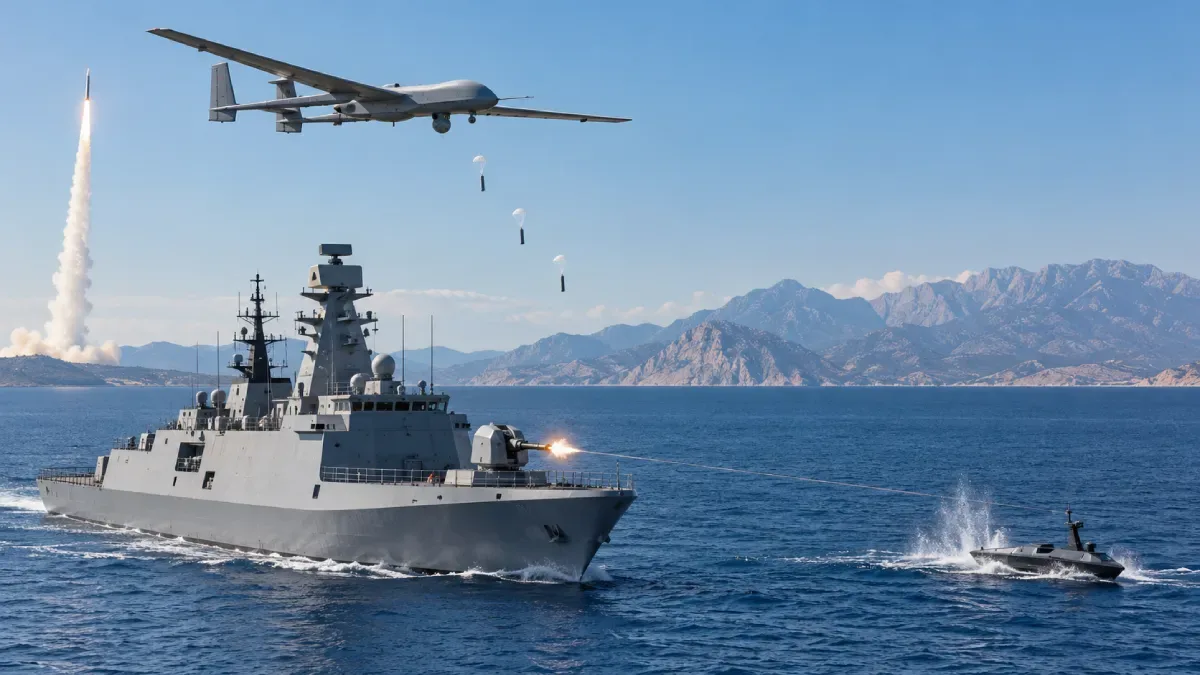
Türkiye's SİPER Product-2 missile destroyed a newly assigned target after receiving updated targeting data in flight, the Presidency of Defense Industries announced on October 25. Separately, naval trials off Antalya tested shipboard counter-drone weapons, a Bayraktar TB2-directed strike craft and airborne acoustic sensors.
SİPER-2 switches targets in flight
ROKETSAN described the firing as Product-2's first successful demonstration of in-flight retargeting. ASELSAN said the test also covered engagements against targets flying close to the sea surface, along with midcourse and terminal guidance.
Presidency of Defense Industries (SSB) President Haluk Görgün linked the result to Çelik Kubbe, or Steel Dome, Türkiye's layered air-defense program. ASELSAN, ROKETSAN and the Defense Industries Research and Development Institute (TÜBİTAK SAGE), part of the Scientific and Technological Research Council of Türkiye, are developing the missile under the SSB program. Neither the engagement distance nor a deployment date for Product-2 was disclosed.
ROKETSAN identified the Air Force's October 21 SİPER firing at Sinop as a Product-1 training event, distinct from the Product-2 retargeting capability announced on October 25.
TOLGA fires from warship; TB2 directs PİRANA strike
The National Unmanned Maritime Systems Exercise (TURNAs-2026) runs from October 19 to 27 off Antalya and in the Eastern Mediterranean. Its purpose is to test how unmanned aircraft, surface vessels and underwater vehicles operate alongside crewed naval forces.
The October 25 distinguished visitors event involved 18 ships, 11 aircraft and 1,300 personnel. Seventeen defense companies brought 41 systems.
Makine ve Kimya Endüstrisi (MKE) fitted the 20 mm twin-gun revolver component of its TOLGA close-in air-defense system aboard TCG Beykoz, the weapon's first installation on a warship. MKE said the gun destroyed drone and unmanned surface vessel targets. The company lists an effective range of 1,000 meters for TOLGA.
MKE's PİRANA unmanned surface vessel struck a target with its 100 kg warhead while controlled through a Bayraktar TB2. The craft had carried out an earlier successful surface attack during the Denizkurdu-I exercise.
The Antalya trials follow earlier demonstrations of Turkish unmanned surface and underwater systems at Gölcük in August.
AKSUNGUR drops acoustic sensors off Antalya
Turkish Aerospace's AKSUNGUR unmanned aircraft flew from Ankara to waters off Antalya under satellite control, powered by a TEI-PD170 engine. It released three ASELSAN ASELBUOY 100P acoustic listening devices and another sonobuoy from about 1,000 feet, then climbed to 6,000 feet to receive their signals.
During roughly four hours in the exercise area, AKSUNGUR relayed acoustic data to a processing center linked to its ground control station in Ankara. The data was used to identify underwater targets, according to the account of the trial.
ASELSAN announced serial production of the ASELBUOY P family in September. The October trial was the first time ASELBUOY sensors had been released from an unmanned aircraft, with their data then processed remotely.
Other TURNAs demonstrations included sonobuoy deployment from a Bayraktar TB3, an STM TUNGA-X intercepting a target drone and an ANKA-S launching a ŞİMŞEK-K attack drone.
At a separate competition in Ankara on October 24, the Turkish Land Forces' first team finished ahead of Pakistan and Italy to win the International Best Military Drone Team Competition. Pilots were judged on speed and maneuvering through a 23-obstacle course.
Sources: Presidency of Defense Industries, Turkish Ministry of National Defense, ASELSAN, ROKETSAN, MKE, Turkish Aerospace, STM, Anadolu Agency, TRT Haber, Bosphorus News review and reporting.