
By Bosphorus News Defense Desk
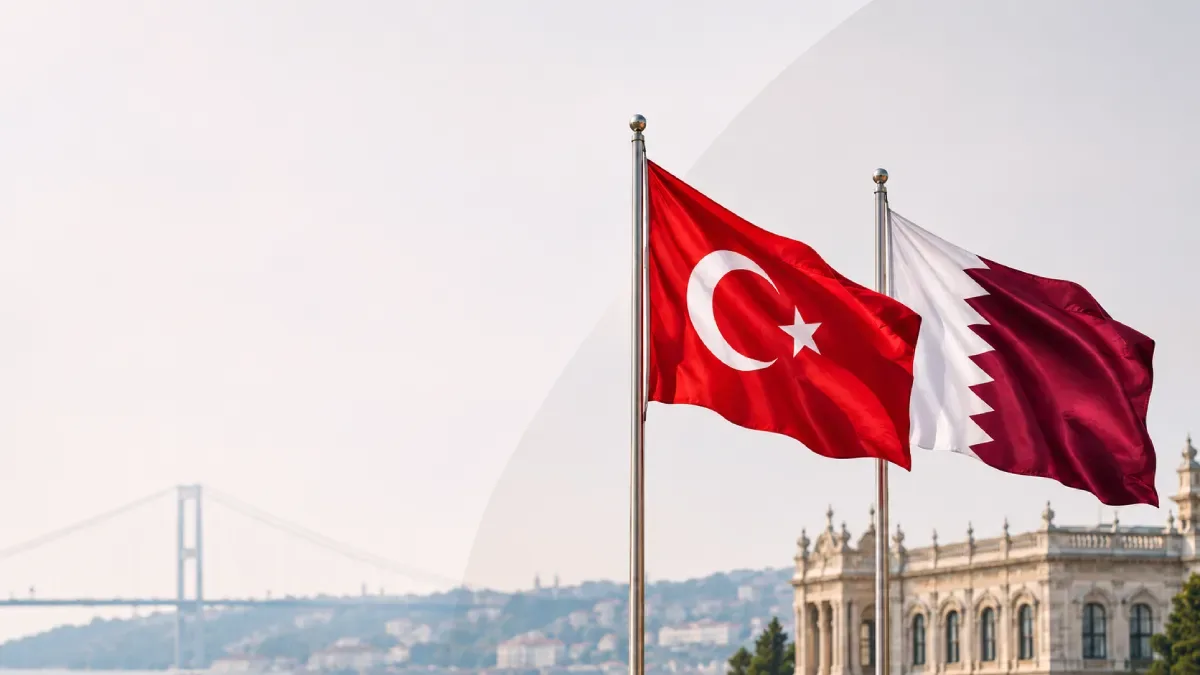
Türkiye and Qatar signed a Mutual Defense Agreement in Istanbul on November 13, 2026. President Recep Tayyip Erdoğan and Emir Sheikh Tamim bin Hamad Al Thani signed the document, but the Turkish presidency did not publish its provisions.
The signing took place at the Dolmabahçe Presidential Office during the 12th meeting of the Türkiye-Qatar High Strategic Committee. Ministers signed four other documents covering education, consumer protection, cooperation on peace and conflict resolution, and the committee's joint statement.
Erdoğan said the agreement would add a new dimension to bilateral relations. He pledged continued cooperation in the defense industry and efforts with Qatar to prevent renewed fighting in the Gulf. The leaders also discussed energy, Gaza, Syria and Libya.
Turkish forces are already based in Qatar
A treaty signed in December 2014 and approved by Türkiye's parliament in March 2015 provided for military training, joint exercises, defense-industry cooperation and the deployment of Turkish forces to Qatar. A separate implementing agreement signed in April 2016 received parliamentary approval in June 2017. In March 2026, the Turkish Defense Ministry said military cooperation and coordination with Qatar were continuing under existing agreements, citing training activities within the Qatar-Türkiye Joint Combined Forces Command.
The two countries signed another defense-industry cooperation memorandum in October 2025. On November 5, Turkish Defense Minister Yaşar Güler met his Qatari counterpart, Sheikh Saud bin Abdulrahman Al Thani, in Ankara. The presidency has not said whether the new agreement changes any of the existing military arrangements.
The separate Badr and Mecca agreements
Türkiye's Defense Ministry confirmed that the Badr memorandum was signed in Doha on October 21 by Defense Minister Yaşar Güler and defense officials from Qatar, Pakistan and Indonesia. The ministry subsequently outlined plans for joint defense-industry projects, research and development, stronger supply chains and expanded production capacity. No collective-defense commitment was announced under Badr.
The four countries later discussed regular meetings and the work needed to develop individual projects. Pakistan said further protocols or agreements would be necessary. By the October 27 review of Badr's next steps, the partners had announced no joint weapons program, financing commitment or production timetable.
The Mecca Joint Defense Agreement, signed on August 7 by Türkiye, Saudi Arabia and Pakistan, contains an explicit commitment to treat an armed attack on one signatory as an attack on all three. Türkiye's parliament approved legislation authorizing its ratification on November 5. That parliamentary vote does not, by itself, establish when the treaty enters into force.
The Turkish presidency's November 13 announcement does not mention an equivalent armed-attack clause in the agreement with Qatar. It gives no details of any military assistance obligations or when the new accord would take effect. The statement also makes no reference to Qatar joining the Mecca pact or to Badr becoming a collective-defense agreement.
Sources: Türkiye's Directorate of Communications, Türkiye's Ministry of National Defense, Grand National Assembly of Türkiye, Reuters, Qatar News Agency, Bosphorus News review and reporting.